
Apple’s Next Vision Pro with New M5 Chip Launches on October 22nd, Starting at $3,500

19

Apple today unveiled its hardware refresh of Vision Pro, which includes its latest M5 chip and a new Dual Knit Band.

The News

Apple has unveiled the new Vision Pro featuring the M5 chip, which is said to  deliver major improvements in performance, display quality, AI capabilities, and battery life.

Apple details some of these features in its official announcement, noting that the new M5 chip is built on a 3-nanometer process, including a 10-core CPU and GPU with hardware-accelerated ray tracing and mesh shading for richer lighting and reflections in games. Specifically, Apple says the new Vision Pro renders 10% more pixels, supports up to 120Hz refresh rates.
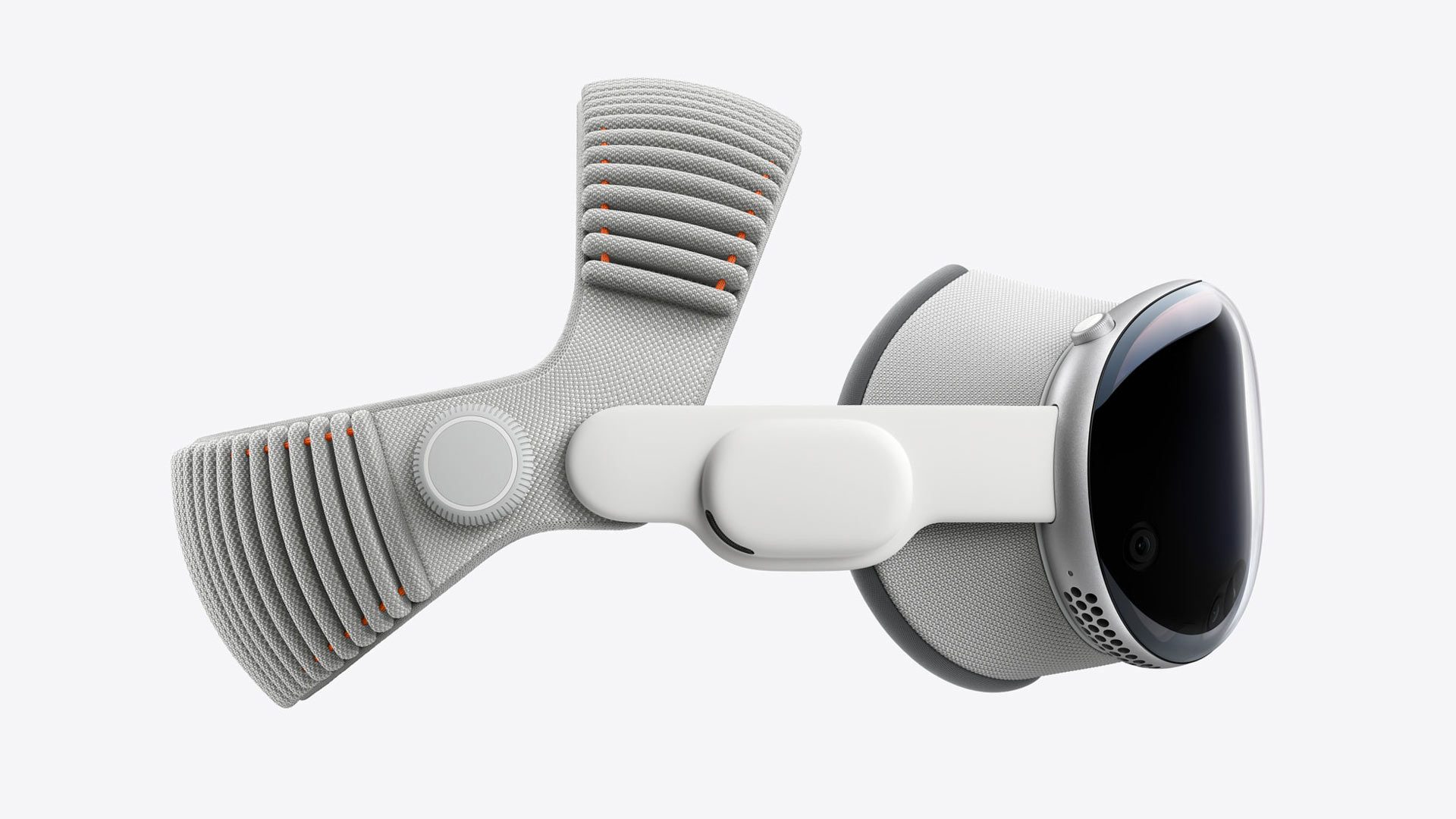
Apple Vision Pro (M5) | Image courtesy Apple

M5 is also bringing some modest battery optimizations, which Apple says now allows users up to 2.5 hours of use or 3 hours of video playback, while the 16-core Neural Engine delivers AI functions up to 50% faster.

The headset is launching with visionOS 26, adding widgets, improved Personas, spatial photo scenes, and expanded Apple Intelligence features, Apple says. Gamers can also use controllers like PSVR 2’s Sense Controllers and PS5’s DualSense gamepad.

Coming October 22nd across major markets, Apple is pitching the usual range of storage capacities: 256GB, 512GB, and 1TB. Like the original 2023 Vision Pro, the new M5 Vision Pro will start at $3,500, which includes the Dual Knit Band in the box. The Dual Knit Band will also be available for separate purchase at $100 among other accessories.

Apple is selling both the Logitech Muse stylus for Vision Pro, available for pre-order for $130 and shipping on October 22nd, and PSVR 2 controllers for Vision Pro, which will be sold in a standalone package with included charging station for $250. The controllers will be available in Apple stores starting on November 11th.

SEE ALSO
Hands-on: Steam Frame Reveals Valve's Modern Vision for VR and Growing Hardware Ambitions

My Take

Apple is being pretty tactical with the release of its new M5 Vision Pro, coming right on the heels of Samsung’s big Project Moohan launch announcement, scheduled to take place on October 21st—just one day ahead of Vision Pro’s launch.

Although Moohan is rumored to be around half the price of Vision Pro, that’s not stopping Apple from taking the opportunity to protect its market share of the premium XR headset segment. And I know what you’re thinking. Who would the hell would pay another $3,500 just to upgrade to a headset that’s not drastically different? Or even half that?

I’ve seen countless comments online decrying Vision Pro as a flop because it’s simply too expensive for what it offers—and that may be true among regular consumers used to console prices—but Vision Pro has managed to find a solid foothold in the enterprise sector. Maybe not what it was hoping for, but that’s the reality. And I think Samsung can only really hope for that too.

I suspect the new M5 version of Vision Pro will essentially deepen that enterprise appeal. Apple is, for the second time, releasing the most powerful standalone headset on the market, which will allow enterprise app developers to make even more impressive in-house apps. The minor difference now is that Vision Pro also support PSVR 2 motion controllers, which positions it even closer to being the best all-around XR platform for business. And maybe a few deep-pocketed Apple acolytes too.

This article may contain affiliate links. If you click an affiliate link and buy a product we may receive a small commission which helps support the publication. See here for more information.

Well before the first modern XR products hit the market, Scott recognized the potential of the technology and set out to understand and document its growth. He has been professionally reporting on the space for nearly a decade as Editor at Road to VR, authoring more than 4,000 articles on the topic. Scott brings that seasoned insight to his reporting from major industry events across the globe.
  • xyzs

    I welcome the chip upgrade, but it's also an excuse for Apple to take 1.5~2 more years before doing a true hardware update.
    This weight and FoV are already very outdated specs, they need to really step up.

    • Arashi

      The FoV is actually really good once you mod the headset a bit. I get to 120 degrees horizontally, really happy with that. But yeah the weight is an incredible bummer.

      • xyzs

        120 is not enough, human vision is 220.

        We are not talking about a cheap HMD here, but one that cost as much as a second-hand car.

        When you sell for a premium, you must sell premium specs too!

        100, even 120 degrees are not premium FoVs at all, they are standard at best.

        • Christian Schildwaechter

          Sure, we aren't talking about a cheap HMD here, but we aren't talking about an HMD intended for VR gaming either. Keep in mind that AVP isn't supposed to be a VR HMD, Apple positioned it as a media and productivity device for "spatial computing".

          For these applications, a higher PPD is much more important than a high FoV. And obviously increasing the FoV would mean decreasing the PPD when using the same display. You can stream VR games to it, but that is just a side effect, not the intended purpose, and certainly not what guided the design/targeted FoV.

      • polysix

        The vertical FOV is AWFUL and very bad for VR games. We actually need more vertical in VR to feel natural before we worry about horizontal.

  • Christian Schildwaechter

    TL;DR: The AVP M5 very likely uses improved microOLED displays. It remains a mystery whether the excessive price for the PSVR2 Sense controllers was set by Apple, or by the same Sony people that thought USD 549 was an adequate launch price for PSVR2.

    With M5, Apple Vision Pro renders 10 percent more pixels on the custom micro-OLED displays compared to the previous generation, resulting in a sharper image with crisper text and more detailed visuals.

    That's kind of an odd statement in the press release, as AVP most likely has always rendered 100% of its pixels. It could refer to something like applying less aggresive ETFR, with more pixels rendered at full resolution, but I'd guess this is Apple's way of indirectly telling that they upgraded the microOLED displays.

    AVP was first released with very expensive early versions of Sony microOLEDs with a dual layer white OLEDs. Apple doesn't list specs, only saying the AVP displays 23MP, but others have measured 3400*3400 or 11.56MP as the per eye resolution, which would add up to 23.12MP total.

    Other HMDs like Project Moohan or Play for Dream also use Sony microOLEDs, but a newer version with 3552*3840 or 13.64MP per eye. That's 11.8% more than on AVP, which in Apple speak might be "renders 10 percent more pixels". Switching to the newer microOLED versions would not only slightly improve the total resolution, but also provide a wider color gamut coverage (96% DCI-P3). There is a chance that Sony simply stopped producing the old ones only used by Apple, reconfiguring their production facilities to now all produce the improved 13.64MP version. Mentioning such tiny technical details has always been beneath Apple, who don't bother with putting version numbers on iPads even when switching them to a completely new processor generation.

    … and PSVR 2 controllers for Vision Pro, which will be sold in a standalone package with included charging station for $250.

    USD 249 for a pair of PSVR2 Sense controllers seems a lot, more aligned with the original USD 549 price of the PSVR, even if they include the USD 49 charging station. It looks even more expensive after Sony permanently lowered the price for PSVR2 incl. a pair of Sense controllers to USD 399 in February. And they now regularly sell HMD bundles like in the USD 349 HCotM bundle, making the PSVR2 Sense controller for USD 250 ridiculously overpriced.

    These are IR tracked 3DoF controllers like the Oculus Touch controllers, and the only thing really differentiating them is the use of LRA/linear resonant actuators for improved haptics feedback. LRAs allow controlling vibration along one axis, finely controlled by sending them a PCM wave signal, while most other controllers only use ERM/eccentric rotation mass devices to create an undirected rumble.

    But the price difference for these will be a few bucks, it is very unlikely that the production cost for a pair of PSVR2 Sense controllers is anywhere near USD 100. Past teardowns/BOMs of Xbox and PlayStation controllers have shown that their retail price is usually 3x-4x the production costs, so while the consoles themselves are sold mostly at cost or close to it, there is a "tradition" of charging a lot extra for the peripherals, which apparently also applies to PSVR2 controllers.

    • XRC

      Apple makes margin, Sony make margin, ODM factory makes margin so always more expensive than buying direct from Sony, that extra hand wants paying…

      the PSVR 2 sense controller also have additional patent tax to immersion inc. for adaptive triggers as well as usual extortion over haptics, regardless of whether full feature set is working on non PS5 platform or not

      • Christian Schildwaechter

        But as mentioned, Apple sells other Sony hardware at Sony prices, and has done this for years. And even though Immersion still blackmails everyone doing any type of haptic feedback, the costs for the licenses aren't in the hundreds. Valve fire-sold their Steam controller for USD 5 esp. to deny Immersion money, as their settlement apparently dictated that Immersion would get a certain percentage of the revenue.

        Immersion of course sued Valve again over first the Index and then the Steam Deck, and about half of the patents mentioned are from 2002-2007, so at least some of the basic ones will now finally have expired. They also sued Sony and Microsoft, which caused both to acquire a broad license for Immersions patent portfolio. LRAs are also used in DualSense and Nintendo Joy-Cons, both available at around USD 80, putting an upper limit to the license costs. I doubt that this about extra-ordinary costs, it mostly aligns with Sony's high price peripheral policy.

    • Stephen Bard

      If the revised AVP is using the same newer Sony microOLED displays as those in the Moohan, but unchanged lenses, might the FOVs of the updated AVP actually be narrower than before? People partaking of Moohan demos a few months ago reported that the FOVs of the Moohan were disappointingly even narrower than the AVP.

      • Christian Schildwaechter

        Not sure, but comparisons usually state that the Project Moohan microOLEDs have a higher pixel density/PPI, so both might have the exact same dimension/pixel area. Which would allow Apple to easily replace the old displays with new ones, but also mean that the FoV won't change at all, only the PPD, unless they also changed the pancake lenses.

      • polysix

        They haven't changed the displays, still the older, lesser ones that aren't even as good as MeganeX, Dream Air, Play for Dream or Moohan. Lower res, smaller (terrible vertical FOV in AVP).

        This is more a 1.5 than a full mk2.

    • Pepezawada

      Hello Christian, I've been reading here for a long time, and seeing that you are a top user, I'd like to ask you a question.

      I see that currently, the top-tier headsets are using Micro-OLED + Pancake lenses, and these are continually improving. I've been wanting to know for some time if Holocake or MirrorLake are planned to become products at some point (or, rather, if they plan to release products based on this technology).

      Technically, since they are based on laser backlight illumination, they shouldn't be as difficult to develop as laser beam scanning (LBS) systems. I ask because Meta has mentioned these concepts, and they presented Holocake 1 and 2 but there doesn't seem to be any sign of a third prototype, and Apple does not seem to be taking that route. I'm very interested to know what the next step after Pancake will be.

      Please forgive my English and if this is perhaps not the right place for this question

    • psuedonymous

      "That's kind of an odd statement in the press release, as AVP most likely has always rendered 100% of its pixels. It could refer to something like applying less aggresive ETFR, with more pixels rendered at full resolution, but I'd guess this is Apple's way of indirectly telling that they upgraded the microOLED displays."

      I think it's pretty unlikely the panels have changed, and mor likely apple have increased supersampling by 1.1x and simply said that in the most Apple way possible.

      If the panels were new, Apple would absolutely have given them an updated sub-brand-name, as they have with all their panels in every other device they produce (e.g. Retina > Liquid Retina > Liquid Retina XDR, etc).

      • Christian Schildwaechter

        I first also thought about increased supersampling, but the fact that it is measly 10% more makes no sense. The jump from M2 to M5 is HUGE, esp. considering GPU performance. 10% is less than the jump from an XR2 to the matching XR2+ version that usually follows one year later, with no design changes, only some process improvements. The M5 will at least offer twice the performance, and comes with more AI accelerator features in the GPU in addition to the also much faster NPU. So improvements in resolution that involve either GPU performance or NPU driven upscaling should be a lot bigger. And the ETFR on AVP had to be aggressive to drive the high resolution, causing visible artifacts during fast eye movements, something no PSVR2 user reported. So the M2 was already quite taxed with the display, meaning there was a lot of room for improvement by something as powerful as the M5.

        The driving factor for a change would most likely be Sony, not Apple. It is very unlikely that Sony simply let the production facilities for the microOLEDs used in AVP sitting around unused for half a year, and now restarts production. Because this would be a waste of extremely expensive resources. They will have reconfigured them for some products they actively sell. Unless Apple already has a stash of microOLEDs that will be sufficient for the whole AVP M5 run until it is replaced in 2028, they will have to use whatever (improved version) Sony is producing now. Which probably wouldn't be an issues, as such components often feature the exact same dimensions/connections precisely to allow picking different versions for price or other reasons.

        And Apple doesn't really throw around excessive amounts of new terms. They are very willing to create new ones for existing technology once in a while, like retina displays or spatial computing, but then they tend to use them for a decade. Retina displays started with the iPhone 4 in 2010 using LCD, Liquid Retina are displays using OLED, and XDR was added for the first displays capable of displaying HDR images, so these all indicated some significant improvement. 10% more pixels wouldn't be significant. Other companies are a lot worse here with extending the name for every evolutionary step, like AMD naming their currently most powerful mobile Halo Strix APU "Ryzen AI Max+ 395". Or Shiftall with "MeganeX 8K Mark II", while Apple displays have been called "Retina" for 15 years.

  • Arashi

    I own an AVP and there's no way I'm going to upgrade to a headset which hasn't improved upon its mayor flaw, the headset weight. The weight really is THE worst part about the headset.

  • deckert

    @Scott Hayden – you stated, "but Vision Pro has managed to find a solid foothold in the enterprise sector." Can you share where you found that information? Thanks!

    • Christian Schildwaechter

      I'm not Scott, but there are a number of indicators. There was a recent WSJ article about Apple gaining traction in the enterprise market, with the author exploring several (paywalled, www_linkedin_com/posts/tonyfadell_apples-vision-pro-gaining-traction-in-some-activity-7369114427943481346-7jnm from the same author). There are a number of other articles discussing AVP's adoption for enterprise use. Apple has a dedicated enterprise site for AVP (www_apple_com/business/enterprise/apple-vision-pro/), showing a couple of projects done with some industry heavy weights like SAP or Dassault Systèmes, the latter have integrated AVP into their 3DEXPERIENCE platform for enterprise data management and were also part of Apple's demo for visionOS' capability to share an experience with multiple AVP users in the same room using one of their industry CAD applications.

      These are much less obvious cooperations than the usual suspects Nvidia, Microsoft, Cisco or Zoom that are also listed. And often more complex applications, with KLM Royal Dutch Airlines overlaying maintenance instructions for engineers working on their latest engines, while CAE uses AVP for cockpit simulation in pilot training. There are plenty more, and Tim Cook said during an earnings call in 2024 that half of the USD Top 100 companies had bought AVPs to at least evaluate their use.

      Of course all these projects could fail in the end, and there are no official numbers for how many enterprises actively use AVP in some way. But Apple dedicated parts of 2025 WWDC to sessions on using AVP for enterprise, and added a number of enterprise-only features to visionOS 2 like MDM (mobile device management, allowing to remotely administer large amounts of devices, setting policies and installing custom inhouse apps), extra security or APIs to access the cameras, none of which is available to regular AVP users. This hints that there was at least some enterprise demand for these features. There is also a (short) list of (boring) enterprise AVP apps on the App Store

      Some of the enterprise use is mostly for show, like the impressive Porsche Race Engineer app showing the (virtual) course, car and driver parameters and synchronized live views to help with decision making during a race, where I have some doubts that is is used in actual races, mostly due to reliability concerns.. or their 911 Spirit app that allows buyers to customize their car before ordering. For these the PR value will be what justified the development costs. The cost for the AVP HMD itself will be almost negligible compared to what these companies have to pay to create their own apps that won't sell to hundreds of thousands of users, and most uses cases don't require wearing it for a long time, removing some of the main obstacles has as a consumer device.

      https://uploads.disquscdn.com/images/9347710762290c71fb87c04d72ce3c35a228e1cf42e8fb43e471b67f41b66b80.jpg

  • fcpw

    It was weight, price and lack of compelling content we needed an update for. The processor was fine…

  • Yeah, but for small-medium businesses, 3500$ is out of discussion. Big enterprises are using it. The cool thing is that no other headset out there can compare with the M5 chipset, so now Apple has a unique value proposition in the B2B market