
Meta is Testing a Quest UI Overhaul and 3D Instagram Photos in Latest Horizon OS Release

17

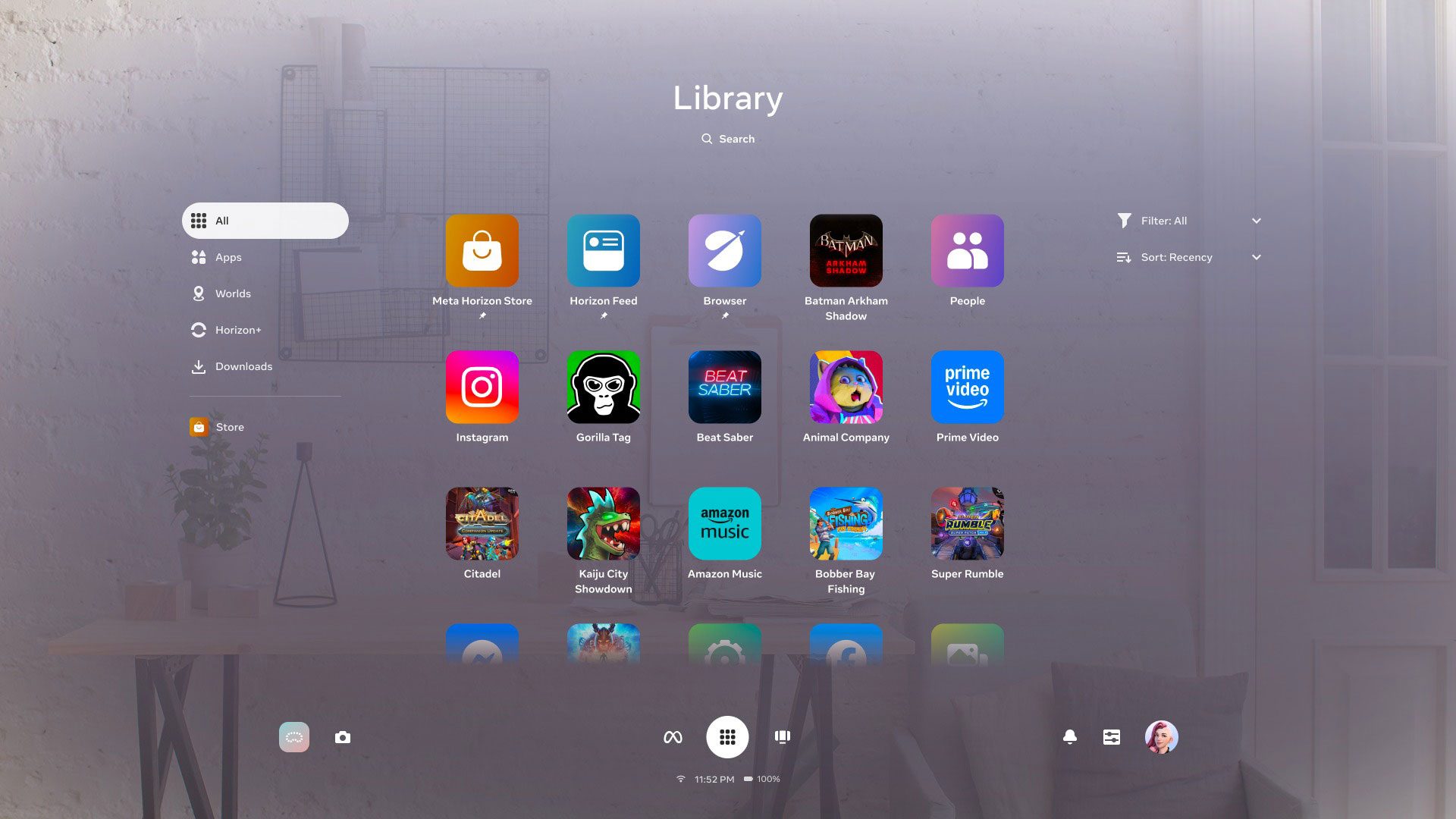
Meta announced it’s now running a test in Quest’s latest Horizon OS release (v77) that overhauls the platform’s dock-based UI for a new launcher overlay. Additionally, Meta says some users will also see 3D Instagram photos in their feed on Quest too, which is neat.

First teased at Connect 2024, Meta is finally bringing Navigator to Quest, which serves as a new centralized hub for apps, quick actions, and system functions.

“As part of our work to develop a fully spatial operating system designed around people, Navigator gives you convenient access to your recently used applications, with the added ability to pin up to 10 items in your library for quick access and seamless task resumption. This makes it easier to multitask in-headset and connect with the people and things you care about most,” Meta says in the v77 patch notes.

Essentially, Navigator is supposed to make it easier to access system-level controls and then quickly return to what you were doing in-headset. More specifically, the new UI should feel pretty familiar to smartphone users thanks to its more traditional layout.

YouTuber ‘The Construct’ shows off Navigator, including a tutorial video and hands-on impressions:

“We designed Navigator based on everything we’ve learned over the last decade. It’s unobtrusive, intuitive, and built from the ground up for the unique needs of spatial computing,” Meta says.

The company says Navigator will begin rolling out as a limited test to some people on the Public Test Channel (PTC) v77, which is expected to roll out gradually to all users over the coming months.

SEE ALSO
Apple Continues Investment in Exclusive Immersive Content for Vision Pro

Additionally, Instagram is getting a little love on Quest too, as Meta says it’s currently testing 3D-ified photos on the platform. For some users on PTC v77, Meta’s AI will automatically transform existing 2D photos not originally captured in 3D into an immersive format.

“And it’s an early look at our plans to continue bringing more social and entertainment experiences that are 2D today into a more immersive, 3D future,” Meta says.

Note: To enroll in Quest’s Public Test Channel (PTC), you need to use the Meta Horizon app on your phone and navigate to the ‘Devices’ section. Select your Quest headset and then go to ‘Headset settings’ and then ‘Advanced Settings’. Finally, toggle on ‘Public Test Channel’.


This article may contain affiliate links. If you click an affiliate link and buy a product we may receive a small commission which helps support the publication. See here for more information.

Well before the first modern XR products hit the market, Scott recognized the potential of the technology and set out to understand and document its growth. He has been professionally reporting on the space for nearly a decade as Editor at Road to VR, authoring more than 4,000 articles on the topic. Scott brings that seasoned insight to his reporting from major industry events across the globe.
  • Rayza

    how about giving us 3D movies like on Vision Pro

    • Sven Viking

      The weird thing is that Oculus had 3D movies on GearVR over a decade ago. They gave up on it shortly before they started to reach the type of audience that’d make it worthwhile (and refused to negotiate to figure out a mutually beneficial arrangement that would have allowed third parties like Bigscreen to handle it effectively).

  • Andrew Jakobs

    It's not like VisionOS was anything original, they also 'stole' from others including from Meta (from experimental options).

    • Christian Schildwaechter

      I just deleted a 4000 characters response about the development on visionOS, VR, intellectual property law etc. that had turned more into a rant about oversimplification being very dangerous, and silently accepting it leading to incompetent morons getting elected presidents instead of going to jail.

      The essence: Please don't make such bluntly oversimplified claims just to respond to other bluntly oversimplified claims. It's never that simple, there rarely is one single original in a long, iterative process with products adapting features from others. And this is very intentional and helps all of us and even the companies involved.

      Apple hired VR engineers before Rift CV1 released, introduced ARkit before Meta released Quest 1/Rift S with inside-out tracking, and has currently ~1.75B AR capable devices in the field providing research data for AVP or smart glasses. And most of the Android based Horizon OS is designed after parts pioneered by Apple. It's way more complicated than one side stealing from the other.

  • FrankB

    But we still can’t delete old apps and demos properly.

  • JanO

    Sigh… Here's Meta missing the point once again, with no real direction and a sad case of Apple envy…

    I don't mind the usual folder/icons combo for managing tasks, but in an entertainment setting, I want this:

    – a home cinema-like interface where I can choose what info appears on my library page (I personally prefer "poster" images for movies and games, but you should be able to customize the appearance to your liking easily.

    – Navigation should be made easy by the inclusion of an alphabet bar on top or to the right of the app poster images (because I should also have the choice of horizontal or vertical scrolling). Just tap the letter to skip to that section.

    – We need to be able to remove unwanted junk we tried years ago from our library.

    – We need to be able to add tags to our apps so we can create categories to help navigating to a specific app or type of app (ex.: Racing games). The categories should appear as tabs in our library…

    Nothing fancy here and espescially nothing that hasn't been done before… and better, by others…

    Hey boz/Zuck… I'm available… Really. : )

    • Christian Schildwaechter

      Here's Meta missing the point once again […] I don't mind the usual folder/icons combo for managing tasks, but in an entertainment setting, I want this:

      But Meta doesn't want Quest to be just/mostly considered an entertainment device. This already backfired with gaming, which people perceiving Quest solely as a VR game console, making it very hard to expand beyond that. From the article:

      As part of our work to develop a fully spatial operating system designed around people […] This makes it easier to multitask in-headset and connect with the people and things you care about most.

      Meta's goal is to turn Horizon OS into a multi-purpose XR OS, similar to what Apple has shown with visionOS (also) using iPad apps, or Google with AndroidXR. And they'll have to if they want to compete with Apple and Google in the upcoming mobile XR market. So a future proof UI has to deal with other/more demands than just quickly selecting the next media to play. You should also expect Horizon OS on Quest to at one point add AI driven features from the voice-based UI on their Ray-Ban smart glasses, even if only to counter AndroidXR with very tight Google Gemini AI integration.

      Meta actually gets it, and this is not just "Apple envy". It's simply that their (and Apple's and Google's) vision of the future XR market doesn't necessarily align with that of current Quest users.

      • JanO

        I agree with most of what you say, but as a consumer I don't give a fuck about what Meta wants. If it wants MY money it has to cater to me, not the other way around. Sadly, Meta is all about CONTROLLING your experience, rather than EMPOWERING its users. While I know most people are just sheeps, early adopters tend not to be. Meta should provide more options for those who want it, with a default for the masses… Just look at Steam's customability.

        The backlash you mentionned about Meta first catering to gamers actually happened when they started to move away from gamers, without ever having delivered an OK experience for them. They started removing features and unsurprisingly got bad feedback. You can't "move fast and break things" when the thing you break is your customer base. Meta has just shown for all to see how easy it is for them to abandon their users…

        As for reinventing the wheel and call that spatial compooping, I just don't drink that kool-aid… File navigation has been ironed out decades ago and this latest "Navigator" uses the exact same principles. It doesn't even feature tool to …navigate better! Marketing BS, and yes, Apple envy…

        • JanO

          …Steam's customizability.

          Also, I understand Meta have their eyes set to the future, but the future is built on the present.

          • Christian Schildwaechter

            TL;DR: Steam to the rescue, as Valve is the only major VR player that is in it for the games, not for the mainstream platform dominance.

            Valve/Steam is probably your best bet, simply because the current mobile VR market doesn't really work as a market. The "If it wants MY money it has to cater to me" would only work if Meta actually made money from Quest, but so far it's more them giving us cheap stuff while losing billions each quarter. And it even got worse over time, with later buyers engaging a lot less with the platform, buying even less software, the younger ones mostly keeping to free-to-play and the older ones tending more to media consumption than buying/playing games.

            The VR enthusiast market turned out to be rather small and quickly saturated, which unfortunately means the enthusiasts don't hold a lot of purchase power. My Meta/Oculus library contains more than 100 Quest titles in addition to 150+ for Go plus some for Rift, most of them paid titles (in addition to several hundred VR supported titles on Steam), so in my case Meta probably made back the development costs through software sales as they hoped. But even a couple of years ago the average Quest users bought only around eight games in total, roughly half of what PS4 users bought, and at lower prices. And it only got worse since then.

            So there isn't a lot of initiative for Meta to cater to their current users if they see more growth potential somewhere else, and right now smart glasses seem to provide that, as they aren't limited to gamers, with apparently only a very small fraction of all gamers even interested in VR. Meta will still continue with Quest to not lose their ~10M active users, but I wouldn't expect huge initiatives or lots of subsidized AAA titles any more, and instead more pushes to get everyone into Horizon Worlds (mostly on mobile phones) with lots of micro-transactions.

            Which is why Valve is still very important, even if it takes them eons to release a new HMD. The whole company actually cares about games, makes a lot of money from selling games which allows to pay for expensive side projects like Index or Steam Deck that are basically sold at cost, similar to Meta. Valve doesn't have any ambitions to become a large mobile platform to compete with Google and Apple, or a metaverse or AI company to take a cut on anything their users do. They seem happy with staying small (350 employees) and keeping a rather open environment. You can install Steam games pretty much everywhere, you can install non-steam games on Valve hardware, and developers can use other platforms to sell Steam keys without having to pay Valve.

            They are pretty much the opposite to the walled gardens Meta and Apple have build and Google tries to turn Android(XR) into, and their attempt to establish the Linux based SteamOS as a free alternative to Windows gives the users even more control. And their users are very loyal due to the value/service Steam provides over other stores like Epic selling the same games, resulting in a rather save stream of income for Valve. Nothing compared to what Meta makes, but about 98% of Meta's revenue/earnings comes from ads on Facebook and Instagram, while Valve makes most money from actually selling games. So in theory Meta could drop Quest tomorrow because they want to solely focus on smart glasses, and might even save money in the process, while it is pretty safe that Valve will still be selling games in 10 years, and push technology that allows their users to play/buy games.

          • JanO

            I don't disagree. We all know Meta/Apple/Google/your mother all have their eyes set on smart glasses. But if we're talking about Quest, it's just not that. How about Meta actually deliver a compelling experience for the VR headsets they already have on the market.

            Markets are built on confidence, not uncertainty.

            Hey Meta, prove me you can actually bring something to completion before moving away from it. For now, you just smell like Google…

          • JanO

            Valve has a good rep because of their dedication to make both their products and platform stand on their own merits. Which in turn inspires confidence that they will do things right ( if a tad slowly! ) by their users/clients/devs…

          • JanO

            Here's another unrelated subject I'd appreciate your input on:

            Every now and then when there are Horizon OS updates I feel I can resolve a bit more detail in the rendered image… Since Meta doesn't get very technical in the update notes, I've often wondered if they are still optimizing the barrel distorsion algorythm/rendering pipeline or if this is just a variation in the positionning of my glasses with regards to the Quest lenses… While I see a difference, I've never seen any coverage on the subject…

            Anyway, it's always a pleasure to read your posts!
            Have a great day!

      • Ondrej

        Meta's goal is to turn Horizon OS into a multi-purpose XR OS

        No. And Apple doesn't want that either.

        A true multipurpose XR OS would, by definition, need MORE capabilities than a laptop OS, but they specifically do NOT want that, which is why Apple forked a gadget iOS instead of Mac OS.

        Any OS that doesn't allow you to install or do whatever you want with it is not a real computer OS, but a toy software for a gadget.

        • Christian Schildwaechter

          Multipurpose just means multipurpose, not "typical desktop OS with the user responsible for managing apps and files" or what you consider a "real computer OS". Which is very obviously just your personal expectation based on what you are used too.

          I can easily come up with a "real computer OS" definition where everything not providing the powerful pipe command mechanism and tool based operation typical for Unix-like operation system is just a toy operating system, and a lot of people would agree. So MacOS would be a real OS, Windows a toy, only somewhat saved by former POSIX compliance and WSL, which really is just running the Unix-like Linux inside of Windows.

          And while all Apple operating systems are based on MacOS and historically NeXTSTEP with a Unix‐like FreeBSD personality, MacOS is not the most powerful superset of the others that makes it a "real computer OS". The other OSes got different features for different purposes, visionOS obviously handling spatial presentation, but for example to this day MacOS cannot handle touch screens, even though Apple Silicon Macs now can run iOS/iPad OS apps. All of them somewhat converge and become more multipurpose in the process, with the purpose not simply to become a traditional desktop machine.

  • xyzs

    Anyway, Horizon OS is a mess, they cannot make it worse:
    lack of global consistency
    lack of decent anti-aliasing on the windows edges
    lack of global polish
    lack of options for sorting – especially in the store
    lack of full featured clean native apps
    lack of volumetric use for the UI – why everything is perfectly 2d flat ? they could make some buttons with slight volume, etc

    It's like there is no quality control, making sure everything is absolutely neat, like at Apple's.

    • Ondrej

      Don't worry. None of it matters.
      Vision OS is an utter disaster no matter how "nice" and polished it is, because of the core anti-consumer and anti-developer strategy that is the opposite of what was promised a decade ago (the final platform that does everything what was possible on "legacy" platforms + so much more).
      And it's all due to short-sighted greed, not actual technical reasons.

      Don't forget to buy a Macbook with another M-series chip, just like the one inside of your AVP, to videostream the apps to your AVP.