
VITURE has now launched Luma Ultra AR glasses, which pack in Sony’s latest micro-OLED to go along with spatial gesture tracking thanks to onboard sensor array.
Priced at $600, and now shipping worldwide, Viture Luma Ultra is targeting prosumers, enterprise and business professionals looking for a personal, on-the-go workspace.
Notably, these aren’t standalone devices, instead relying on PC, console and mobile tethering for compute, which means they integrate as external (albeit very personal) monitors.

Luma Ultra is said to include a 52-degree field of view (FOV), Sony’s latest micro-OLED panels with a resolution up to 1200p and 1,250 nits peak brightness. Two depth sensing cameras are onboard in addition to a single RGB camera for spatial 6DOF tracking and hand gesture input.
Unlike some AR glasses, which rely on slimming waveguide optics, Luma Ultra uses what’s called a ‘birdbath’ optic system, which uses a curved, semi-transparent mirror to project the digital image into the user’s eyes. It’s typically cheaper and easier to manufacture, and can also reach higher brightness at the expense of more bulk and weight.

The device also includes an electrochromic film for tint control, myopia adjustments up to -4.0 diopters, and support for 64 ± 6mm interpupillary distance (IPD).
In reality, the company also launched a slate of AR glasses alongside it, which are targeted at consuming traditional media, positioning Viture Luma Ultra the company’s flagship device.
Check out the full lineup and spec below:
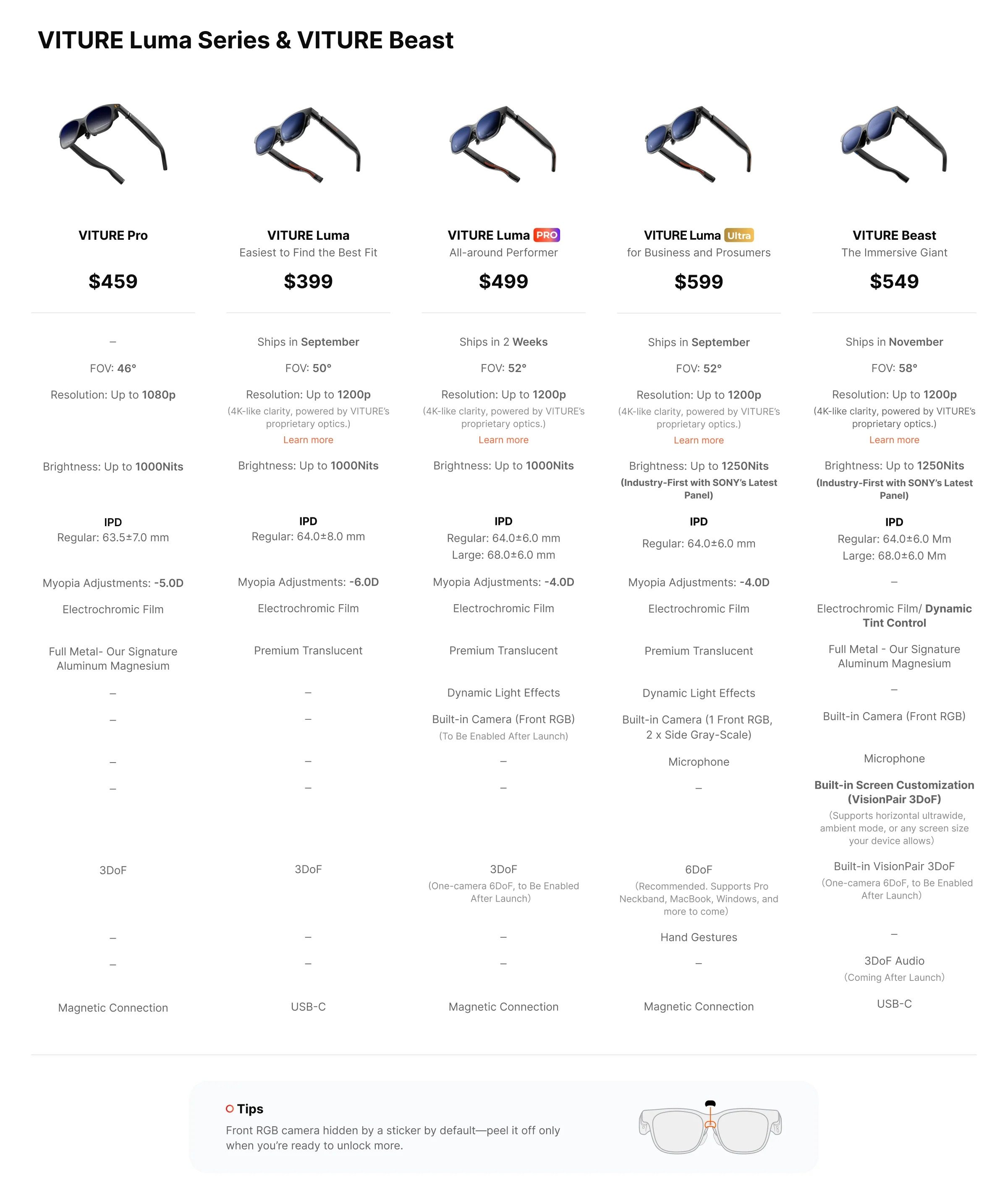
Viture Luma ($400), Luma Pro ($500) and Luma Ultra ($600) are all estimated to ship within two weeks of ordering, with the next device, Luma Beast ($550) slated to ship sometime in November.
None of the devices above (besides Luma Ultra) include spatial tracking due to the lack of depth sensors, however Luma Beast is said to come with the same micro-OLED displays as Luma Ultra at a slightly larger 58-degree FOV and an auto-adjusting electrochromic film for tint control.
This follows the news of Viture’s latest funding round, which brought the San Francisco-based XR glasses company $100 million in Series B financing. which the company says will aid in global expansion of its consumer XR glasses. Viture says the funding will aid in global expansion of its consumer XR glasses.