
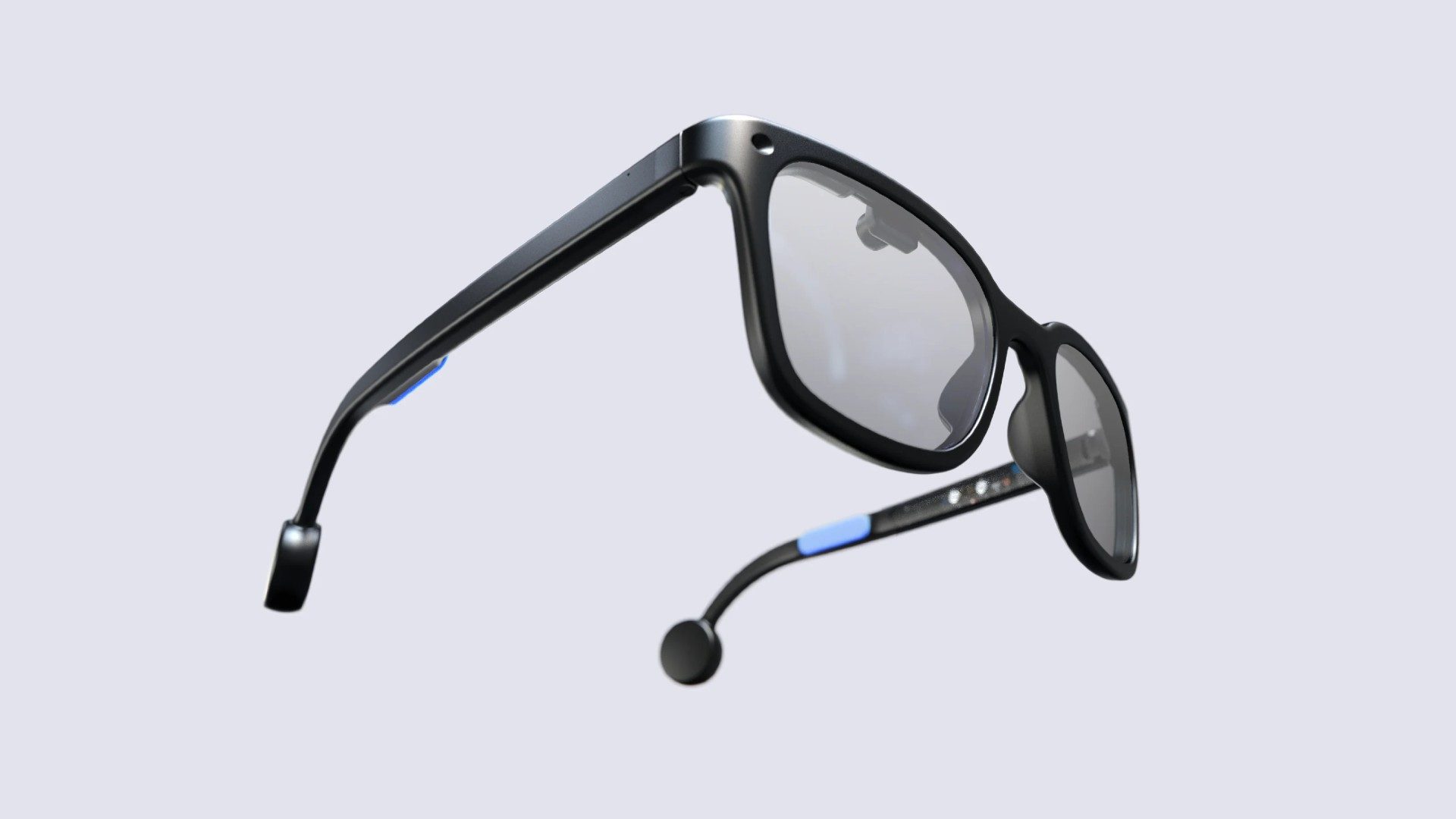
Brilliant Labs unveiled Halo, its next-gen smart glasses that pack in a full-color micro OLED display, bone conduction speakers, and real-time voice-based AI assistant—priced at a surprisingly reasonable $300.
Weighing in at just over 40 grams, Halo builds on the company’s earlier experiments in heads-up displays, including Monocle, a clip-on developer kit released in 2023, and Frame, a slimmer display unit launched a year later.
Halo represents a more consumer-oriented evolution, combining vision correction support, on-device AI, and open-source hardware in a form factor designed for everyday use.
The glasses are powered by a low-power Alif B1 processor with a Cortex-M55 CPU and a neural processing unit (NPU) capable of performing AI tasks directly on the device.

A big feature is the company’s new integrated AI assistant, Noa, which supports real-time chats, promising to not only see what you see, but remember it too for later. And you’re meant to use it all-day, as the company says battery life is rated for up to 14 hours of typical use.
And as you’d imagine, a pair of microphones are onboard so you can talk with Noa, while a low-power optical sensor and six-axis IMU provide input for gesture and tap recognition. Connectivity is handled via Bluetooth 5.3.

That single optical sensor isn’t for taking POV videos or images and posting them on Instagram though, as it’s used just for “AI inference,” Brilliant Labs says. Notably, there’s no familiar capture LED to indicate when it’s recording, like you see on Ray-Ban Meta or Xiaomi AI Glasses—likely because Halo doesn’t natively make video/images accessible to the user.
Noa is slated to be offered in two tiers: a free ‘Basic’ version with memory support and limited usage, and a ‘Plus’ subscription tier that includes full-speed conversational AI. Pricing for the premium tier has not yet been disclosed.
The display optics can be adjusted between +2 to -6 diopters to accommodate users with various levels of vision correction, and prescription lenses will also be available through partner Smart Buy Glasses.

As with Brilliant Labs’ previous projects, Halo is open source. The company has published its design files and source code on GitHub, inviting developers and hardware enthusiasts to experiment with and modify the platform.
Shipping is slated to begin in Q4 2025, with Brilliant Labs noting that shipping is on a “first come, first served” basis. You can pre-order today direct on the Brilliant Labs website, priced at $299.
Check out the specs below:
Brilliant Labs Halo Specs
- Display: Micro color OLED, adjustable +2 to -6 diopters
- Audio: 2x bone conduction speakers
- Processor: Alif B1 with Cortex-M55 CPU and NPU
- Sensors
- Low-power optical sensor
- 2x microphones with audio activity detection
- 6-axis IMU with tap detection
- Lenses: Optical-grade with anti-reflective coating
- Optional: prescription or sunglass lenses
- Connectivity: Bluetooth 5.3
- Software
- Open Source software (available on GitHub)
- ZephyrOS with Lua scripting
- Cross-platform mobile companion app
- Cloud-based AI assistant (Noa)
- Battery life: Up to 14 hours
- Fit: Designed for IPD range of 58–72mm
- Weight: Just over 40 grams