
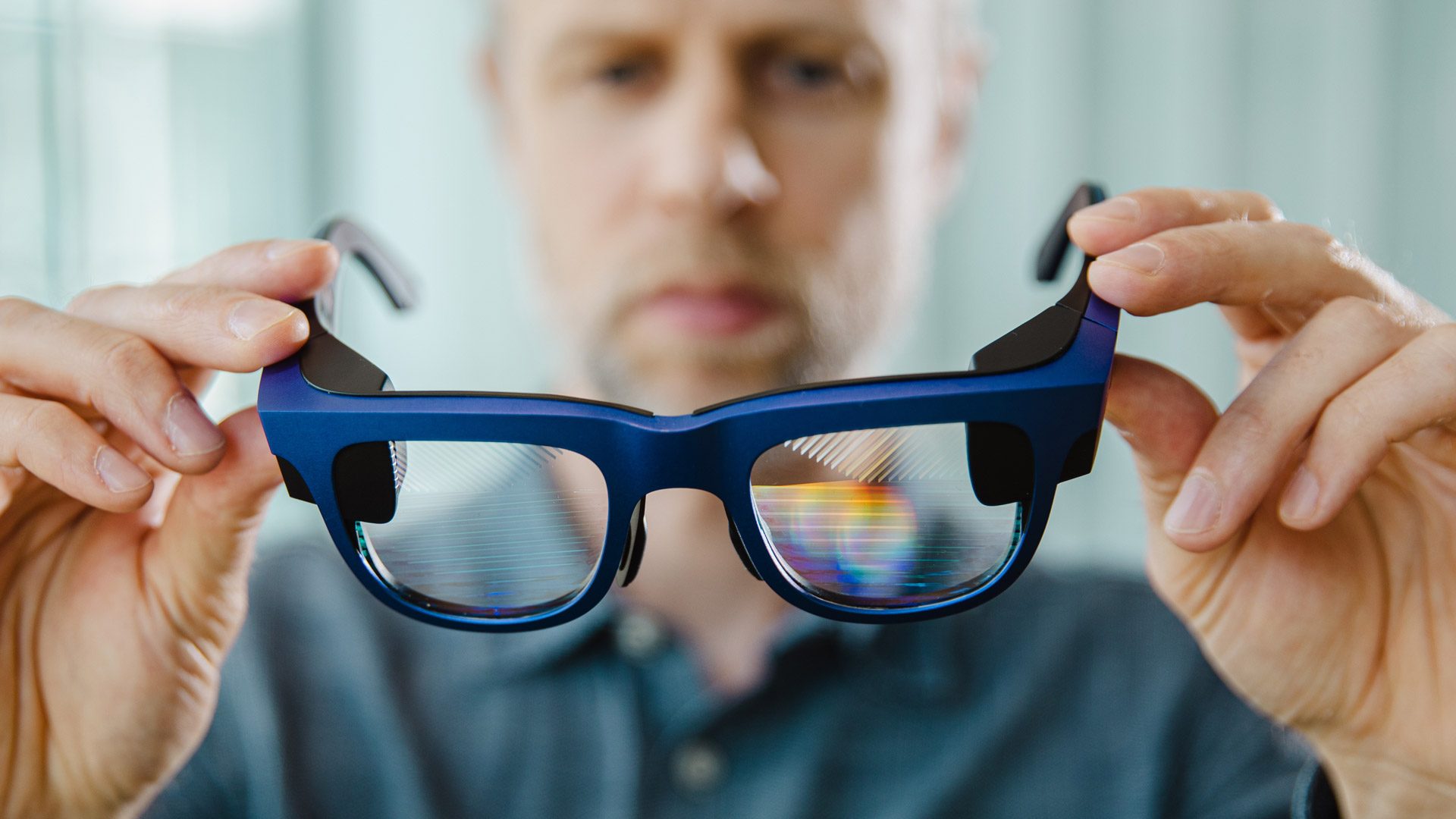
SCHOTT—a global leader in advanced optics and specialty glass—working with waveguide partner Lumus, is almost certainly the manufacturer of the waveguide optics in Meta’s Ray-Ban Display glasses. While the Ray-Ban Display glasses offer only a static 20° field-of-view, the company says its waveguide technology is also capable of supporting immersive wide field-of-view glasses in the future.
The News
Schott has secured a big win as perhaps the first waveguide maker to begin producing waveguides at consumer scale. While Meta hasn’t confirmed who makers the waveguides in the Ray-Ban Display glasses, Schott announced—just one day before the launch of Ray-Ban Display—that it was the “first company capable of handling geometric reflective waveguide manufacturing in [mass] production volumes.”
In anticipation of AR glasses, Shott has spent years investing in technology, manufacturing, and partnerships in an effort to set itself up as a leading provider of optics for smart glasses and AR glasses.
The company signed a strategic partnership with Lumus (the company that actually designs the geometric reflective waveguides) back in 2020. Last year the company announced the completion of a brand new factory which it said would “significantly enhance Schott’s capacity to supply high-quality optical components to international high-tech industries, including Augmented Reality (AR).”

Those investments now appear to be paying off. While there are a handful of companies out there with varying waveguide technologies and manufacturing processes, as the likely provider of the waveguides in the Ray-Ban Display glasses, Schott can now claim it has “proven mass market readiness regarding scalability;” something others have yet to do at this scale, as far as I’m aware.
“This breakthrough in industrial production of geometric reflective waveguides means nothing less than adding a crucial missing puzzle piece to the AR technology landscape,” said Dr. Ruediger Sprengard, Senior Vice President Augmented Reality at Schott. “For years, the promise of lightweight and powerful smart glasses available at scale has been out of reach. Today, we are changing that. By offering geometric reflective waveguides at scale, we’re helping our partners cross the threshold into truly wearable products, providing an immersive experience.”
As for the future, the company claims its geometric reflective waveguides will be able to scale beyond the small 20° field-of-view of the Ray-Ban Display glasses to immersive wide field-of-view devices.
“Compared to competing optical technologies in AR, geometric reflective waveguides stand out in light and energy efficiency, enabling device designers to create fashionable glasses for all-day use. These attributes make geometric reflective waveguides the best option for small FoVs, and the only available option for wide FoVs,” the company claims in its announcement.
Indeed, Schott’s partner Lumus has long demonstrated wider field-of-view waveguides, like the 50° ‘Lumus Maximus’ I saw as far back as 2022.
My Take
As the likely provider of waveguides for Ray-Ban Display, Schott & Lumus have secured a big win over competitors. From the outside, it looks like Lumus’ geometric reflective waveguides won out primarily due to their light efficiency. Most other waveguide technologies rely on diffractive (rather than reflective) optics, which have certain advantages but fall short on light efficiency.
Light efficiency is crucial because the microdisplays in glasses-sized devices must be both tiny and power-efficient. As displays get larger and brighter, they get bulkier, hotter, and more power-hungry. Using a waveguide with high light efficiency thus allows the displays to be smaller, cooler, and less power-hungry, which is critical considering the tiny space available.
Light and power demands also rise with field-of-view, since spreading the same light across a wider area reduces apparent brightness.
Schott says its waveguide technology is ready to scale to wider fields-of-view, but that probably isn’t what’s holding back true AR glasses (like the Orion Prototype that Meta showed off in 2024).
It’s not just wide field-of-view optics that need to be in place for a device like Orion to ship. There’s still the issue of battery and processing power. Orion was only able to work as it does because a lot of the computation and battery was offloaded onto a wireless puck. If Meta wants to launch full AR glasses like Orion without a puck (as they did with Ray-Ban Display), the company still needs smaller, more efficient chips to make that possible.
Additionally, display technology also needs to advance in order to actually take advantage of optics that are capable of projectinga wide field-of-view
Ray-Ban Display glasses are using a fairly low resolution 0.36MP (600 × 600) display. It appears sharp because the pixels are spread across just 20°. As the field-of-view increases, both brightness and resolution need to increase to maintain the same image quality. Without much room to increase the physical size of the display, that means packing smaller pixels into the same tiny area, while also making them brighter. As you can imagine, it’s a challenge to improve these inversely-related characteristics at the same time.