
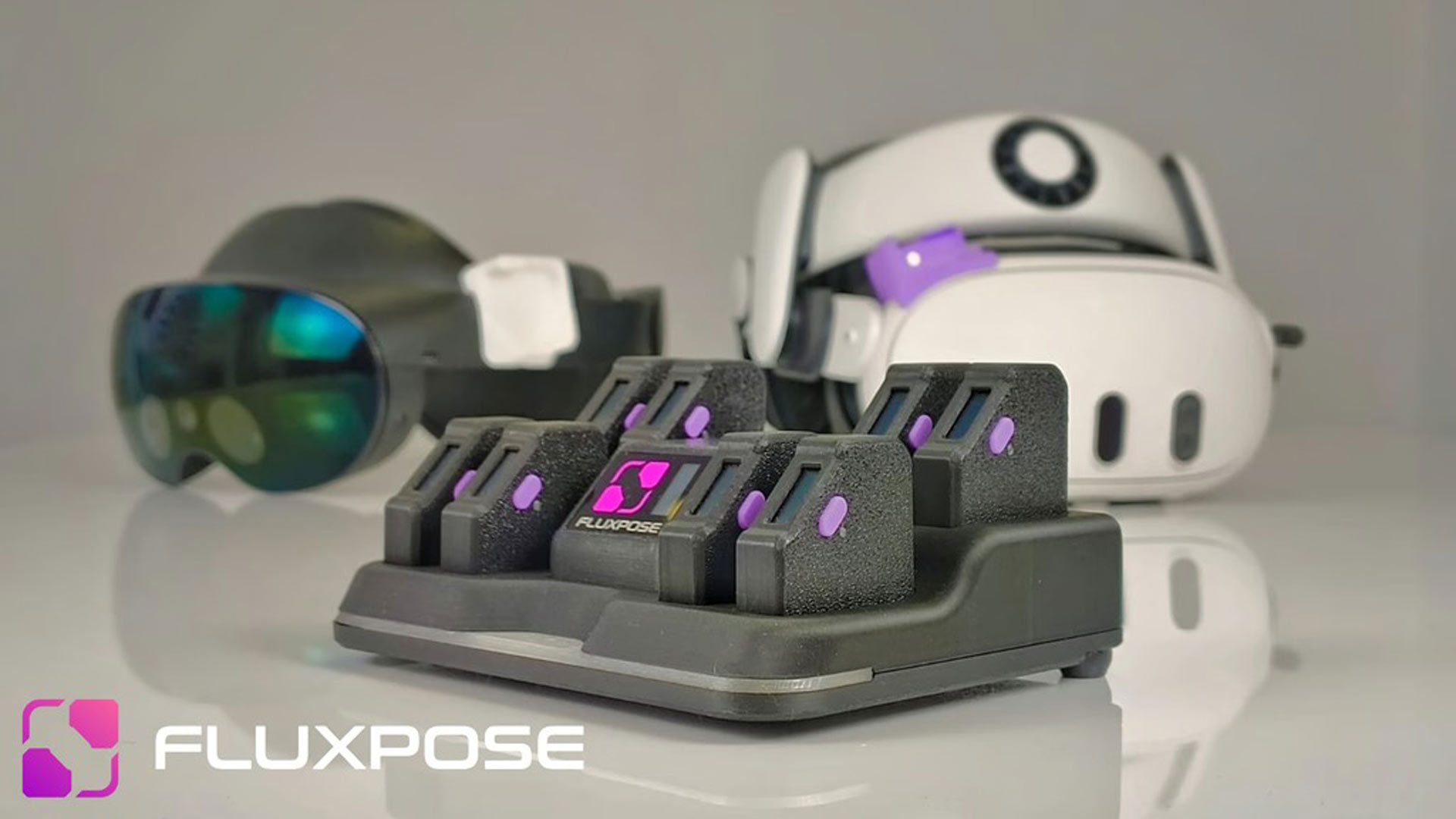
FluxPose VR Tracker Raises $2M on Kickstarter, Promising Compact 6DOF Body Tracking

14

FluxPose is a 6DOF tracking solution for full-body tracking that seems to be picking up speed on Kickstarter, having now garnered over $2 million in crowdfunding since its initial launch on November 29th.

The News

FluxPose is a full-body tracking system that’s said to deliver occlusion-free positional tracking without the need of externally mounted base stations or sensors. It does this by way of a wearable beacon, which generates magnetic fields, the team explains on the FluxPose Kickstarter campaign.

“It’s completely occlusion-free, incredibly compact, drift-free, and the trackers last up to 24 hours on a single charge, offering high-end performance in the smallest, lightest form factor possible,” the Logrono, Spain-based team says.
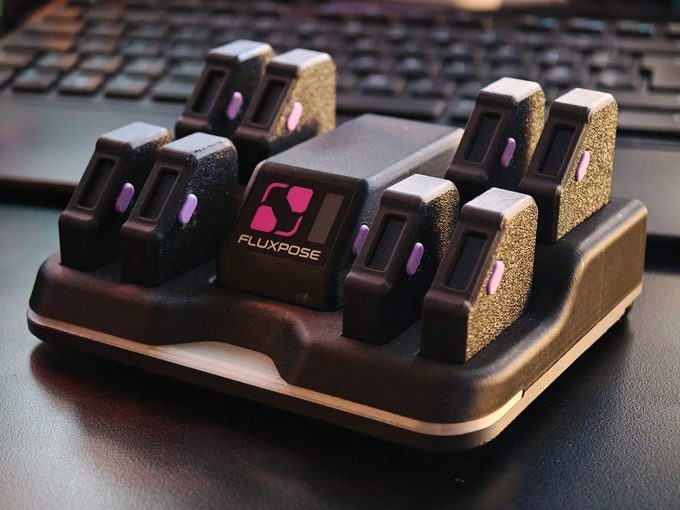
Image courtesy FluxPose

And because the beacon is worn on your body, and automatically synchronizes the tracking space with VR headsets without any additional software, it essentially means the tracking volume moves with you as you move (or more likely, dance) in VR.

Weighing in at 85 grams, the trackers are also impressively compact: a Dorito for scale.
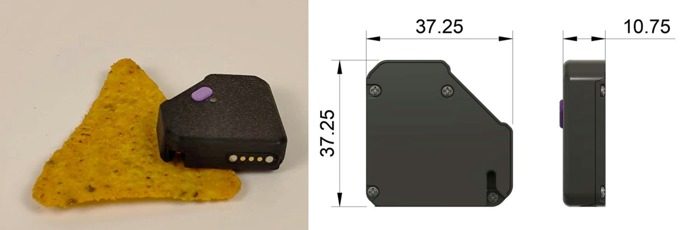
Image courtesy FluxPose

At the time of this writing, the cheapest support tier is the ‘Lite Kit’ for €339 (~$394 USD), which comes with three tracking points (straps sold separately). At the higher end is the ‘Pro Kit’ for €689 (~$800 USD), which includes eight tracking points. Notably, those prices do not include taxes or import tariffs.

VR headset mounts provided through the Kickstarter are said to include Quest 2/3/3S/Pro, Pico 4/4 Ultra, Samsung Galaxy XR, HTC Vive Pro/Pro 2/Focus/XR Elite, Bigscreen Beyond 1/2, Valve Index, and Steam Frame. Backers will have the chance to select the exact headset model on a survey after the Kickstarter ends, and again a few months before delivery.

You can find out more over on the FluxPose Kickstarter, which we’ll be following for the campaign’s remaining 58 days, ending on January 28th, 2026. The earliest delivery is expected in August 2026 for early bird supporters, and October 2026 for late comers to the Kickstarter.

SEE ALSO
Valve's Next VR Headset Reportedly Enters Mass Production, Targeting 500K Units This Year

My Take

Magnetically-tracked peripherals aren’t anything new in VR; I’ve seen a number of solutions come and go, with the emphasis mostly on goRazer Hydra, Sixense StemAtraxa, Magic Leap 1 controllers—these implementations seem to be good enough in optimal conditions, but not rock solid across the board.

In short, magnetic trackers position themselves in 3D space by measuring the intensity of the magnetic field in various directions, which (as mentioned above) is generated by a beacon. When the trackers’ measurement point is rotated, the distribution of the magnetic field changes across its various axes, allowing for it to be positionally tracked.

And while those magnetically-tracked peripherals listed above don’t suffer from optical occlusion, they can be affected by external magnetic fields, ferromagnetic materials in the tracking volume, and conductive materials near the emitter or sensor. These things typically reduce tracking quality, making them less reliably accurate than optical (Quest 3) or laser-positioned systems (SteamVR base stations).

Granted, I haven’t tried FluxPose yet, although I don’t think those drawbacks are nearly as important in fully-body tracking than they might be in actual motion controllers, which require much higher accuracy. A few millimeter’s discrepancy in your foot’s position really doesn’t matter as much as it might if you were reaching out and trying to grab something with a magnetically-tracked controller.

Provided Road to VR doesn’t get to go hands-on in the coming months, I’ll be keeping my eyes peeled for videos and articles as we move closer to the campaign’s close next month.


This article may contain affiliate links. If you click an affiliate link and buy a product we may receive a small commission which helps support the publication. See here for more information.

Well before the first modern XR products hit the market, Scott recognized the potential of the technology and set out to understand and document its growth. He has been professionally reporting on the space for nearly a decade as Editor at Road to VR, authoring more than 4,000 articles on the topic. Scott brings that seasoned insight to his reporting from major industry events across the globe.
  • Christian Schildwaechter

    TL;DR: basically IMU trackers with a clever (and cheap) magnetic field generator at a rather high price

    The use of a magnetic beacon attached to the headset is clever, but not anywhere as revolutionary as the Kickstarter page makes it sound. Pretty much all tracking mostly uses IMUs/Inertial measurement units, very small and cheap components that measure rotation around and acceleration along three axis, with most also containing a compass used to measure the 3DoF orientation of the earth's magnetic field, plus a gravity sensor always pointing down. The degrees of freedom are added up, so a gyro + accelerometer + compass + gravity sensor is sold as a 10DoF IMU, even though some of the measurements are doubled and you only get 6DoF.

    These IMUs are very fast and can be queried hundreds of times per second, which is required for VR. Pretty much everything else (except maybe Valve lighthouses) is way too slow, so on Quest the camera based SLAM room tracking is only used to correct for the inherent drift that the IMUs with only relative measurements have, not the tracking directly. Which is also why controller tracking isn't immediately lost the moment your hands are no longer visible by the cameras, the software can calculate the position from the IMU data plus a skeletal model. In theory this would work indefinitely, in reality the calculated position will shift quickly due to drift.

    The FluxPose will do exactly the same, and is therefore very comparable to other IMU solutions like the much cheaper SlimeVR, which you can even build yourself from extremely cheap ESP8266/ESP32 microcontrollers, IMUs and batteries. If you shop around and use simpler components (with less precision and more drift), you can get below USD 10 per tracker, and the SlimeVR firmware plus all hardware designs are open source. You of course have the problem of drift, as SlimeVR lacks an absolute reference point in space to correct sensor drift against, and that is where FluxPose adds a small, but important component.

    Instead of using an external source like lighthouses or a webcam like it is used by the QR code based April Tag trackers, it assumes that the headset's precise 6DoF position is always known, so all they need is to somehow measure the position relative to the headset. The magnetic beacon will be basically a coil through which a pulsed current is sent, so it generates its own magnetic field that the compass sensors in the IMUs will be able to detect. By pulsing the signal, they can calibrate between the influx of the earth's magnetic field and the field generated by the beacon attached to the HMD, plus some clever software.

    But the consequence is that SlimeVR could basically update their current purely relative tracking by creating a similar coil based beacon and updating the firmware. The FluxPose is more of a consumer product than SlimeVR, with a small display, pogo pins for easy charging, a small rumble motor and very low weight, but the pure component costs will still be far below USD 20 per tracker. Of course full body tracking is a niche product, and many of the users in that social VR niche are heavy hardware spenders, and the current solutions from HTC or Tundra are rather pricy. But USD 800 is still pretty rich for a kit of what are basically 8 IMU trackers plus a small magnetic field generator that allows them to re-use the very good headtracking the HMD itself for sufficiently good 6DoF tracking error correction.

    • psuedonymous

      It's not quite as easy as just sticking a stock IMU with a magnetometer in a magnetic field and calling it done. For one, the magnetometers in IMUs are only designed for geomagnetic orientation: giving you the direction of the local magnetic field with little regard to its magnitude.
      Instead, magnetic tracking needs magnetometers that can frequency-lock to the field emitter coils to minimise influence of the geomagnetic field and static magnetic fields (this doesn't help with nearby ferrous objects distorting the generated fields), and need to be very accurate in their measurement of field magnitude (and doing so independently for all 3 axes) to perform trilateration as well as just gross orientation.

      The technique of magnetic tracking is indeed not new (many decades old), the trick would be getting it to work at consumer price points. Hydra sorta managed it, but tethered and was far too early to even serve the second VR boom. Sixense collapsed in attempting it. The devil is in the details for magnetic tracking, and 'just stick some IMUs in a magnetic field' is glossing over all of those details.

      • Christian Schildwaechter

        TL;DR: this isn't magnetic 6DoF tracking, which is much harder. This is magnetic referencing of relative 3DoF rotation to be used as drift correction, combined with a skeletal model to calculate hand/tracker position. This doesn't require any field magnitude measurement, only field orientation, and only works as a low frequency reference for correction. But that is all that is needed to fix current IMU tracking.

        I'm aware that accurate magnetic tracking is a lot more complicated, but I doubt that they actually do anything as complex as the Razer Hydra or the Sixense STEM VR controllers. All they need is a stable orientation towards the headset itself, not an exact location, as the exact position can partly be extracted from the skeletal model. So all they need is the current orientation of the field, the magnitude isn't really necessary.

        What they really want to know is how far the IMU based tracking has drifted. To determine rotational drift with an IMU only reporting magnetic field orientation, you'd basically need to generate three consecutive fields standing orthogonally on each other, basically three coils oriented in XYZ. Pulsing through these will give you a field oriented along the current XYZ axis of the headset. If you know the absolute rotation of the headset from inside out tracking, you can then derive the "magnetic" rotation of the sensor and compare it to the data reported by the gyro and correct the drift. That doesn't have to be particularly precise and can be very low frequency, as we aren't using the magnetic sensors for tracking, only for drift correction. It would be sufficient to switch the field orientation once per second and have the famously jittery magnetometers in IMUs take a lot of samples to then average the results, taken into account any new rotation reported by the gyros during the sampling phase.

        If you have the angular rotation of each limb and a skeletal model, you basically have the translational position too, as you know the head position and how each joint and bone connects from there, at last with the 8 tracker solution. So you can correct for accelerator drift too. It is mostly clever software and the fact that for drift correction you don't need a precise or fast magnetic reference, just a mostly rotationally stable one. The result won't be as precise as positional tracking with lighthouse, but your proprioception sense allowing you to know where your limbs are without looking isn't that precise either, so you most likely won't notice.

        I of course don't know what exactly they use. Their whole description is

        This is done with a wearable beacon that acts as a "basestation" that generates magnetic fields. The trackers then use these fields to understand where they are in space.

        The inside view of the trackers below doesn't show any complex setup, so I'm still guessing that all the use is a decent IMU without any extra calibrated magnetometers or similar.

        Sixsense tried to solve this in hardware, doing all the tracking magnetic, which required measuring the strength of the field to determine the distance from the beacon. That required a different type of sensor, everything had to be calibrated with precisely know frequencies for exact timings, and was still very prone to interference from basically anything close by containing iron.

        But it is often smarter/cheaper, and today also technically possible to just do things in software. The Gear VR as a cooperation between Oculus and Samsung came with a separate, individually calibrated hardware IMU/gyroscope, because the gyros used in phones were pretty rubbish and prone to drift, as one could see with Cardboard. When Google tried to come up with a Cardboard successor that could compete with Gear VR, they didn't require an calibrated sensor to come with the viewer, instead they required a Snapdragon 820 SoC because it contained a dedicated Hexagon digital signal processor, which they used to do sensor fusion between the still prone to drift gyroscope, accelerometers, magnetometers and the gravity sensors, this way achieving a similar stable experience as Oculus/Samsung at basically zero extra hardware costs. Oculus then started using the Hexagon for all tracking on Quest.

        So I suspect that FluxPose isn't anywhere as complex as what Sixsense created, and this is largely possible because they are taking a piggyback ride on the headset's own absolute tracking. So they only have to determine how the hand is connected to the head, which is completely solvable with only rotational data for each limb/joint. And rotational data/drift can be correct by with field orientation only, resulting in a much simpler, cheaper solution relying on clever software instead of calibrated hardware.

        https://uploads.disquscdn.com/images/4ba5f12e8252dee2ed71b53b7f6d7ef85e1acffa3bd22b1b04bc1cdcdae4e461.jpg

        • psuedonymous

          The problems with your idea is twofold:

          First, it would only work if you could reference world-relative gyroscopic-drift with a world-relative magnetometer reference. But by putting the emitter on the body, that reference is no longer world relative: at best you could perform multiple coordinate-translations to try and estimate world-referenced coordinates, but since most tracking systems don't output true world-referenced coordinates but instead room-referenced ones (because it's far easier, and because room-referenced coordinates are what is useful for head-tracked rendering and hand-tracking) that is at best adding multiple error terms to a rough estimate. Putting the magnetic field emitter on a stationary surface (e.g. the floor) would work far better.

          But then comes the second problem: everyone is ALREADY doing world-referenced magnetic compensation for gyro drift, using the Earth's geomagnetic field. This is in the same reference-frame as the gryo's existing world-reference (local geoid 'down', or g-vector), and with the exception of the polar regions the geomagnetic field will already be orthogonal to the g-vector to provide a reference for drift in the other two axes.

          Now, as we know from IMU-only tracking using G-vector and local geomagnetic referencing is entirely insufficient to clamp gryo drift, and does nothing for accelerometer drift.

          Adding an additional-but-worse reference to the existing magnetic reference is not of any real utility.

          • Christian Schildwaechter

            Again, this is not about world-relative tracking, this is only about headset-relative tracking. The FluxPose beacon/emitter has to be placed on the headset itself, so its world position/rotation is always known because it is the same as the position/rotation of the headset itself, determined by inside-out tracking. And the rest is indeed "perform multiple coordinate-translations", but these only need angular data, as your body parts don't change size or how they are connected, only at which angle they stand to each other.

            Using magnetometers measuring only the earths magnetic field to correct for drift has been tried, but this is very buggy due to both the jittery magnetometers themselves and the fact that the magnetic field is so easily distorted, so a slight movement can result in a significant change in measured field orientation, making it unsuitable for correcting drift on devices that not only rotate, but also move around.

            But that is where the fields created by the beacon at known angles relative to the current head rotation come into play. These can be both stronger and a lot more stable, and by turning them on and off individually, the field orientation reported for each, and also the much weaker earth magnetic field can be compared, though the latter will probably be simply ignored. It only works because the beacon is on the headset with a well known 6DoF position/rotation, meaning the absolute orientation of the fields created by the beacon is also always known, and because it tracks limbs of which we know how they are connected. It would be unsuitable for 6DoF tracking of separate objects with the beacon just placed somewhere in the room as a fixed reference point.

          • Jistuce

            You've made a mistake in your bolded text. The beacon isn't mounted on the headset, it is a waist-mounted unit. However, the headset-mounted tracker does provide a very important function, as an intersection between two tracking spaces.

            The headset tracker is always at a known location and orientation relative to the headset(the headset mounts are designed to ensure that). Thus, knowing where the headset tracker is relative to the waist beacon makes it possible to precisely establish where the waist beacon is relative to the headset.
            That allows them to automatically align the beacon's tracking space with the headset's location and orientation, and gives the beacon a known location in real space without the range problems of a fixed-location base station(magnetic field strength falls off very fast with distance). Without the headset-mounted tracker, the whole magnetic-tracking system has no idea where the beacon is, either in relation to the headset's optical tracking system(be that camera-based or Lighthouse-based) or in relation to the world in general.

            And since the beacon's location is established relative to the headset location, it also means the magnetic tracking space is automatically aligned with the headset's tracking space for free, without the user having to lift a finger, which would be the other problem of a fixed-location base station.

          • Christian Schildwaechter

            Thanks for the correction. I've read through the kickstarter page at least twice, and still was sure to have read that there was a direct connection between headset and beacon. After seeing your comment I first thought that my whole idea of how it works would have to be thrown out the window, but it should still work the same way, only require the extra tracker on the headset to first establish the relative position to the HMD with absolute 6DoF tracking.

            Placing the beacon directly on the HMD would have saved that extra tracker, but as the trackers weigh only weigh 15g, while the beacon weighs 85g, it makes a lot of sense to place the beacon at the hip. I went down somewhat further and found on their website that the magnetic field the beacon creates switches polarity 20,000 times per second, so the trackers can ignore/disregard any other field influencing sources that don't flip by 180° every 0.05ms.

          • Plexy

            putting he beacon on the hip creates an even radius around our whole body, offsetting it wouldnt make sense

      • Jistuce

        Actually, I was surprised to learn that Sixense didn't collapse, though they disappeared from our sight.
        Like many proto-VR companies, they realized the real money was in the commercial sector and now sell VR packages for medical and industrial training. And their packages include full-body, occlusion-free, 6-axis tracking. Seems like they made it work, and then decided that it was bad business to sell to enthusiasts when they could sell the same product to the commercial sector at a much larger profit margin if they didn't undermine themselves.

    • PancakeWaffles5

      Unfortunately you have a fundamental misunderstanding of what Fluxpose actually is. In the discord, I am recognized as knowledgeable on the way that the trackers work, enough to answer any question that people may have. In reading your arguments with other commenters, I can see you are very set in your misunderstanding, but try to actually understand what you are being told.

      You are getting confused by the presence of the IMU being mentioned, but fundamentally it is the same idea that Vives use. They run a calculation based on a reference point to determine position and then use the faster polling of IMUs to smooth the data between pulses of their reference point. Fundamentally, Fluxpose should be treated as a vive tracker where you wear the base station instead of mounting it stationary. The beacon emits a 3 axis magnetic field that all the trackers pick up on to determine their position relative to the beacon. Every tracker ALSO has a 3 axis magnetic coil to be able to pick up on these fields. It IS 6DOF tracking, which is why you only need 3 trackers and the beacon for them to function. The only use of a slime-like mode is in the 6DOF+ mode, which is intended to be used when you have large amounts of metal in your floor and requires 2 trackers per leg. In every other situation, you don't need any more than 3 trackers and the beacon, the beacon being worn at your waist and the trackers being on your headset and feet.

      Fluxpose piggybacks off the HMDs tracking because the beacon is not stationary. If the beacon was stationary, you wouldn't need the headset for room position, but you would still need a tracker on the headset for aligning the playspaces into one area with something like Space Calibrator. If you had bothered to watch any of the videos that Fluxpose has put out, especially the early ones, you would see that they are 6DOF trackers, tracking independently of one another, without any sort of tracking skeleton. Beta testers have also shown this in ways such as tracking their pets in space when the pets are nearby.

      But USD 800 is still pretty rich for a kit of what are basically 8 IMU trackers plus a small magnetic field generator that allows them to re-use the very good headtracking the HMD itself for sufficiently good 6DoF tracking error correction

      TLDR: You fundamentally misunderstand the product because you haven't actually looked into how it works. All trackers have IMUs, even Vives and Tundras, and these fall into that category of being IMU smoothed but positionally tracked like Vives and Tundras by measuring the 3 axis magnetic field emitted by the beacon. Watch some of the videos shown on the fluxpose site, they show you how wrong you actually are. Especially the earlier videos, showing the software preview on the screen while the dev covers trackers with various methods

      • Christian Schildwaechter

        TL;DR: This is not about terminology or only deriving 3DoF data, this is about whether 6DoF data is derived directly from the magnitude of the magnetic field, not requiring extra information, or if it is derived from a 6DoF base (headset) plus rotational data corrected by field orientation plus a skeletal model. It is about a very technical detail that end users will never bother with.

        I can guarantee you that I haven't fundamentally misunderstood the device. I may be wrong about how they derive the actual 6DoF position, because I made a guess based on existing and failed technology, but there is always a chance that they found new ways or improved old ones.

        You misunderstood the discussion about 3DoF vs 6DoF tracking. Nobody doubts that the result you get from FluxPose are 6DoF positions/rotations, the question is only how they are derived. I'm not confusing it with IMU ONLY tracking, I just pointed out that all controllers use IMUs, with those offering 6DoF tracking also using an external reference point for drift correction, while 3DoF only trackers like SlimeVR have to be regularly reset by entering a default pose.

        BTW, I had seen all the videos on the Kickstarter site except the 50min "[EN] Episode 6 (feat. ‪@fluxpose‬)" virtual show for VRChat users. I've now also seen the 23min "Alecamar interview" about FluxPose it contains, and learned nothing I didn't already know from their Kickstarter and company page, as none of them ever go into the technical details. They all only point out that it provides 6DoF tracking without occlusion using magnetic field, but the actual question I have been discussing with @psuedonymous isn't answered anywhere, and your comment also skips that central detail:

        There are two informations you can get from magnetic fields that are useful for tracking: orientation and magnitude. Orientation is the one that every IMU offers, telling you basically whether you are aligned with the field lines of a magnetic field, but not where on the line or how far from the source you are. This can be used to correct for rotational drift where only relative angles are required, so it enables drift free 3DoF tracking (which can be turned into 6DoF results with a reference and skeletal model), but not for true 6DoF tracking.

        There are ways to achieve true 6DoF magnetic tracking with positional data too, and Razer Hydra and Sixense STEM tried this. For this it is required that the magnitude/strength of the field is known or derivable at every position, which requires very precise calibration of both beacon and trackers, and very precise timings to calculate distance from deliberate changes in the field, similar to how HTC/Tundra trackers uses the difference in time light from the lighthouses hits their sensors to calculate runtime and thereby distance relative to their absolute position. This is what @psuedonymous pointed out in his first reply, to which I answered with the IMU + drift correction via field orientation + skeletal model + 6DoF base alternative to achieve similar results with simpler tech.

        So the whole question is whether FluxPose uses only field orientation and derives the rest from the skeletal model, or whether it uses much more complex (and sensitive to field distortion) true 6DoF sensors that can give you a 6DoF position directly, not just a rotational reference.

        The beacon emits a 3 axis magnetic field that all the trackers pick up on to determine their position relative to the beacon. Every tracker ALSO has a 3 axis magnetic coil to be able to pick up on these fields.

        This simply doesn't answer what they use, as both orientational as well as orientational plus magnitude will work that way. That every tracker includes a 3 axis magnetic coil just means that it can report the orientation along field lines in X, Y and Z at the same time, while I assumed they'd use just one magnetometer and cycle through three different fields.

        The real question is HOW the position is derived. If there are very advanced sensors capable of precisely measuring magnitude with exact timing, then the position can be calculated with only the beacon and trackers, and also works with the beacon on the ground and random objects in the room. If the 3 axis magnetic coil only allows for faster/more precise measurement of orientation in the field, then the position cannot be calculated with only beacon and trackers, you absolutely need a skeletal model, because all you will get is a rotational/3DoF result, which you than have to combine with the 6DoF position of the HMD and derive the 6DoF position of the controller by adding the skeletal parts at the known/measured 3DoF rotations.

        Everything else you talk about is mostly dialectics. I called it 3DoF tracking with drift correction because I assume that the trackers only measure field orientation and therefore need the skeletal model plus 6DoF HMD position, not because the result would still be only 3DoF. So there is no misunderstanding on my side of what kind of data/tracking you get. The real question is whether the sensors measure only orientation or orientation and magnitude, because this has a lot of impact on the use.

        And neither the kickstarter page nor their webpage nor any of the videos answer that. Magnitude tracking has been tried (Sixense) and dropped/replaced by optical tracking due to interference problems. I'm not going to join the discord to find that out, so if you want to contribute to the answer beyond assuming that I simply confused IMU, 3DoF and 6DoF tracking, please answer the following question:

        Does FluxPose derive the position of trackers from the MAGNITUDE of the magnetic field created by the beacon instead of just measuring orientation relative to the beacon?

        ( ) Yes
        ( ) No

        Alternative you could point to a demonstration where FluxPose is used to track a separate object in the room, not held by the users, because this wouldn't work with an orientation-only tracking that requires a skeletal model. If you can find such a demonstration, it proves that position can be derived directly from field measurements, but everything I've seen so far has always been body tracking, or tracking of things attached to the body, strongly hinting they need the skeletal model.

        • PancakeWaffles5

          Well it seems that my attempt at a reply was denied because of the links provided. The fluxpose website provides tracking demo videos completely off the body and without a headset. Their Twitter account highlights object tracking. One of the testers even put a tracker on their cat and had a passthrough window to see said cat, which is reposted on the fluxpose Twitter account.

          To answer your question: Yes, they do derive position from the magnitude of the fields.

          There is no skeletal model unless you enable 6dof+IK mode to mitigate the effects of metal in your floor for your legs.

          • Christian Schildwaechter

            Thanks for that info, I’ll try to find these details and the demos on their site, and hopefully more information about the sensors.

            Based on your info about magnitude measuring I agree that what they are using isn’t anywhere close to SlimeVR trackers and will not only allow drift free 6DoF tracking, but also independent object tracking, which so far requires lighthouses or self-tracking trackers. And that in this case a USD 800 price tag isn’t rich, as there is a lot of added value to anything limited to body tracking.

            I still would expect that what I suggested, a sort of the field-orienation drift corrected IMU trackers should be technically possible, but have no idea how accurate this would be. “True” 6DoF magnetic tracking in FluxPose may result in much higher precision, and I’d assume they went for a more complex technology for a reason. I’m still very interested in how they worked around the problems that caused the Sixense STEM controllers to fail, admittedly a decade ago.

  • This actually seems really damn compelling. FBT has always felt like a pipe dream due to cost, bulk, weight, jank, and hassle.
    This seems to address pretty much all of these things in a really thoughtful way.
    I won't be backing the kickstarter, but definitely keeping a close eye on its development.