
Big tech players like Meta and Apple see the ultimate destiny of XR as a replacement for the smartphone. One of VR’s leading studios makes the case that there’s much to be lost in the transition to that future of XR if the talent and techniques built over the last decade of virtual reality aren’t carried through.
Guest Article by Denny Unger
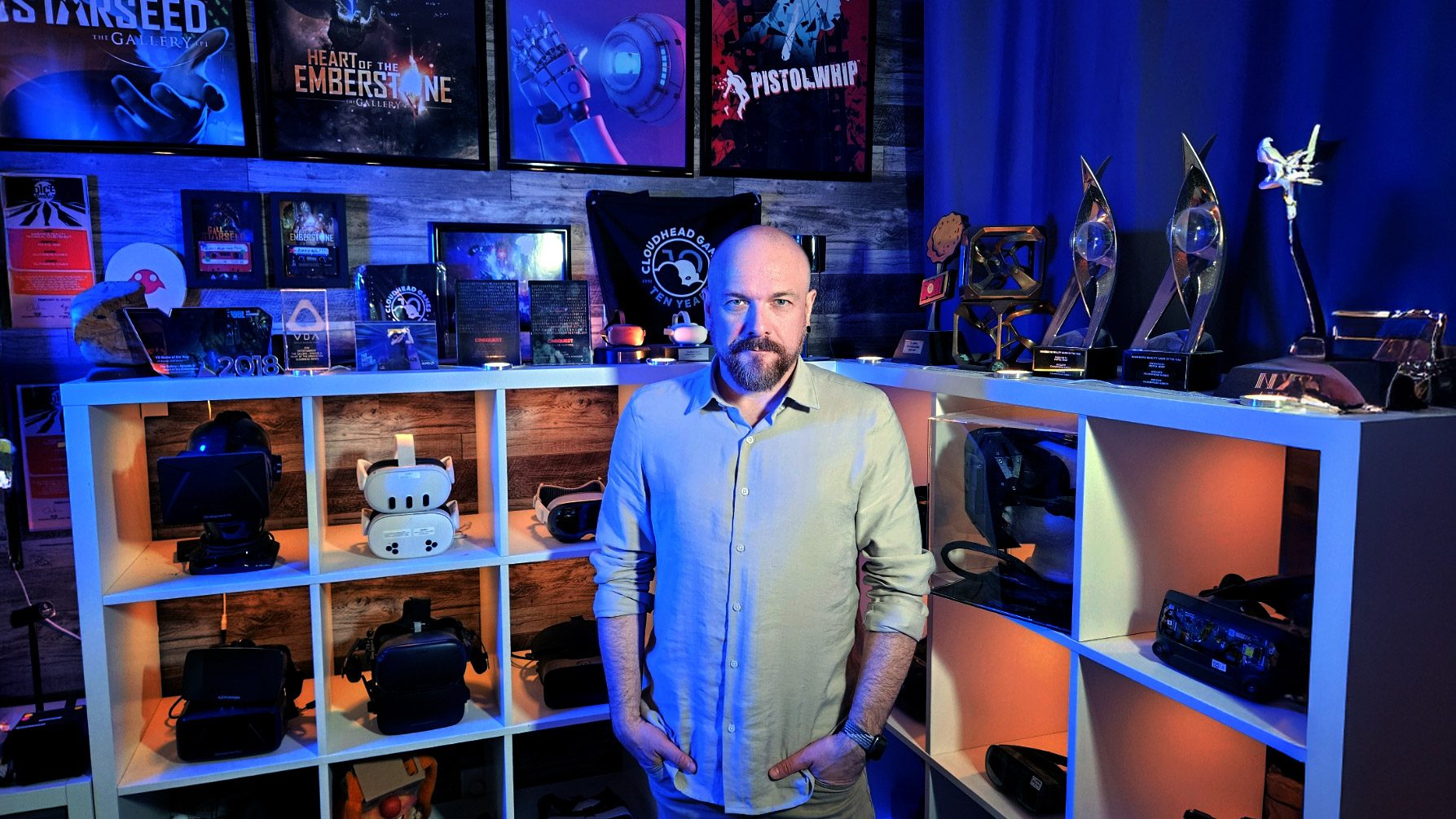
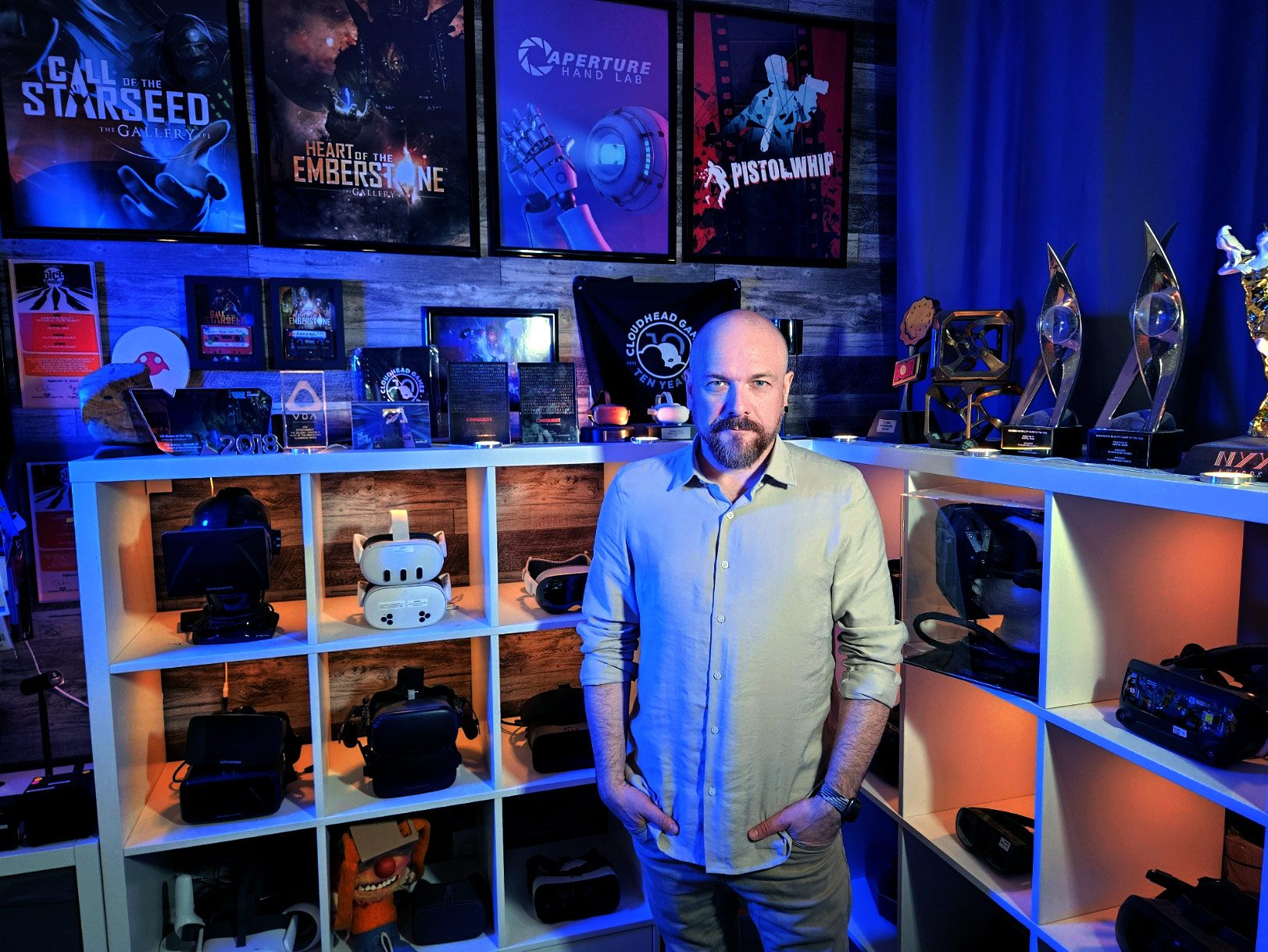
Denny Unger is CEO and Chief Creative Officer at Cloudhead Games, a 60+ person VR studio based in British Columbia and founded in 2012. Known for shaping foundational movement systems like Snap Turns and Teleportation, Cloudhead has worked closely with Meta, Valve, HTC and Sony while innovating broadly across XR. The studio is best known for the action-rhythm FPS Pistol Whip, alongside Aperture Hand Labs, Call of the Starseed, and Heart of the Emberstone, each exploring new dimensions in immersive storytelling and interaction.
Hi there! My name is Denny Unger. I am the CEO (and professional VR snob) at Cloudhead Games. I founded Cloudhead because I saw pure magic and unlimited potential in virtual reality. Since 2013, we’ve grown to 60 VR pro’s, formed deep relationships with the key OEMs, all while creating, innovating, and shipping multiple top-selling and award-winning titles. This year marks our 13th year, and from this vantage I’d like to speak in broad terms on the state of VR, its future and why it’s so important not to lose focus on this incredible medium.
VR’s Growing Pains
I’m going to speak to VR’s growing pains, but before I do, I think it’s important to point out that year-on-year, key competitors are spending more on XR development, not less. VR hardware development has shifted in branching and accelerated ways, but its overall fit within a broad consumer landscape has always been an act of pathfinding. I would also like to reinforce that the data clearly points to ‘games & gaming’ as the primary revenue generator in this market. Productivity and general ‘apps’ still haven’t found their footing, but there are important reasons for that.
The first ‘VR downturn’ was focused around glacially slow adoption in the PCVR market in 2018, after its 2016 rebirth. This was based on various points of consumer friction (cost, setup, and technical know-how, form factor, onboarding friction, and lack of content), generally minimal investments in studios/software, a lack of publisher interest, and a tech community fixating on the next shiny thing. Most VR studios just weren’t finding the support or margins they ultimately needed in this nascent market to build multi-year projects at scale. But in that very same year, Meta (then Facebook) introduced the Oculus Quest: a stand-alone VR headset that removed some of the biggest points of friction for consumers, and offered developers an outlet for more curated, high-quality content. This was further bolstered by significant growth with the launch of Quest 2 in 2020 against the backdrop of a world held captive by lockdowns and uncertainty. Our 2019 release Pistol Whip participated in this wave of success maintaining a top spot in the list of ‘all-time gross revenue’ earners globally.
VR was apparently booming, it outsold Xbox Series X|S, it was competing with consoles for the first time, and it was paired with some of the best VR content available.
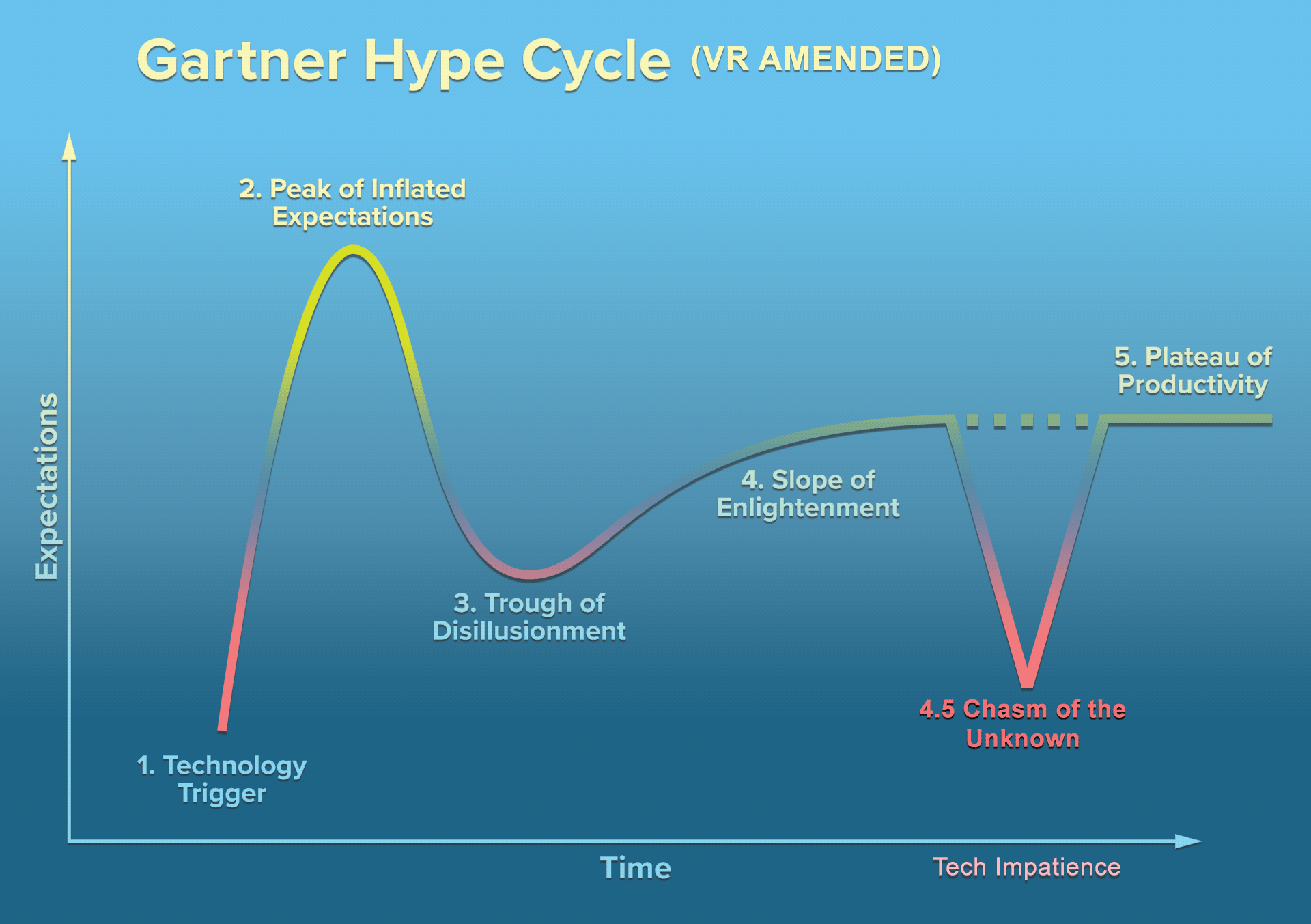
But from 2022 forward, VR’s climb up the Slope of Enlightenment appeared to meet a great Chasm of the Unknown, a slow but steady storm, predicated by a challenging global economy, a decline in consumer spending, layoffs and game studio closures, and a rapidly shifting investment focus towards AI over XR and Metaverse ambitions.
Technological Impatience
VR’s extraordinary ambition to penetrate into all human activities appears to be held back by a kind of technological impatience. To many of us working within the industry, XR is taking an appropriate amount of time to work out the kinks of this completely transformative new medium, bringing both hardware and software to a place which matches consumer expectations. But mainstream consumers, while very impressed with VR, remain skeptical due to critical points of friction (comfort, isolation, software ecosystem, utility, cost). I have often compared modern VR to putting on your shoes to go outside, in order to do X activity for 30 minutes. Humans have a tendency to opt for the lowest energy requirement possible, especially when it comes to their entertainment. So the simple act of donning a headset is often an additive point of friction, which in some ways is keeping current XR tech and form factors in limbo. This has profound relevance to our future approach to XR technologies.
So instead of the world-dominating technology we all thought it might be at this time, VR resonates most deeply with a market of core gamers, enthusiasts, and a growing youth segment, all of them willing to endure VR’s growing pains for the raw experience. And while that market is significant, it is in some ways antithetical to a broader mission where VR dominates at smart phone adoption levels. And more recent attempts to capture the market segments of Productivity, or even Media Consumption, are a challenge due to social isolation, long-term wearability, and mostly barren ecosystem choices.
All of this in turn has softened investment prospects and left a lingering question mark over XR’s future for those that are unable to see where this is all headed. Stay with me here!
Into the Chasm
The greater frustration for modern VR studios (of which there are fewer every year) lay between where we are now, and that ‘Chasm of the Unknown,’ which we must leap past in order to see VR’s true rebirth. The thing is, VR will become profoundly relevant when consumers are opting to wear a device which is comfortable for long periods, fashionable, and does ‘everything’ (no small order). A device that is your supreme portal to other realities, entertainment, work, education, and everything in between. Something you live with, and within.
But where does VR fit when we usher in this new age of malleable realities, and will there be enough VR studios around to meet the moment?
There has been a significant refocus around Augmented Reality, but this is just one complementary aspect required for a true ‘metaverse’ future. MR/AR is more narrowly focused on anchoring information spatially, as opposed to deeply exploring new realities, which is to say it’s part of a constellation of complementary ‘modes’ that will comprise future XR tech (Modal switching between Virtual Reality & Augmented Reality). MR/AR is great, emulating functions of your phone on your head is interesting, it’s just not that ‘sexy,’ and in isolation it is not a complete picture of our XR future.
So what, then, is the primary draw to XR? In some ways it might be better to think of Mixed Reality as a ‘gateway drug’ to VR. We can say one thing fairly confidently here with respect to how consumers interact with current XR tech: true awe generally doesn’t come from spatial widgets, it comes from spatial experiences that draw users into whole new realities which play into deep areas of wish fulfillment. So while our future certainly includes MR based applications, XR’s true ‘killer app’ is spatially aware, adaptive, replacive reality.
A Modal VR Future
Let me double down on that statement a little bit. I have always looked at the technologies evolving out of AR as a solution for VR locomotion and discomfort. When consumers are finally living with ‘all-day XR glasses,’ which can map their living or working spaces in real-time and allow them to dip in and out of VR and MR modally, users will begin to actively reskin their real-world environments (spaces, objects, people, etc.) to look and behave however they want. It won’t be enough to look at anchored apps against the backdrop of a dirty laundry bin or a sink full of dishes; consumers will customize their living rooms to be castles, resorts, Minecraft landscapes, etc. They will dine in the halls of gods and have meetings at the bottom of the ocean. Some may think it dystopian, but I believe the true Metaverse levels the playing field between the haves and have nots, allowing for a landscape of human activities in fantastic environments custom tailored to the user, or a consensual experience tailored to a group. It will eventually be done completely on the fly, and will likely be the true ‘killer app’ of future XR devices.
Lifeskin’ video by Reddit user Jesser722
But when users come down from their slightly hollow (but very cool), potentially ‘auto-generated’ fever dream, they will also crave high-quality, hand-architected VR experiences. Expertly crafted stories, games, Virtual Reality entertainment, from a human perspective which guides them on a journey of play and discovery.
Not-So-Hidden Opportunities
This is why it is so vitally important that the VR studios of today are supported and invested in over the next 5-10 years. Critical domain knowledge and unique skillsets have been mastered over the last decade, and yet the landscape of remaining VR studios face an existential risk. Building for VR is VERY different from building for traditional mediums, and we’ve cracked the code on many things that still aren’t universally adopted as best practices. A future without that domain knowledge, infrastructure, and experience will guarantee a poorly timed reinvention of the wheel, which could jeopardize the stability of the moment and longevity of future XR technologies. And that moment requires powered-up studios, content, technology, and investments, which can cover the entire spectrum of how users will want to interact with the technology. It will be a wide and deep breadth of augmentation dipping in and out of an increasingly malleable reality, where new experiences are just a click away. VR does not live outside of that future, it IS that future.
If you are on the edge of XR, directly invested in it, or frustrated by how long it’s taking, I don’t want you to miss out on potentially one of the biggest booms mankind will experience: an incoming cultural shift into unfathomable augmentation and customization of how we live our lives. The right device, the right software, the right investments, the right balance, all takes time. And at the risk of sounding like an entrepreneur…it won’t be long now.
Why VR?
I founded Cloudhead Games in 2013 because I saw pure magic and unlimited potential in VR. This was a technology which could literally take you anywhere, let you be anyone, could evoke powerful emotions, perspectives, and knowledge that was simply not possible in any other medium. VR was going to change the world, transform the entire media landscape, entertainment, training, education, and in many ways it already has (for those looking at the right places). I still very much believe in VR’s raw power, giving the average person limitless possibilities and potential. That’s how big it is and despite all reports to the contrary, it’s on its way.
Over a decade later, I for one can firmly say that VR is not dead, it’s just getting started!