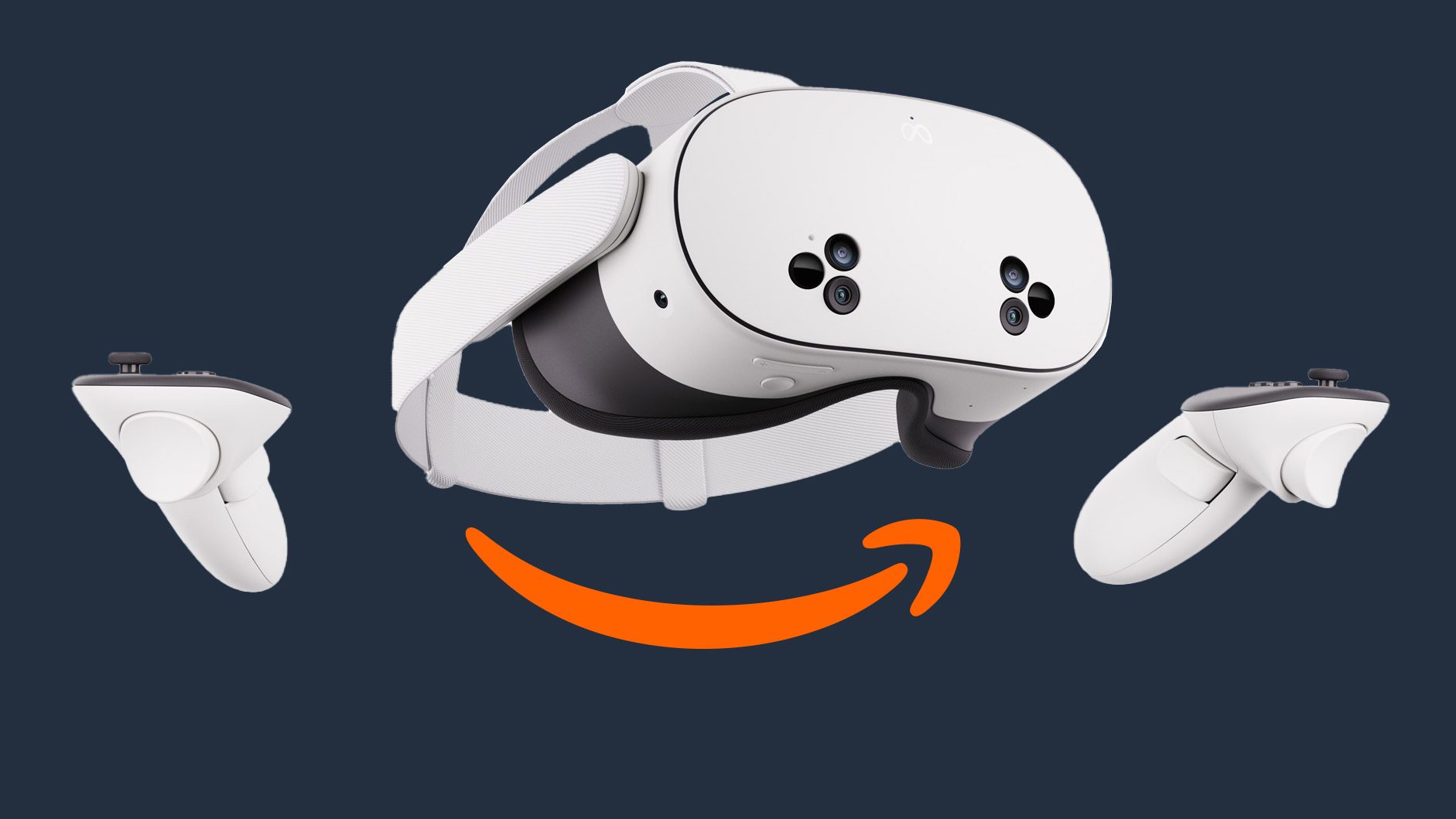
Meta Quest 3S Reaches Its Lowest Price Yet in Black Friday Sale

9

Meta Quest 3S is already getting Black Friday 2025 sales and Costco is offering the headset at its cheapest price yet.

Updated: November 28th, 4:00PM ET

We’re tracking the best Quest 3S Black Friday 2025 deals, check back for updates as sale season kicks off!

Can’t Decide between Quest 3S or Quest 3? Check out our no-nonsense recommendation right here.

Best Meta Quest 3S (128GB) Black Friday Sale: Costco – $200 (or $215 for non-members)

Note: this deal may be backordered but it’s still available. If you need your headset sooner, the next best deal on Quest 3S (128GB) is $250 from Amazon.

Deal Includes:
Deal Context:

Quest 3S (128GB) is usually $300. If you include the bundled content value ($60) with the deal, the effective sale price is $140 ($155 for non-members), which is a 53% discount (48% for non-members).

Best Meta Quest 3S (256GB) Black Friday Sale: Amazon – $330

Deal Includes:
Deal Context:

Quest 3S (256GB) is usually $400. If you include the bundled content value ($74) with the deal, the effective sale price is $256, which is a 36% discount.

Accessories, Games

If there’s already Quest games you’re planning to buy, Costco has another great deal right now: members can buy $100 worth of Meta Quest app store credits for $90.

Meta is running a big Black Friday sale for Quest games right now through December 2nd. Use code BFCM25 at checkout to get 40% off of any number of games in the sale section. There’s hundreds of titles to pick from, but here’s a smattering of our favorites, in no particular order:

And if you’re looking to equip your Quest with some added conveniences, there’s deals on official Quest accessories via Amazon and direct from Meta:

  • Carrying Case: $56 (MSRP $70) – AmazonMeta
  • Elite Strap: $56 (MSRP $70) – AmazonMeta
  • Elite Strap with Battery: $104 (MSRP $130) – AmazonMeta
  • Quest 3S Breathable Facial Interface: $32 (MSRP $40) – AmazonMeta
  • Quest Link Cable: $64 (MSRP $80) – AmazonMeta

This article may contain affiliate links. If you click an affiliate link and buy a product we may receive a small commission which helps support the publication. See here for more information.

Ben is the world's most senior professional analyst solely dedicated to the XR industry, having founded Road to VR in 2011—a year before the Oculus Kickstarter sparked a resurgence that led to the modern XR landscape. He has authored more than 3,000 articles chronicling the evolution of the XR industry over more than a decade. With that unique perspective, Ben has been consistently recognized as one of the most influential voices in XR, giving keynotes and joining panel and podcast discussions at key industry events. He is a self-described "journalist and analyst, not evangelist."
  • Christian Schildwaechter

    I have no idea how "accessible" Costco is in the US, whether this is an offer with limited units that may sell out instantly like the Quest 3S Xbox edition, or whether we will see more similar offers. But USD 200 is an insane deal. Meta sold tons of Quest 2 from April 2024 until their stock ran out by June, by dropping the price to USD 199, and despite everybody knowing that the Quest 3S with much faster hardware would arrive by October.

    Quest 2 already outsold the brand new Quest 3 severalfold during the 2023 holiday season due to a first temporary and then permanent price drop to 249. The final sub USD 200 final price allowed for a decent finish run for the by then more than 3.5 years old HMD, proving again that most Quest buyers are very price sensitive and less concerned with the latest specs.

    The Quest 3S is only a year old, still uses the most recent XR2 Gen2, and apparently won't be replaced before 2027, so this isn't Meta dumping existing stock, instead selling at significant loss. They stated several times that they sell their HMDs at cost, and there is no way they managed to reduce costs by 1/3rd within a year, esp. with RAM and flash prices currently going crazy thanks to AI sucking up all manufacturing resources.

    Assuming that a lot of people can get a Quest 3S at this price, it should guarantee a decent Q4 2025 for Quest HMD sales, even if they didn't release a new one this year like they did in 2024 and 2023. And maybe they can benefit from the current hype around the Steam Frame/Machine/Controller, reminding people outside of the VR bubble that VR (still) exists. Even if we don't know the price of Steam Frame yet, it will surely be multiple times that of a USD 200 Quest 3S. So this might be a great opportunity for a lot of people to finally give VR a try.

    • Rogue Transfer

      I've never seen Meta ever state that they sell their HMDs at cost. That's always just an assumption by people. In fact, Meta are very tight-lipped about how much the cost of their HMDs are – like nearly every company are.

      Tear-down estimates for component costs by third parties often show that the Quests are closer to their retail price than usual, but these don't account for mass component purchase deals that Meta likely have negotiated, driving down the overall costs per headset significantly.

      Perhaps, you can find an official source from Meta saying they sell HMDs at cost to prove your point?

      However, it is true that $200 is a very good price for the Quest 3S. Makes me wonder how long Costco will stock the devices for, as this quick a discount(after just a year on the market) suggests the devices are sluggish to sell and Costco wants to clear stock space for faster selling devices running up to Xmas.

      • Christian Schildwaechter

        We basically deliver our devices at cost or at a slight subsidy, or slightly more than cost in some cases. But the bottom line is our business is not primarily taking a premium on the devices. We want as many people to be interacting in there as possible. Part of that is having it be an open ecosystem that's interoperable.

        Mark Zuckerberg, 2022-07 in an internal mail, leaked to The Verge (paywalled), quoted here www_businessinsider_com/mark-zuckerberg-meta-sees-apple-as-metaverse-rival-report-2022-7

  • Nevets

    That's super cheap. It's around the price people who had been buying the dev kits hoped the Oculus Rift would cost prior to its release in 2016 (excluding the PC).

    • Christian Schildwaechter

      It's actually a lot less. The DK1 sold for USD 300, the DK2 for USD 350, with Palmer Luckey famously commenting "We're roughly in that ballpark… but it's going to cost more than that" on the CV1 price. So people expected USD 400-450, while Rift CV1 launched at USD 599 with a single constellation camera, an Xbox controller and no 6DoF controllers. Adjusted for inflation people expected USD 528-594, so almost triple of the insane Costco Quest 3S for USD 199, not even including the free extras.

      • Jonathan Winters III

        I remember that! was hyped for the promised price, and walked away when the real price was announced. Until it went down in 2018 thanks to FB's acquisition.

        • Christian Schildwaechter

          The purchase happened in 2014, the Luckey price quote is from 2015, but they apparently changed a lot after DK2 thanks to now having more money. This massively delayed CV1, which was supposed to ship just a few months after DK2 as a minor refinement, not a redesign.

          His statement may have still referred to the original plan, but they apparently miscalculated. They seemingly didn't intend to subsidize CV1 with Facebook money, but were sort of forced to after the HTC Vive also released in 2016 massively outsold the USD 600 CV1 plus USD 200 Touch cotrollers. They stepped on the emergency break in summer 2017, offering both CV1 and controllers in a USD 500 bundle, most likely sold at a loss, and haven't stopped selling at coat or below since.

          I'm sometimes wondering what would have happened if they had stuck to the original plan, sold a more DK2 like CV1 for USD 400 by early 2015, intended mostly to play regular PC games with VR modes/mods like Euro Truck simulator had already implemented by 2014. The whole VR market might have taken a different direction, more like UEVR today.

          • silvaring

            The question is was the priority always to sell to a big tech company like facebook, or did they want to go it alone? I.E what was the real 'original' plan of the company. I havent read the oculus book yet but its probably in there. What do you think?

          • Christian Schildwaechter

            Haven’t read the book either, but selling the company was most likely the plan to begin with. Not necessarily what Luckey had in mind when he build a DK1 prototype and planned to sell a few hundreds via kickstarter, but by the time DK2 shipped and Oculus was bought by Facebook, they had already collected about USD 90M in venture capital. And for VCs the exit strategy is pretty much always “sell the company with a huge markup”.

            And while a software company can organically grow, consumer electronics requires huge investments to reach the unit numbers where economies of scale allow to bring down prices. In 2016 the Rift CV1 was initially priced at USD 600 plus USD 200 for the Touch controllers released a few months later. And it sold a lot worse than the similarly priced HTC Vive, until Oculus dropped the price to USD 500 for both HMD and controllers combined in summer 2017. The initial USD 800 may have included a small margin, allowing the company to slowly grow, but the USD 500 most likely meant selling at a loss, something a small company simply cannot afford for a longer time.

            So they would either have had to stick to a higher price enthusiast market like Pimax today, which would have meant that HTC with money from smartphones selling hardware developed by Valve and paid for by Steam game sales would have eaten their lunch. But to establish themselves as a player in the VR market that back then everybody expected to grow a lot quicker, Oculus needed a lot of money. So either selling the company or at least partnering with a large partner with huge financial resources was pretty much inevitable, and selling very likely what the initial Oculus investors had in mind. Which worked out pretty well for them, the USD 90M invested in 2012 turned into USD 2B just two years later.

            In theory organic growth would have been an option, and Pico operated for several years with less VC capital (USD 87M) than Oculus had collected by 2014, until they were sold to Bytedance/TikTok for est. USD 700M. But they had the benefit of being in China with much lower costs, and entering the market years later, allowing them to mostly buy VR HMD components from Goertek and Qualcomm that Oculus initialy had to mostly develop themselves.