
New Reference Design From Key Manufacturer Shows What to Expect From MR Headsets in 2026

27

A Chinese company which mass produces many of the best known headsets in the industry has shared a new compact MR headset reference design which sets expectations for 2026.

Goertek is a little-known but massively important player in the XR industry. The company is a key enabler in the production of XR headsets as it provides reference designs which function as blueprints for consumer companies to build headsets, and handles mass production for some of the best known headsets in the industry.

At CES 2026, Goertek revealed its latest MR headset reference design. Reference designs like this act as a blueprint for any company that wants to put their own spin on the device and take it to market. Rather than a prototype—which might use novel materials or techniques that aren’t yet mass producible—reference designs like this represent a fully functional set of ready-to-manufacture components with tangible costs and delivery dates.

There isn’t a lot of info available on the reference design yet, except what has been officially stated by Goertek:

An Ultra-Lightweight MR Reference Design showcases system-level optimizations, reducing the weight of a 4K MR headset to approximately 100 grams. It delivers retinal-level clarity (38 PPD) within a 100-degree field of view, with Video See-Through (VST) and 6DoF [tracking].

We’ve reached out to Goertek for details, but in the meantime many questions remain.

Considering the incredible 100g weight of the headset, it seems almost certain that this reference design does not include on-board compute or battery. For comparison, Quest 3, even with a soft strap, weighs in at 515g.
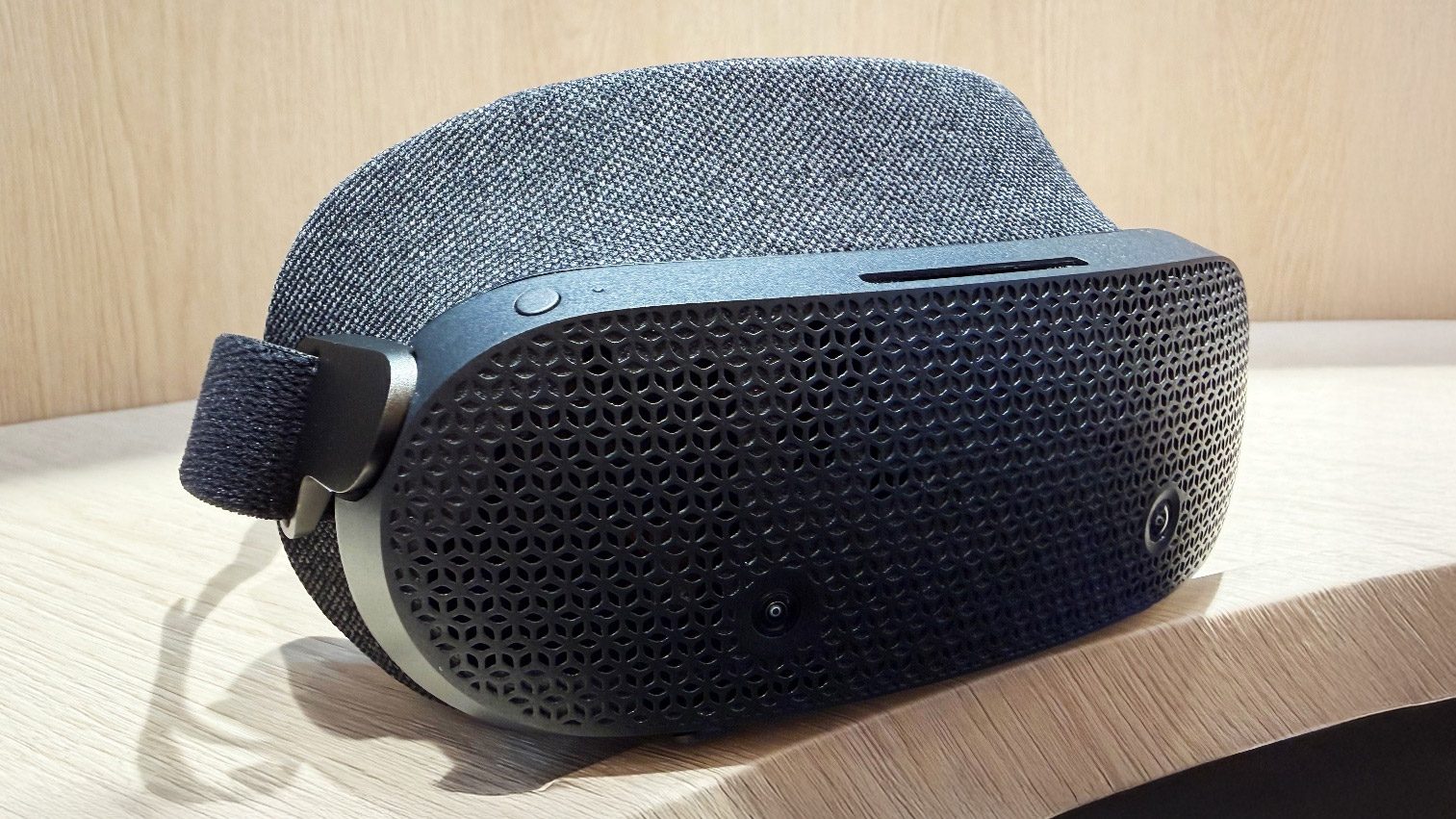
Image courtesy CNFOL

That means the headset would need to rely on a tethered compute/battery pack, or some other host device, to function. This would follow the trend of headsets like Vision Pro and Galaxy XR which both offload the battery weight to a tethered battery.

SEE ALSO
VR Design Unpacked: The Best Shotguns in VR (and what makes them feel great)

Adding to the confusion, Goertek calling the headset an “MR reference design” would generally be understood to mean a standalone device, but in the one photo we’ve been able to find of the device in use so far (courtesy CNFOL), it appears to be part of the company’s “PCVR Software Suite” display station, and looks to be tethered directly to the PC in front of the user.
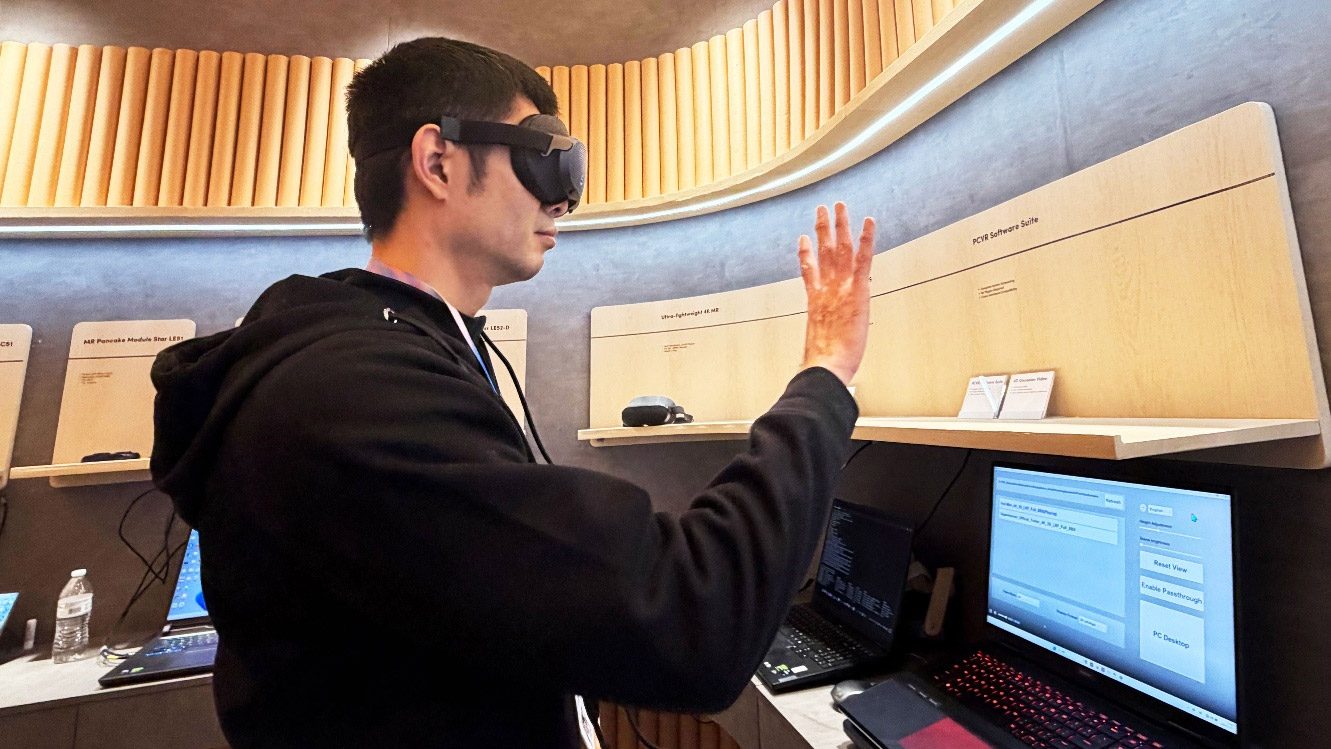
Image courtesy CNFOL

In any case, the reference design shows us what kind of resolution and field-of-view can be expected from headsets in 2026 with this compact form-factor, even if the design doesn’t have its own compute/battery.
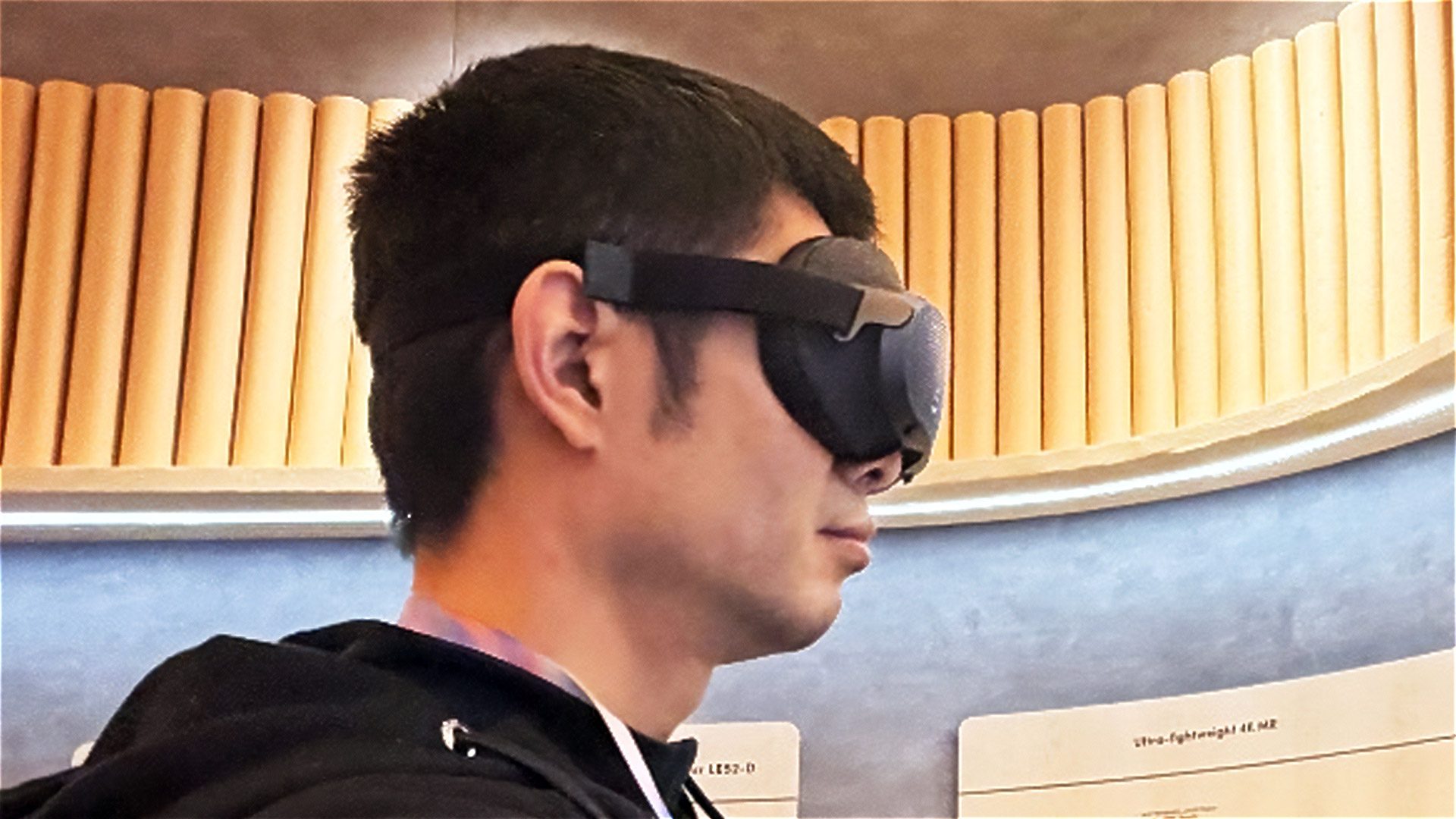
Image courtesy CNFOL

Likely the reference design is meant to show the form-factor while leaving it up to customer companies to decide if they would bring it to market as a standalone or tethered headset.

This article may contain affiliate links. If you click an affiliate link and buy a product we may receive a small commission which helps support the publication. See here for more information.

Ben is the world's most senior professional analyst solely dedicated to the XR industry, having founded Road to VR in 2011—a year before the Oculus Kickstarter sparked a resurgence that led to the modern XR landscape. He has authored more than 3,000 articles chronicling the evolution of the XR industry over more than a decade. With that unique perspective, Ben has been consistently recognized as one of the most influential voices in XR, giving keynotes and joining panel and podcast discussions at key industry events. He is a self-described "journalist and analyst, not evangelist."
  • fcpw

    fabulous- headsets cannot be too light.

  • Christian Schildwaechter

    TL;DR: There is need for an open source alternative to Google's Android XR spatial features for Goertek's and Qualcomm's current XR HMD boutique shop business model to continue working.

    I'm not sure if Goertek already released their own reference designs in the past, as up to now they always partnered with Qualcomm to produce their reference HMDs. These were usually packed with tech and rather expensive, more a showcase of what is currently possible, not necessarily feasible at a reasonable price. And most released HMDs were clearly based on these Qualcomm/Goertek reference HMDs, but often with less sensors/cheaper displays to reduce cost.

    What would be very interesting to see is what software stack this new reference HMD was running. In the past Qualcomm/Goertek offered a complete OEM solution with not only all the hardware components plus production and even handling shipping to consumers, but also a ready-made OpenXR stack on top of their own XR OS based on the open source version of Android. This allowed small vendors like Play for Dream to release their own standalones even without the development budgets of Meta.

    But Google now went and locked Android XR behind their Google Play services, forcing vendors to use the Play store and shoving all software revenues to Google. And Play services aren't available in China in the first place. In the past that wasn't that much of an issue, as for games the OpenXR stack combined with Unity support for generic Android and VR was mostly enough to allow easy porting from other platforms like Quest. But with MR and productivity apps, you need deeper intergration for running flat apps etc., and there is no open standard comparable OpenXR to do this.

    These features are essential for use beyond VR, which is why Google put them on a closed license, cutting off all the HMD manufacturers that relied on the open source Android version so far. But these spatial integration tools make up only a small part of Android XR sitting on top of regular Android as an extension. Most of the features they showed on Samsung's Galaxy XR were about intergration with Google apps and Gemini.

    So a third party could come up with their own, open integration layer to counter the closed versions from Apple, Google and Meta (with their Spatial SDK for Quest), leaving out all the Google AI integration parts. And the third party most interested in this would be Qualcomm/Goertek, as this would allow them to continue being the one stop solition for anybody wanting to release a new HMD anywhere without being bound to Google.

    AFAIK Goertek will also produce the Steam Frame, which will run SteamOS, and can run regular Android apps via Waydroid. Valve has shown little interest in MR so far, so they won't offer their own APIs for flat app integration, but other vendors wanting to release HMDs based on SteamOS might be very interested in that option to add a unique selling point and better compete with Android XR/Horizon OS HMDs, so Qualcomm/Goertek offering their own free Spatial SDK could make it standard across both (the open source) Android and SteamOS.

  • Looks like they've got the headset down to about as small as it needs to be. Now they just need to get everything else up to spec and we're golden.

  • XRC

    "It delivers retinal-level clarity (38 PPD)"

    Goertek might want to adjust their pr, retina resolution is considered 60pd (1 arc minute)

    i can think of one PCVR headset from Pimax (Super 57ppd) that is almost there…

  • Dawid

    I hope that 100-degree FOV from this reference design can be changed to something slightly wider by companies using it.

  • Sofian

    They ll need to make the cable as light and flexible as possible.

    • Andrew Jakobs

      No, they should not bother with a cable at all…..

      • foamreality

        I've had many issues with various headsets but honestly having a cable teathered to my PC is WAY down the list of issues with VR for me. Unless you are using MR/Spatial apps I don't see much need for wireless for VR, the headset needs to be close to the PC anyway. And wireless needs charging constantly – which a cable relieves the stress of.

        • Andrew Jakobs

          I hated the cable on my vive pro, I hated the cable on my 'wirelessmodule' for my vive pro, and I never looked back once I bought my Pico 4, which I actually only bought for testing something, never thought it would be my main headset, just picking it up and play was such a lower treshold as having to deal with the battery cable of the vive pro (including having to turn on the base stations and extra software for the wirelessmodule.).
          and I'm not using ANY MR/spatial game, only VR.
          Yes charging is the only gripe some times with longer playtimes, but even for that you have comfortable headstraps with hotswappable batteries from third party, especially with the Quest 3 which doesn't come with a decent headstrap.
          and with my vive pro/wirelessmodule I had a battery which lasted for 6 hours playtime, which I could extend if needed with 3 hours with the original battery which came with the module. But I think 5.5 hours of VR (Obduction) was the longest session I played in one go till date wireless..
          so certainly anything tethered to the PC is something I really will never buy, tethered to a battery I would only consider once a headstrap with built in/hotswappable battery is available

        • kraeuterbutter

          Why ? why needs the headset to be close to the PC ?
          i use my Quest3 for wireless PC-VR:
          i have a 50qm livingroom with 18qm empty space i can use for vr…
          my PC is in the büro, 4 rooms away..
          i have LAN in all rooms..
          i plug in my Router in the livingroom for the quest3 (only the quest3 uses this accesspoint)
          and: voila.. PCVR in the livingroom..
          when the Livingroom is occupied by wife or children:
          i go in ont he balcony or one of the childrens room, take the accesspoint with me, plug it in..
          and: voila: PCVR
          the room (büro) where my gaming PC is placed, is the room with the least amount of playspace-area
          i use VR directly in front of PC mostly for Flightsim and Racingsim (so sitting VR)

      • xyzs

        What is this toxic stance.
        You may prefer playing your ugly android wii level games on your quest, but stating that cables should be entirety dismissed because YOU don’t use them is so selfish…

        I have a quest 3 and a pcvr headset, the one taking the dust is the quest 3 in my situation. It’s never out of battery, it’s much lighter, it starts in 2 seconds, doesn’t heat, stuff that standalone won’t match for 20 years.

        • Andrew Jakobs

          Yeah, but it has a f-ing cable.. never again will I ever want to deal with a cable to a PC for a VR headset.

      • JanO

        While I agree that untethered is the way to go, this isn't it. For this to be standalone, it would need a battery and all the compute required to do the streaming and last second image warp adjustment, meaning it would have the same hardware as any standalone HMD… And the added weight to go along…

    • NL_VR

      Im and many others are not interested in cable only headsets

      • Sofian

        You can have the compute unit and the battery in the strap, but the direction things are going is clearly not what you want.
        I think that the display should be a separate unit, just like a monitor so I am fine with what Goertek is doing.

        • NL_VR

          I dont want to be connected with a cable tona PC or something. I choose wireless connection

      • Wifi Streaming with Virtual Desktop works GREAT! I don't understand people talking about PCVR and cables in the same breath. There's no good reason to use cables when the Wifi streaming with a Quest to computer works so well.

        • NL_VR

          Yes I agree, i can understand to infinite play and dont have to rely on batteries but its solvable wireless also by hotswapping extra batteries.

  • JanO

    With a 500g HMD, we can already feel when we are wired VS when we are wireless… Just imagine how badly you will feel the cable pull on a 100g HMD..!

  • polysix

    no more standalone shit please. VR will remain a novelty while it's driven by shit-chips.

    • Andrew Jakobs

      No it won't, mobilechips get better and faster every year, bigger problem is they put older chips into these headsets. It's actually these standalone headsets that's moving VR forward, not the tethered PCVR headsets which require very expensive GPU's. It will actually stay a niche/novelty if they stop with standalone headsets as most people can't afford the needed highend GPU's. And now with even memory prices blowing up, a highend even midrange PC really has become very expensive.
      anything terhered is actualjy the death of VR.

      • Seth Alpine

        What is the real cost of a PCVR device against a stand alone one…?
        The estimated price for 2x4K² displays in 2026 is $450.
        often (Pimax dream Air by example) use a simple (and unsuitable) DP1.4 video controller (not even a 2.1), pancake lens 70$, a few cameras 90$ and other minor components. So under 1000$…
        A stand alone device add battery 20$, high end GPU/CPU 240$, or mobile GPU/CPU 100/150$, wifi module…
        Nevertheless…
        The next stand alone Pico 5 will be cheaper than a Dream Air from Pimax
        A very good stand alone device, without requiring a PC…( if you don't want to play PCVR immediately )seems to me..A better choice…

      • Christian Schildwaechter

        Hence the Steam Machine. We don't know the price yet, and RAM prices might still mess it up, but this is Valve's solution for top of the line mobile GPUs trailing their desktop counterparts by roughly a decade in performance, and standalones being limited by battery life/weight. That won't change anytime soon, there is only so much you can do with a 10-15W TDP.

        The Steam Frame itself will run Steam x86 VR games at about the same speed as a Steam Deck locally, draining the battery in about an hour. When paired with the Steam Machine, you will get more like 4h of runtime and 6x the performance of the Steam Deck from a 15cm^3 cube, with basically tether-like latency thanks to foveated streaming, and improved performance in games that also implement foveated rendering. And all that for less than you'd pay for a Play for Dream or Samsung Galaxy XR, each of which features a processor slower than the one in Steam Frame itself (but also very nice and expensive 4K microOLED displays).

        My guess is that the USD 600 + 600 rumors for Deckard pricing was what Valve had initially in mind, though I seriously doubt that they will now be able to match that. For the time being USD 1400 or USD 1600 for Frame plus Machine seems more realistic. They went with somewhat weaker PC hardware and an LCD HMD featuring an SD 8 Gen 3 that will be almost 2.5 years old when Frame releases, all to reduce cost, with the special Valve magic being the extreme low latency thanks to eye tracking and foveated streaming, for a hopefully well balanced 2K VR experience.

        This could makes the Steam Frame plus Machine a rather interesting alternative to pure standalones, esp. for those not already owning a fast gaming PC, and obviously a lot more affordable than pairing a 4K standalone with a PC capable of rendering that high resolution for probably USD 5000+ combined. The Steam Deck has proven to provide an extremely hassle free gaming experience, much closer to a console than any Windows PC ever has, so it's reasonable to also expect the Steam Machine to just sit somewhere in your living room, connected to a TV, and creating an instant connection to your Frame whenever you feel like hopping into one of the many PCVR games available on Steam. The combo will provide more performance than any non-Apple standalone will offer for many years, all while keeping the weight low, the battery life high and the cost at moderate levels without creating any system administration issues. Plus you get a free living room console as part of the deal that can be filled during the next Steam sale.

      • I disagree. These mobile based games are.. ok, some are clever with using limited hardware, but it's the PC gaming extremists who buy the nice toys.

        The mobile based games get used as another baby sitting device. The community their attract is cheap, and wouldn't even exist if Facebook wasn't subsidizing cheap headsets. Gorilla Tag isn't the future of VR, its the future of childcare.

        With Facebook pulling out, headsets will go back up to their more legitimate prices, well over $500. So the only people playing are going to be the PC gaming "master race". Mobile gaming is going to DIE without subsides to keep the cost under $500.

        So PCVR is the ONLY future for VR now. This will remain true until either some MASSIVE company is willing to take billions in loses by selling a headset below cost, or the tech gets SO CHEAP, a company can make money with a sub-$500 headset. (which has NEVER HAPPENED TO DATE)

        If Facebook is really done with Oculus, they should sell it back to Palmer Luckey.

        • Andrew Jakobs

          Nah PCVR isn't the only future, especially not with the absurd prices these times. I was planning on buying a new PC as I'm still on a core i7 4770/RTX2060super, and I would have bought one last summer but I didn't need one back then, but now the same PC I had in mind has risen over more than 1000 euro's in price, so I won't be buying a new one any time soon, at least not one with a decend VR capable GPU.
          for mainstream, standalone is the future for VR.

  • Bram

    A future reference design shouldn't take us back in time. A FOV of 100 degrees is not acceptable anymore in 2026. Even with micro-oled panels, a company like Pimax has proved you can squeeze 110FOV out of it with the right lenses and still keep a small form factor and a reasonable binoculair overlap with their dream air model. Any light and small formfactor is not an excuse anymore to compromise FOV. Although some users maybe don't mind, for most users small FOV is a too much of a limitation of the overall experience. 110FOV should be the very minimum from now on.

  • Ok, fine. No compute onboard. But give us WiFi streaming. That's my 2nd most favored way to use my headset, by logging into my gaming machine via Virtual Desktop over WiFi and playing PCVR games.