

Why One of VR’s Most Valuable Companies is Shutting Down, According to Top Creator

2

Social VR platform Rec Room, once valued at $3.5 billion, announced earlier this week that it will be shutting down in June. The studio says it never quite figured out how to turn a profit, though top avatar creator blueasis maintains the story is a bit more complicated.

If you’ve ever seen the weird little VRChat avatar ‘Brush the Marmoset’—a staple of Internet memes since 2020—you’re likely already familiar with blueasis.

While they’re one of the OG 3D character and environment artist on VRChat, they’re also the top creator on Rec Room, which gives them a fair bit of insight into why the platform’s decade-long existence is soon coming to an end.

Image courtesy blueasis

As one of the most well-funded VR companies to date, the Seattle-based studio attracted over $294 million since its founding in 2016. Its most recent round came in December 2021, bringing to the company $145 million and briefly giving it a $3.5 billion valuation.

Despite its popularity and enviable startup runway, the company said earlier this week it “never quite figured out how to make Rec Room a sustainably profitable business. Our costs always ended up overwhelming the revenue we brought in. We spent a long time trying to find a way to make the numbers work.”

SEE ALSO
Quest Reached Record Number of Users in 2025, Pushing 100 VR Apps Over $1M in Gross Revenue

In a thread on X, blueasis gives an insider perspective on why they think Rec Room is closing up shop. In short, it wasn’t a bad creator economy or lack of returning users; the company just sort of … bungled things.

“I joined Rec Room 1.5 years ago to participate in their avatar cosmetics program,” blueasis recounts. “I made lots of items (2000~) honed my craft, became the number 1 seller on the entire platform, met awesome creatives & talked directly with the team.”
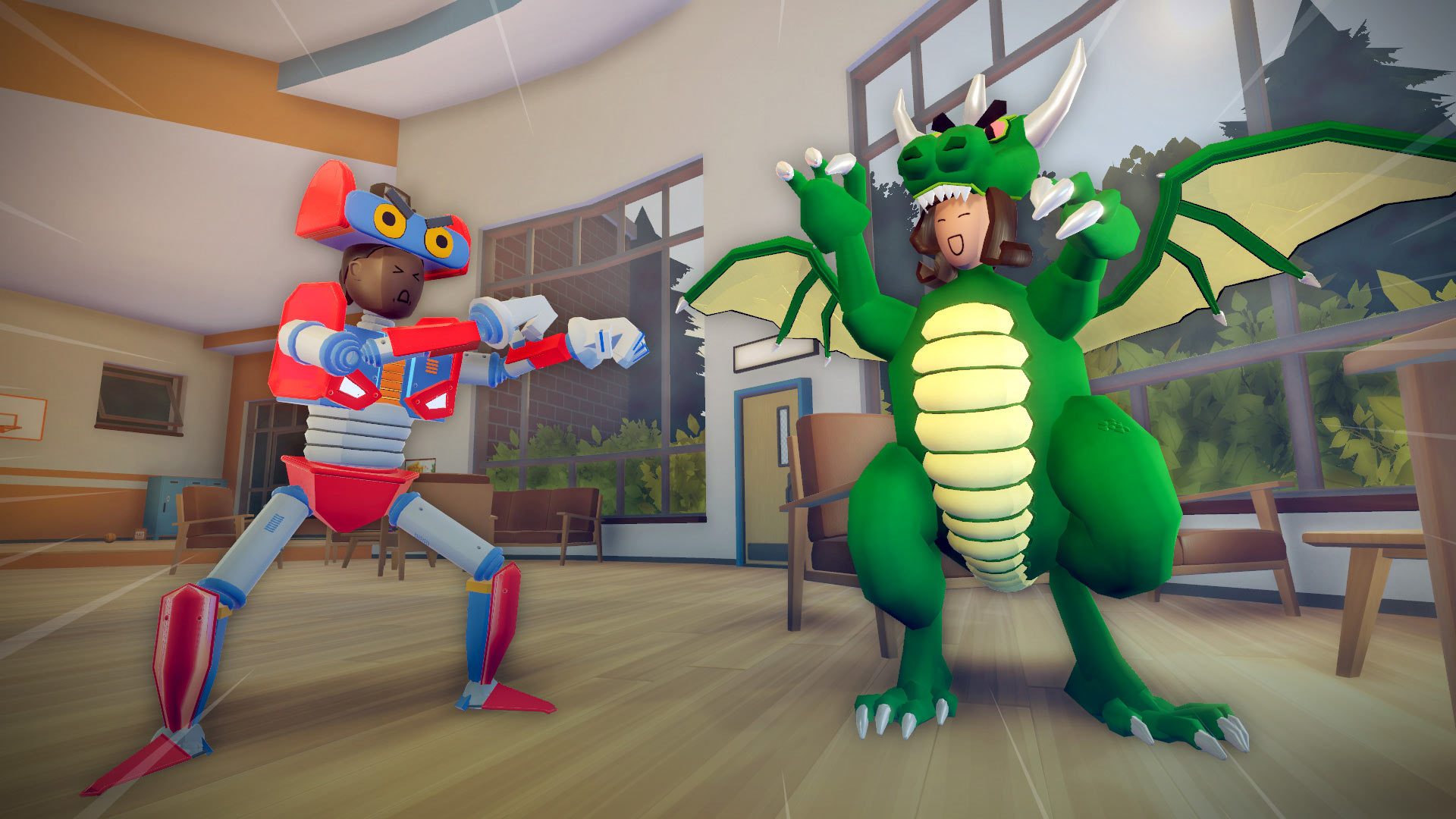
Image courtesy Rec Room

“My estimation of the shutdown; overhiring during the covid boom, making promises they couldn’t keep, continually gambling on new players & tech before focusing on the core experience & existing players.”

Having joined in late 2024, blueasis says it was “immediately obvious that the community was unhappy.”

“Spending so much money on player acquisition, mobile, console etc, with little to no payoff, these users rarely became creators, rarely spent money on the platform etc. The people who cared about the platform, PC, VR, did! but they were neglected in favor of ‘growth’.”

SEE ALSO
New Reference Design From Key Manufacturer Shows What to Expect From MR Headsets in 2026

It was ostensibly that gamble to push for rapid expansion that ultimately tipped the studio into its first big tailspin: in August 2025 the company laid off around half of its staff, citing costs related to a surge in low-level content flooding the platform from users on mobile and console.

“I think by the time they realized this it was too late, the numbers were already dire, so they had to keep trucking along in any direction that would make them revenue, which just meant more gambling new features to hope something stuck, AI pet chat bot was a big one people hated.”

Blueasis says the platform’s push for user-generated avatar cosmetics was “their biggest success,” which they reveal accounted for 60% of player spend, “outselling Rec Room original items by 10x.”
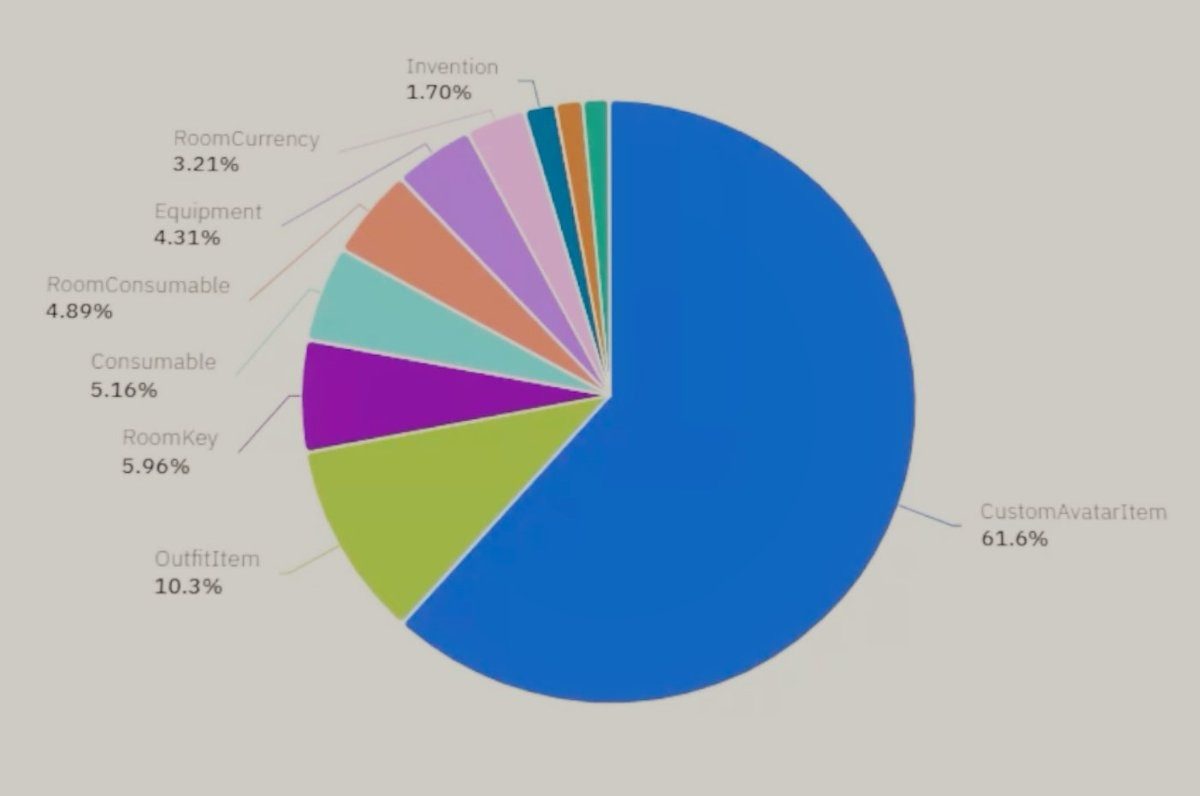
Rec Room platform sales breakdown | Image courtesy blueasis

In September 2025—notably just one month after laying off half its staff—the company announced it was paying out more than a million dollars per quarter to creators. That’s a lot of money coming in, a lot leaving into the hands of creators, and surprisingly little captured by the company.

Blueasis highlights the popularity of the UGC avatar cosmetics program and its outsized share of player spend, although the platform’s modest rake on creator sales may also be a big contributing factor.

While the company retains 70 percent revenue after paying platform fees on first-party content, when it comes to UGC, Rec Room only takes a 30 percent rake. This leaves creators with the bulk of the revenue, meaning Rec Room retained far less from top-selling items.

In the end, low fees are usually a powerful tool to help acquire an initial userbase. But they aren’t a lasting strategy, especially when new users aren’t contributing to the ecosystem in a way that offsets costs. And it seems the studio got interminably stuck in that dangerous gap between aggressive user acquisition and eventual platform stability—and just never managed to climb out.


This article may contain affiliate links. If you click an affiliate link and buy a product we may receive a small commission which helps support the publication. See here for more information.

Well before the first modern XR products hit the market, Scott recognized the potential of the technology and set out to understand and document its growth. He has been professionally reporting on the space for nearly a decade as Editor at Road to VR, authoring more than 4,000 articles on the topic. Scott brings that seasoned insight to his reporting from major industry events across the globe.
  • Christian Schildwaechter

    TL;DR: Hindsight is 20/20. A lot of these stories end in "if only they had focused on their core audience", but neglect to see that this wasn't necessarily an option.

    Many VR companies got financing based on the expectation that the market would continue to grow, with several hot phases around 2016, when the first consumer HMDs launched, around 2020/2021, when Meta had a big success with Quest 2 that seemed to launch mainstream standalone VR, and again in 2023, when Apple announcing the AVP seemed to open a new high margin productivity XR market.

    The nature of VC capital is that a few spectacular success stories have to pay for a lot of duds. So on average out of ten investments, seven simply fail, two turn into zombies, and one makes enough money to still make an overall profit. The interesting parts are the zombies, companies that make enough money to survive on their own and become profitabe, but don't make back their initial investment, at least not in the expected time frame.

    So Rec Room might have become a zombie if only they hadn't expanded outside of VR to draw in more users. But that's not really an option for a VC financed startup, as the investors only care about the stellar successes. That may seem cruel, but VC is always about high risks bets. If you want to slowly grow your business in a sustainable way, you talk to a bank about loans, not VC investors about money they may never see back.

    Lots of VR investment was venture capital, and the big bet was VR taking off. With that not happening, the odds to still win the bet got pretty slim, making companies look for more growth opportunities, which almost inevitably ends up with mobile with billions of active users. And for a time it seemed you had to design games to work on both mobile and VR to even have a chance to make your money back. Not only Rec Room tried this. Mighty Coconut, one of VR's few huge success stories, recently shut down their mobile activities for Walkabout Mini Golf, and even Meta first added mobile to Horizon Worlds, then cut off VR from further development altogether, because HW on mobile did much better.

    If you are a small studio without the ambition to grow more into AA territory, the current size of the VR user base may be enough to pay for a series of releases, but you'll have to make sure that you'll survive a market shrinking further once an unsubsidized Quest 4 sells in much lower numbers, or even more users go for F2P instead of buying games. If you want to do larger project, like the ones many VR enthusiasts are looking for, and you don't already have a huge financial war chest or second source of income that doesn't demand massive growth, you are in trouble.

    So a lot of the hindsight discussion on why a VR company failed and how it was their strategic decisions that doomed them misses some very important points. They made expensive bets on VR, and VR didn't deliver the growth that would be required for investors to still be interested. VCs of course try to get back as much money as possible even from failures, usually by selling the technology or assets to other companies. This happened with Rec Room too, with Snap picking up some pieces, but not the social platform losing money. What VCs basically never do is switch their business model and just keep zombies around, allowing them to concentrate on a small core user group that could keep them afloat and might eventually make them profitale. If you take high risk money, you either deliver lots of quick growth, or you die. And good luck getting money for VR ventures from a bank that in principle might be fine with you slowly paying back a loan over 20 years.

    • blueasis

      I did not neglect that it wasnt an option. i understand why they made the choices they did; this is more of a post-mortem for other platforms to heed the warning when and where they can