
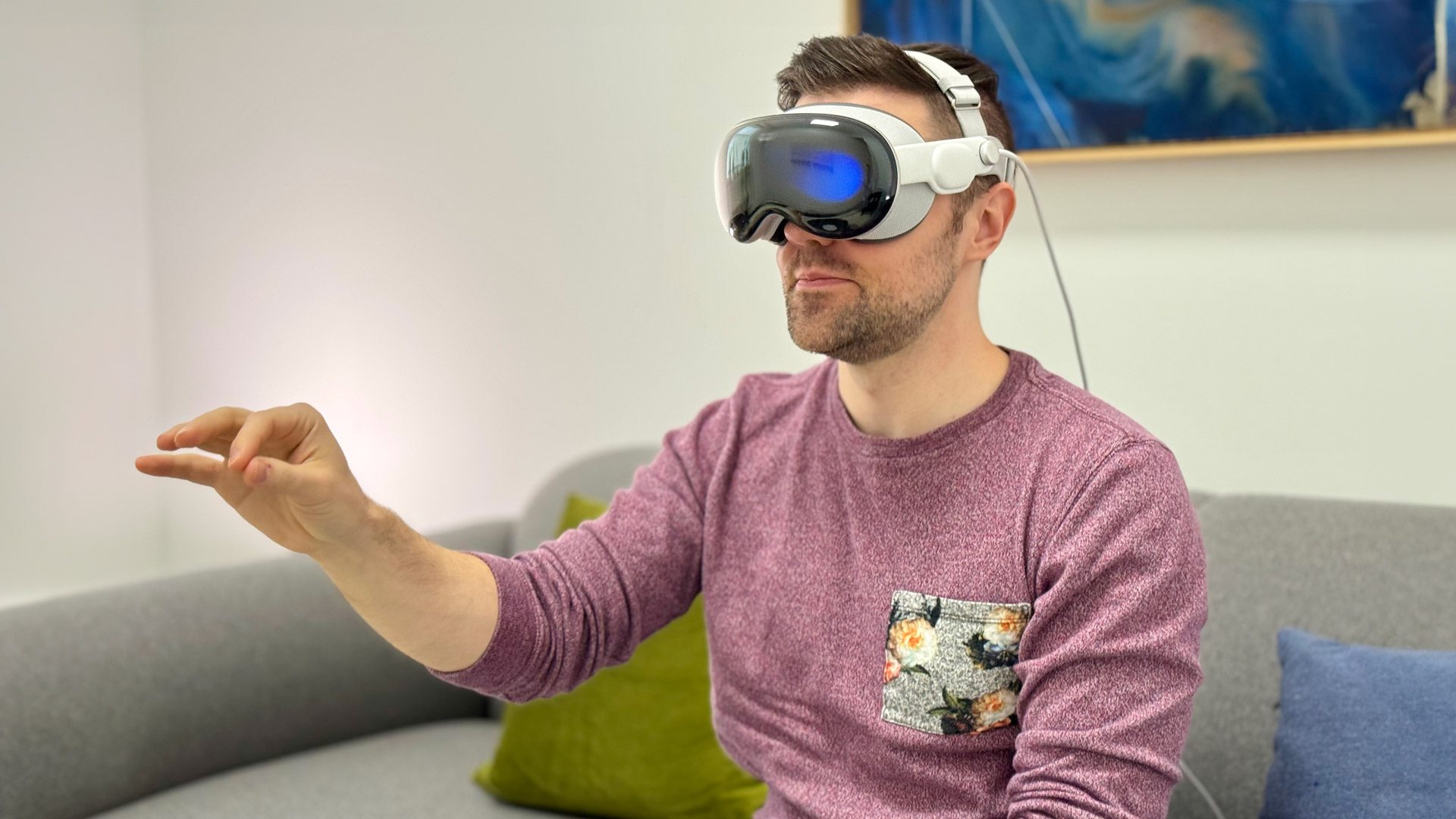
Apple Code Suggests M5 Hardware Refresh of Vision Pro Could Come Later This Year

7

Code shared by Apple and discovered by MacRumors has seemingly confirmed that Vision Pro isn’t getting a massive overhaul in its next generation, instead pointing to a hardware refresh that will feature Apple’s upcoming M5 chipset.

This follows previous reports from last year, including those from independent analyst Ming-Chi Kuo and Bloomberg’s Mark Gurman, that suggested Apple was getting some flavor of Apple’s M-chip in its next release; Kuo reported it was M5, and Gurman reported M4.

Additionally, MacRumors reports that the refreshed Vision Pro “isn’t expected to feature any design changes or hardware updates aside from the new chip,” although it could feature a new, more comfortable head strap.

Considering Vision Pro might include the company’s flagship mobile chipset, we probably shouldn’t expect it to be any cheaper than the original, which went on sale in February 2024 for $3,500, and included its older M2 chipset, which was released in June 2022.
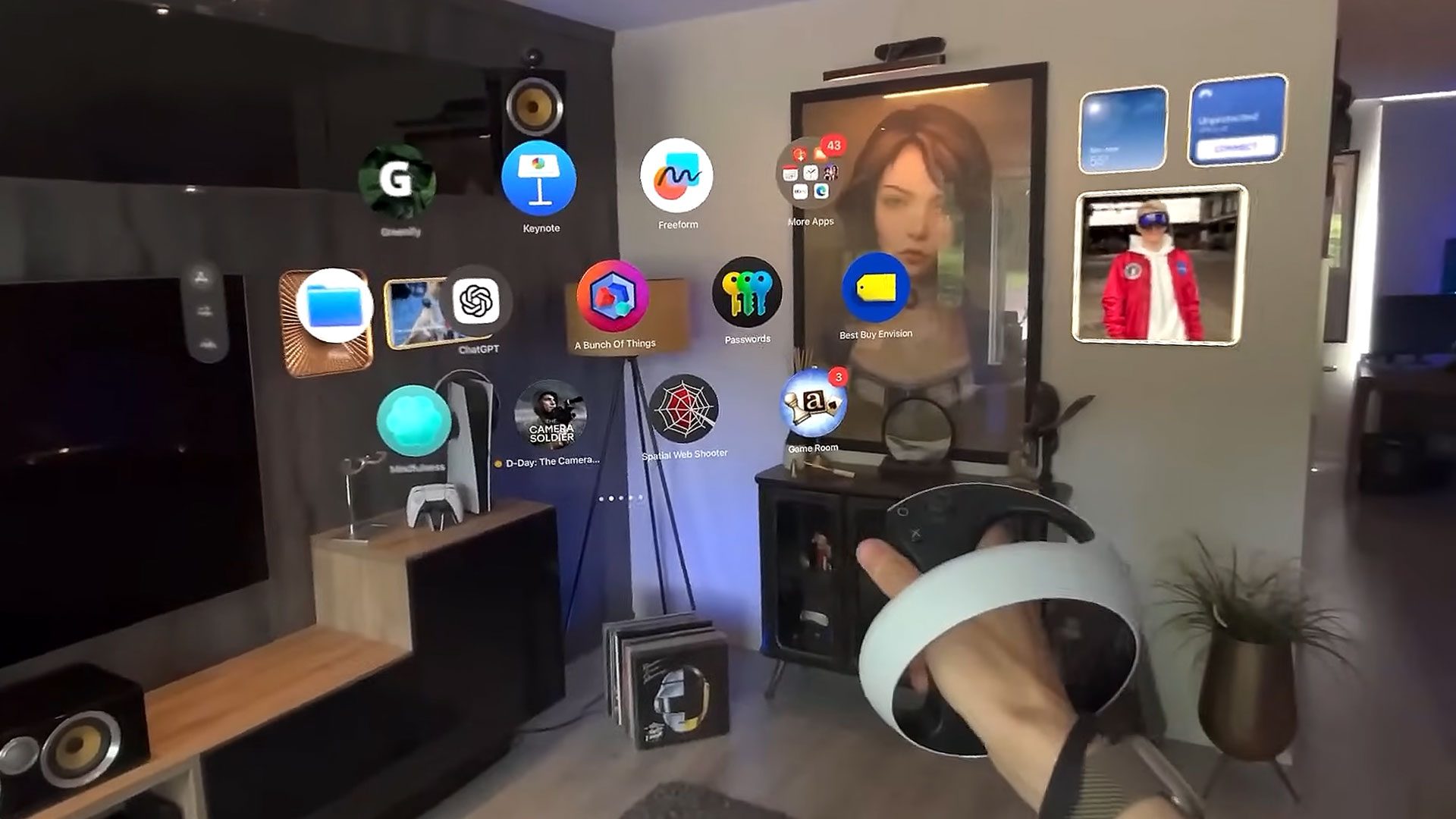
Vision Pro officially supporting PSVR 2 Sense Controllers | Image courtesy Nathie

Notably, in Kuo’s report from late 2024, he suggested a cheaper version of Vision Pro was delayed “beyond 2027”, which conflicted with an earlier report from The Information in mid-2024 that alleged Apple was on track to release something more affordable first, and then release a more powerful Vision Pro 2 at a later point.

And while releasing an M5 refresh of Vision Pro could be seen as ‘kicking the can down the road’ somewhat, having Apple’s latest and greatest chipset may be a bigger deal than might think.

SEE ALSO
Hideo Kojima's Studio Partners with Niantic Spatial on Enigmatic AR Game of the "near future"

Besides better overall performance, M5 would effectively be the most powerful standalone headset to date. It would allow XR developers to not only port previous controller-focused games to the headset, thanks to official support for Sony’s PSVR 2 Sense controller, but also develop even more visually rich XR games and apps for the device.

It also effectively aligns Vision Pro with Apple’s core products for the first time. Apple’s M5 is also reportedly coming to iPad Pro, Mac mini, iMac, and MacBook Pro, which would let developers build apps that perform consistently across its latest devices—maybe even including things like access to desktop-class apps running natively on the headset, such as Final Cut Pro.

This article may contain affiliate links. If you click an affiliate link and buy a product we may receive a small commission which helps support the publication. See here for more information.

Well before the first modern XR products hit the market, Scott recognized the potential of the technology and set out to understand and document its growth. He has been professionally reporting on the space for nearly a decade as Editor at Road to VR, authoring more than 4,000 articles on the topic. Scott brings that seasoned insight to his reporting from major industry events across the globe.
  • Christian Schildwaechter

    It would allow XR developers to not only port previous controller-focused games to the headset, thanks to official support for Sony’s PSVR 2 Sense controller, but also develop even more visually rich XR games and apps for the device.

    I think the M5 upgrade is less about enabling more powerful apps, and more a pragmatic solution for changing Apples silicon and lacking AVP sales. AVP is the last Apple device using an M2, everything else uses either a lower power A-series SoC, or the M4, with only iPad Air and Mac Studio still using an M3 (Ultra). Missing hardware changes besides the upgraded CPU also hint that this is partly just a SoC portfolio cleanup.

    With few apps even fully utilizing the M2, most users won't benefit from an M5. Enterprise customers creating inhouse apps will be happy about the extra performance, but developers targeting consumers probably won't bother with it. These will target a cheaper and lighter 2027 Vision Air that will very likely use a slower A-series SoC, typically found in regular iPhones/iPads. By 2027 these should be as fast as the 2022 M2, but still significantly slower than an M5. The current M2 AVP, due to price and weight mostly limited to developers, enterprise and wealthy first-movers, set Apple's baseline for an acceptable XR performance. A Vision Air should provide mostly the same experience, only in a much more attractive package.

    The M5 AVP could be intended as a step towards an also rumored 2028 AVP2 as a higher performance device. But regarding the M5 upgrade Kuo said that "the company hopes to use the next version to maintain market presence, reduce component stock, and further refine XR applications." So this isn't really a next-gen AVP. Earlier this year Apple told manufacturers to stop producing more AVP components, they apparently sold (a lot) less M2 AVP than expected, and are now sitting on a heap of very expensive, unused components that will apparently end up in the M5 AVP.

    So the refresh seems less about enabling more complex applications, and more about trying to somewhat reignite sales mostly in the enterprise market that actually has use for more performance, dropping the M2 no longer used anywhere else, and using up excess component inventory, before they release a much more consumer friendly model, very likely a lot slower than the M5, and therefore not even able to run those hypothetical "more visually rich XR games and apps" requiring the full power of an M5.

    • If the sales of the refresh won't be great, we risk on the consumer market a similar effect to Quest 2: people must make the apps compatible with the older model and so can't use the full power of the new model

      • Christian Schildwaechter

        I think a Quest 2 effect is what Apple is actually aiming for. AFAIR they estimated that the M5 AVP will sell about 150K-200K units, though I'm not sure if this was per year or even total until it is replaced. We know that Sony was able to only produce enough AVP microOLED displays for about 450K HMDs per year, so even if the 150K-200K is per year, they still cut their sales expectations by half or two thirds compared to the M2 AVP, which isn't exactly a vote of confidence.

        So I think that the M5 Apple Vision Pro will be mostly positioned as a Pro model that offers a lot more performance for a lot more money, only in this case the base model will only become available in 2027. This is sort of an artifact because the tech simply wasn't ready for the lighter base model in 2024, so they had to start with a Pro model that offered the targeted performance of the planed consumer version a few years earlier at a much higher price and weight.

        Which indeed would means that the M2 AVP or an A-series based 2027 AVA/Apple Vision Air with comparable performance will be what most developers will be targeting basically until at least 2030, with the M5 and later Pro line models only as an upgrade option for people with matching compute heavy use cases, for example editing 8K/16K 180° spatial video on the device. Similar to the Pro and Studio versions complementing the MacBook Air, iMac and Mac Mini series selling in much larger numbers and serving as the main performance target for developers.

  • Arno van Wingerde

    OK, so there are no controllers, although you can now use the Sony ones, there are hardly any apps, the thing is ridiculously expensive and heavy and has the worst head strap of the industry, so obviously Apple remedies it all by upgrading the processor… OK this is aimed at developers rather than consumers but still…
    My prediction is that the M5 model is coming out on April 1st…

  • Andrew Jakobs

    Well, having a M5 chip is a major improvement, as the rest of the hardware is still at the topend. But the front display and the crappy headstrap should just be ditched, and of course a hefty price reduction. The AVP is a real niche product, because of its extremely high price, so I doubt many developers will create apps or port their games to it, unless they already are using a multiplatform engine and it would be nothing more then just a simple push of a button to compile it the AVP platform.
    Qualcomm, Samsung, Mediatek, Nvidia or AMD still haven't got a SoC which is as powerful as the M5, so any chance of getting a headset with such a powerful SoC isn't on the horizon for a couple of years.

  • If they also tweaked a bit the design to make it more balanced, that would be great

  • xyzs

    The same bulky headset with refreshed chip? How exciting. We can feel how much they truely care.
    Not even a improved true version 2 after 2 years.
    The world of VR is so sad. You can check the news once a year and still be on top of the last updates.