
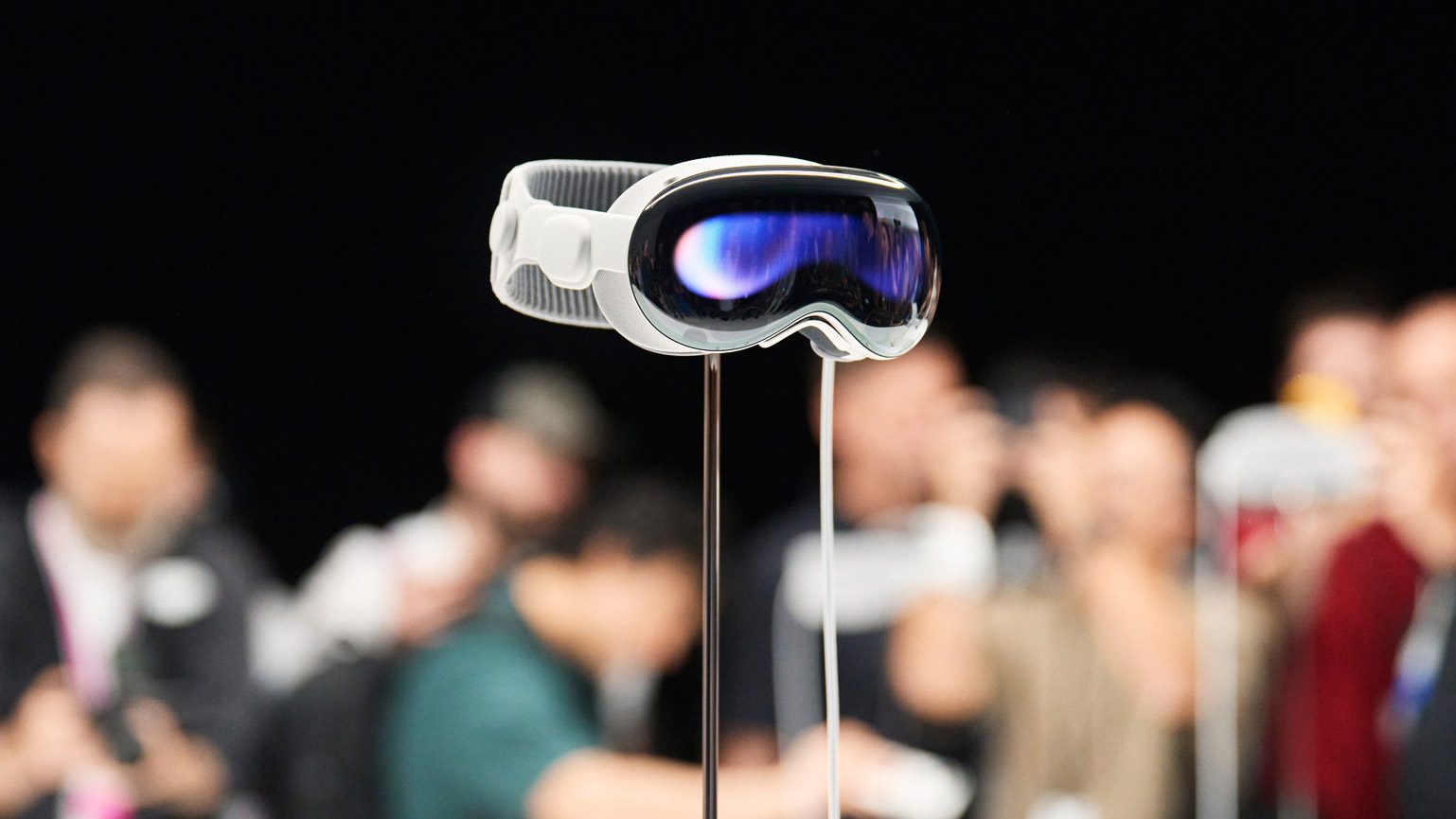
Apple ‘Vision Air’ Rumored for 2027, Reportedly 40% Lighter and 50% Cheaper Than Vision Pro

15

Independent supply chain analyst Ming-Chi Kuo released a report claiming that Apple is gearing up to launch a cheaper and lighter version of Vision Pro in 2027, which is expected to be called ‘Vision Air’.

Ostensibly leaked from supply chain sources, Kuo claims Vision Air is estimated to be “over 40% lighter and more than 50% cheaper” than Vision Pro, which weighs in at around 600g, and is priced at $3,500.

Notably, that weight figure doesn’t take into account the external battery pack, which weighs 350g. Provided Kuo is only quoting that ~600g on-head weight of Vision Pro itself, this would put the rumored Vision Air at less than 400g, and priced at less than $1,750.

At least by Kuo’s description of the headset’s weight, it’s also sounds like Vision Air is sticking with the external battery; the inclusion of an internal battery, like that found in Quest 3 and Quest 3S (both around 515g), would make it difficult to reach that sub-400g weight.

One of the biggest features likely to be on the chopping block for a cheaper and lighter Vision Pro is undoubtedly the headset’s glass-covered EyeSight front display, which provides a sort of virtualized representation of the user’s eyes.
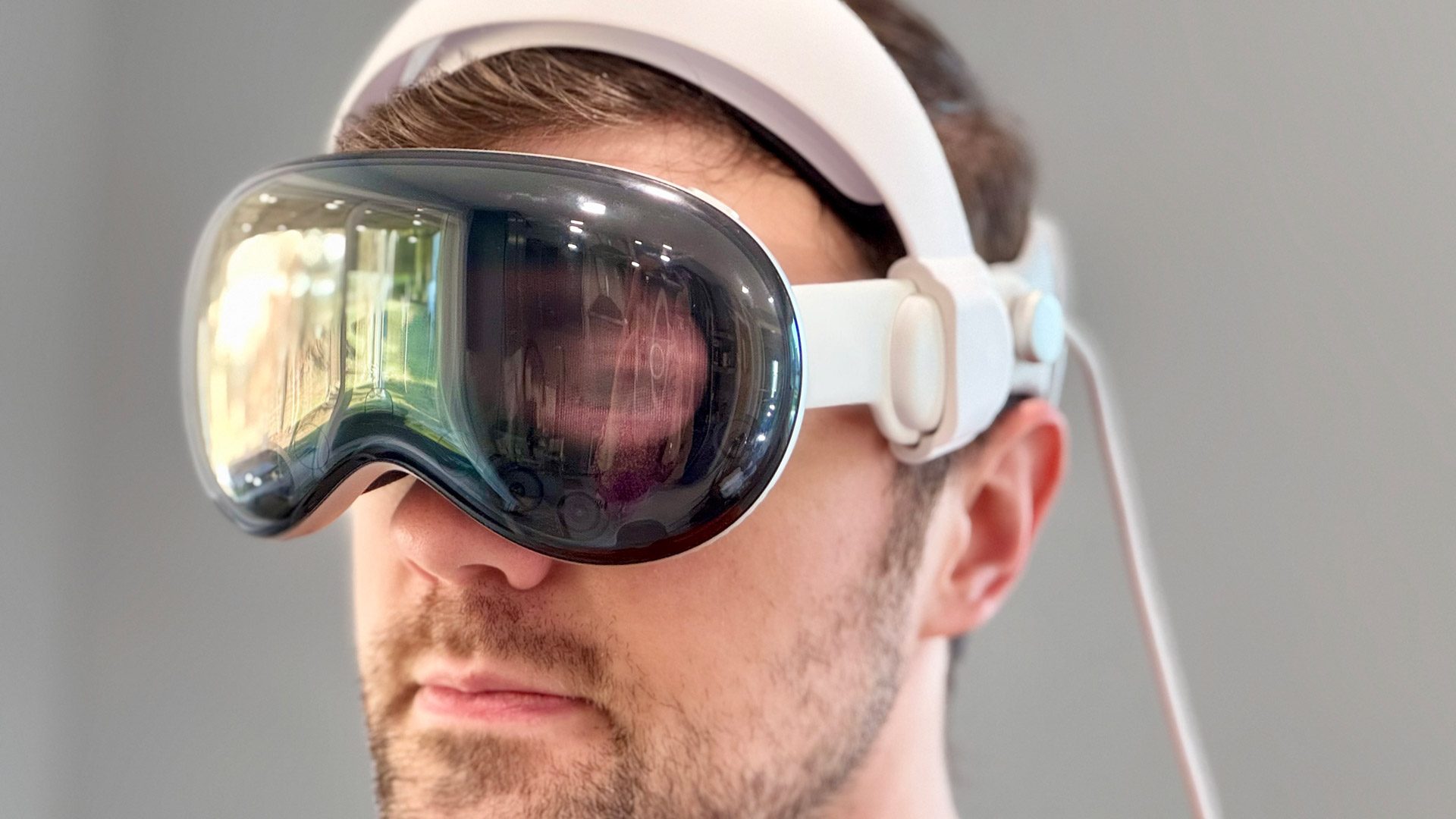
Photo by Road to VR

Vision Pro is also made with out of premium materials, such as aluminum and magnesium, which could be lightened by replacing them with plastic. That may be a bridge too far though, as it could sacrifice Apple’s premium design aesthetic.

According to the report, it also appears the Cupertino tech giant is hoping to make a bigger splash with Vision Pro’s lighter and cheaper follow-up—not to be confused the with reported M5 hardware refresh of Vision Pro expected to arrive sometime later this year.

SEE ALSO
'Aces of Thunder' Still Coming in 2025 Despite Recent Store Glitch Showing September Release

Kuo maintains Apple is internally targeting anticipated shipments of Vision Air to reach one million units in 2027. While Apple hasn’t released Vision Pro sales data any time following the device’s initial launch in February 2024, an October 2024 report from The Information claimed Apple was eyeing a sales target of 420,000 units for its first year.

Additionally, Kuo maintains General Interface Solution (GIS), the Taiwan-based company involved in the lamination process of Vision Pro’s pancake lenses, will broaden its role to become the exclusive supplier of pancake lenses.


This article may contain affiliate links. If you click an affiliate link and buy a product we may receive a small commission which helps support the publication. See here for more information.

Well before the first modern XR products hit the market, Scott recognized the potential of the technology and set out to understand and document its growth. He has been professionally reporting on the space for nearly a decade as Editor at Road to VR, authoring more than 4,000 articles on the topic. Scott brings that seasoned insight to his reporting from major industry events across the globe.
  • Nevets

    Why can't they release this next month? It's not exactly unattainable.

    • Christian Schildwaechter

      Not sure if I just missed the sarcasm here, but if the rumors about Vision Air using an A-series SoC to reduce cost, weight and energy needs are true, it will probably use an A21(Pro), which will arrive in fall 2027 with the matching iPhone generation. They'll want to use one of these to match the performance of AVP's M2 (and R1), and the current A-SoCs still can't. For this and a couple of other technical reasons I very seriously doubt that a 40% lighter Vision Air would be attainable next month.

      A slightly lighter AVP revision would be possible, but is probably not worth the effort, as the high price will keep it a low volume device. And Apple is still sitting on a lot of unused components for AVP despite telling their component suppliers to stop creating new ones earlier this year, so these will go into a similarly heavy M5 AVP first.

      A 50% cheaper Vision Air/Pro would be possible right now, as (more than) half of the USD 3500 for AVP is just Apple's margin on top of the build cost. But something tells me they aren't really willing to sell you an HMD at close to production costs like Meta.

      • Nevets

        Okay makes sense

  • Christian Schildwaechter

    TL;DR: EyeSight stays, weight and cost reduction through faster/newer hardware requiring less components.

    Tim Cook always criticized that VR isolated the users, so EyeSight won't be dropped. It's usually VR users asking for that, while AVP users want a brighter/more hires version. Technically EyeSight is a thin, flexible OLED display with a lenticular lens in front (image below from iFixit's AVP teardown). Display cost estimates are USD 15-30, and the lens is a stamped sheet of plastic. So dropping EyeSight wouldn't save a lot of money or weight.

    Replacing the glass front also won't help. For one it is necessary for all the sensors, and this is very strong technical glass, similar to Corning's Gorilla Glass covering lots of smartphones. Glass is much stronger than plastic and can be thinner and lighter than a thicker plastic cover providing the same protection, and the curved AVP front adds a lot of structural rigidity. Glass is more brittle, but AVP survived drop tests from up to 2.5m directly onto hard floor without issues, and when the front glass finally detached, the HMD was still working.

    Initial AVP teardowns/BOMs hint at possible cost and weight reductions. Build cost estimates are USD 1400-1800, with a much higher margin than Apple's usual 40%. Assembling the complex device costs USD 130, ~4x-8x what it takes for iPhone. Teardowns show tons of sensor connections, screws and cables crammed into a very small space. Inside are very power hungry microOLEDs, a desktop class M2 and extra R1 signal processor, combined drawing up to 30W that need to be dispensed with active cooling and a metal frame probably working as a heat sink.

    Vision Air is rumored to use a smaller, cheaper and more energy efficient iPhone A-series SoC, which by 2027 should be as fast as a 2022 M2. The sensor count will be optimized down, probably no longer requiring the extra R1. microOLEDs will still churn through battery, but we are expecting eMagin microOLEDs with true RGB OLED pixels instead of the current white OLEDs with RGB filters to arrive, which in theory should reduce energy draw by 67%.

    Reducing components, simplifying the structure, using newer and less power hungry parts and thereby also reducing the need/weight for cooling should drive down cost and weight in a Vision Air, while still offering the same experience as AVP. And with less weight to be held they can also reduce the strap and padding, with many already picking thinner face pads than recommended to improve the FoV.
    https://uploads.disquscdn.com/images/c96b1a36311d01e094d452fc37952f74c89e24547e88a5314095d89cd3502851.jpg

    • Zod Zod

      Apple's problem isn't technology. It's far simpler than that. The problem was making an extremely expensive product for a customer that doesn't exist.

      Slapping a "Pro" on it didn't magically entice it's fringe customers willing to spend $7500 on a Mac Pro for music and video editing, and the price was WAY out of range of the masses that only buy Apple as a status symbol.

      IIRC it's currently their most returned product in history. It had embarrassingly poor game support, poor app support, and turned out to essentially be an overhyped, overpriced, glorified virtual display.

      As I said in my other comment if Apple wants to enter this space they need to be targeting the NON Apple faithful, or find a reason for the Apple cultists to want it as well as be able to AFFORD it.

      • Christian Schildwaechter

        A significant percentage of Vision Pro returns are from customers who can't figure out how to operate the headset when they first get it, according to a high-profile analyst who recently said he surveyed the product's repair and refurbishment production line.

        Ming-Chi Kuo, an analyst who often reports on Apple's supply chain, estimates that 20% to 30% of Apple Vision Pro returns stem from users not knowing how to set up the mixed-reality headset, he wrote Wednesday.

        But overall, Kuo says some of Apple's smaller Vision Pro suppliers are expanding production and he estimates the current return rate for the device is less than 1%.

        This is from Business Insider in early 2024, and other sources like Mark Gurman from Bloomberg and data collected from Apple Insider also confirmed that the return rate was very similar to that of other Apple Pro products, around 1% (1.2% for iPhone Pro, 1.4% for regular iPhones during the first month, compared to 2.5% average for all smartphones sold by AT&T).

        For Apple the return rates are overall higher with cheaper products, and the most likely reason is that those who buy the more expensive tier do that because they have done more research that made them pay (significantly) more, so they are less "surprised". The reports that 20%-30% of the actual AVP returns are from people who simply couldn't figure it out also points this direction, as people had no point of reference for what to expect from experience with previous similar devices. Which is why Apple wants you to come into an Apple Store to buy the AVP, where you'll be given a 30min introduction plus a custom fitting with for the different paddings, instead of just ordering it online.

        The myth that AVP had high return rates mostly arose because a lot of influencers very publicly bought the AVP that was out of their price range to publish their review, but then returned it after. This gave the impression that this was typical, while the average AVP buyer could actually afford it, and those that (after an demo in an Apple Store) didn't deem it worth USD 3500 simply didn't buy it in the first place. Despite several sources busting this myth, it was then spread by the "Apple is doomed" people that also call Apple users cultists, claim that Apple devices are only used as status symbols by the clueless, and have apparently never been to a software developer conference to count laptops by brand, or tried to configure a PC with the same performance as the entry level MacBook Air or Mac Mini for a similar price.

        The part where Apple gets incredibly expensive isn't their base hardware, but RAM and SSD upgrades. And people who buy an Mac Studio M3 Ultra maxed to 512GB RAM for USD 10K or more don't do this because they can't calculate or need to outshine their buddies, but to run large LLM locally that otherwise would require a cluster of much more expensive Nvidia AI accelerator cards. But yeah, nobody buys a Mac for gaming.

  • STL

    Apple still hasn’t explained why a customer would buy such a device. It’s too heavy and “closed” for street wear, uncomfortable for watching movies at home, and lacks controllers, a wide FOV, and wireless connectivity, making it unsuitable for PCVR. Honestly, it’s an expensive niche device. Tim Cook isn’t Steve Jobs, who could invent anything on his own!

    • Andrew Jakobs

      Steve Jobs never invented anything on his own.

      • Christian Schildwaechter

        That's just dialectics. Jobs "never invented anything" in the same sense as Thomas Edison didn't invent the light bulb, not only because there were other (not very usable) light bulbs before, but also because thanks to his telegraph business he already had hundreds of people doing all the preparations, tests and research work, with his Melno Park laboratory growing to the size of two city blocks by the late 1880s. Thomas Edison invented the light bulb in the sense that he set the goal and closely directed and controlled the process that led to the first sufficiently reliable and commercially usable light bulb. And it wouldn't have happened without him, though some other lab would eventually have achieved it.

        There would be no Apple without Steve Jobs, as Wozniak as a tinkerer wasn't really interested in business, and required some convincing to even leave his job at Hewlett Packard.

        There would be no MacOS(X)/iOS/visionOS without Steve Jobs, who founded NeXT after being ousted at Apple, with the goal of creating a next-gen workstation targeting the educational market, which pioneered concepts like OOP IDEs. A decade later NeXT was bought by Apple, with the NeXTSTEP OS becoming the base for every operating system Apple offers today. Jobs didn't come up with the Unix base or the Mach kernel or the OOP concept, instead he pushed a certain vision (influenced by others), provided the resources, hired the right people and managed the overall execution.

        There would be no Pixar without Steve Jobs, if he hadn't bought the Lucasfilm Computer Division in 1986 that George Lucas had wanted to sell for years, renaming it to Pixar. And then financed them until they finally turned profitable almost a decade later after the release of Toy Story.

        There might be no WWW today without Steve Jobs, as back then everyone was offering closed systems like Compuserve or AOL, until a scientist at CERN used a NeXT computer with its advanced software tools to create the first web browser and server, the same tools id Software used to create all the level editors for the original 1993 Doom, with John Carmack stating that it wouldn't have been possible otherwise.

        Jobs actually wrote software and build hardware in the early days, but for most of his life his role was that of a manager and visionary, getting/hiring/forcing/abusing others into creating things, and being ruthless in his demands, criticism and treatment of them. The idea of the solitary inventor coming up with something great in his basement is mostly a myth, as even if someone created something alone, we are all standing on the shoulders of giants that created the things we are working with and on which we improve. If by your definition "Jobs never invented anything on his own", then basically nobody ever did.

    • Christian Schildwaechter

      They apparently agree that it is too heavy, otherwise they wouldn't release one 40% lighter. The AVP promo material shows only indoor use, and the few spatial outdoor images/videos are most likely supposed to have been taken with an iPhone and only viewed on the AVP inside. I seriously doubt they'll promote using even a much lighter and hopefully more comfortable Vision Air as a device to be worn outside like smartglasses, but as even the very heavy AVP is by many considered as the currently best device for watching movies, a lighter version should only improve that.

      visionOS 26 now supports PSVR2 sense controllers, though their use will be mostly limited to PCVR streaming and some VR ports, as eye plus hand tracking will remain the default input method, The AVP FoV can be significantly improved by using a thinner face padding than the Apple fitting process based on a face scan suggests. AVP at USD 3500 is no doubt an extreme niche device. A Vision Air at half that/USD 1750 would still not sell tens of millions, but is not too far off from an iPhone 16 Pro Max 1TB at USD 1600, and close to what Samsung's Project Moohan, Play for Dream or Pimax Dream Air are priced at.

      Regarding the Wifi performance we already had a long discussion in March. Yes, like all Macbooks featuring an M2, AVP only offers Wifi 6. Only the M3 Macbooks and later got Wifi 6e. But no, this is not an issue, as in a not overly congested area, even Wifi 5 is more than fast enough for PCVR streaming, with the main limiting factor usually the decoding speed on the headset, followed by the encoding time on the GPU. The transfer of the encoded image only requires a fraction of the bandwidth, with the connection mostly idling.

      Your personal experience of much improved streaming performance after switching from Wifi 6 to Wifi 6e most likely had nothing to do with added speed, but a lot with Wifi 6e adding the new 6GHz band to the often overcrowded 2.4GHz and 5GHz bands. These come with lots of latency adding packet collisions esp. in densely populated areas. As Wifi 6e routers only appeared in 2022, you still have that 6GHz lane mostly to yourself, while most others are stuck in a traffic jam on 2.4GHz/5GHz. Quoting you from the discussion in March:

      Well, since I want this clarified for once and all, I will bring my setup “to the woods” (I have cottage in the woods), as you say, and check with my Wifi 6 router there. This might become an interesting insight! I shall report back, once I’m done.

      Did you ever manage to real-world test this? The results would obviously be relevant for the question whether AVP with Wifi 6 is fast enough for PCVR in areas with lots of 2.4GHz/5GHz band use. It probably won't matter for the Vision Air, as all current Macs using M-SoCs now support Wi-Fi 6e, the iPhones already switched to Wifi 7 in 2024, and the Vision Air is supposed to use an iPhone A-series SoC in 2027.

    • Zod Zod

      Let's be clear here. Steve Jobs literally never invented ANYTHING. He was a salesman. He excelled at taking existing technology others invented, baking it into a neat little cake in a svelte package, then convincing people they badly needed it.

      When you account for the M1 Apple has actually become far more innovative when it comes to technology since Jobs died. Tim Cook just isn't as good at being a Pied Piper.

      Apple's business model technically shouldn't even work. They're a fluke. They got huge selling inferior hardware at premium prices to frothing at the mouth fanboys. While they do have a few good products the vast majority of their customers only buy their products because they see them as a status symbol, which is precisely why you'll never see a phone case that covers up that precious logo. No one cares if you have a smartphone, but Apple cultists want to make sure you know they have an iPhone.

      • Arno van Wingerde

        I am not a typical Apple fanboy, but your description is exaggerated: Apple product do not aim for "most specs per $". Instead Apple carefully crafts a hard/software system that actually is useful to the user, in contrast to "China ware" which typically offers way better specs for the money but is often let done by lack of software or lack of a user-centric design concept.

        The last aspect is one of the weakest points in the AVP: what are you using it for that is so compelling that you are prepared to spend your cash AND walk around with a brick on your head?

        – Games? No controller – maybe fun if you use for something else and play a game in between, but no competition (yet) for the Quest. Perhaps if really compelling games become available with hand tracking… developpers cannot count on AVP users owning Sony controllers…
        – 2D productivity? Maybe for on the road, but at home/office, people would likely prefer a monitor unless the headsets become less cumbersome.
        – 3D productivity (CADCAM, medical etc.) Maybe if there are good applications available.
        – On the road: media consumption/games: an iPad on your head. Yeah, i can see that!

        • Christian Schildwaechter

          2D productivity? Maybe for on the road, but at home/office, people would likely prefer a monitor unless the headsets become less cumbersome.

          Recently I was away for a couple of days, knowing that I'd spend most of my time away from a computer. To give 2D productivity work in HMDs a try, I packed a Mac Mini, keyboard, mouse and Quest 3 instead of my MacBook, plus a barrage of cables and HDMI-grabbers, as I knew the Wifi would be way too horrible to stream over it.

          For me the Quest 3 isn't comfortable, I was limited to 1920*1080@30Hz, and the resolution of the Quest is too low to even display that properly. Nonetheless I was impressed how well it actually worked for most tasks, and found it very convenient to place five other virtual screens/windows floating above and to the side. There were some hiccups, for example I had to disable hand tracking, as my hands hovering above the keyboard accidentally moved the virtual windows all the time.

          I usually stare at 2K/4K dual monitors that provide a much better image without having to wear a sweaty HMD, but they also only cover a much smaller part of my view. Being able to resize the virtual screens in the Quest was probably what I liked the most, next to them not physically being in my way. My very primitive experiment convinced me that I'll drop physical displays and switch to HMDs completely much sooner than expected.

          And we are getting there. The AVP may already be there in terms of resolution, though it is still way too heavy, expensive and inflexible for me to consider it. But if Valve releases Deckard in 2026, and it comes with 4K displays, and an AMD APU on top of Linux/SteamOS that would allow me to run all the software I need on the headset itself, that may be the year when after literally decades of sitting in front of monitors I'll switch to a purely virtual setup.

          I already own a couple of bizarre portable keyboard mouse combos, and have plans (and components) to build one in single hand controller form, removing even the need for a desk or flat surface. With those I'd probably work a lot more outside or wherever I want, which will be worth some discomfort and irritated looks from the people passing by.

  • $1750 is still a lot of money, especially if no compelling use case is found. 1M units makes sense as target for the sales… but it means we are still talking about a niche device in 2027

  • Zod Zod

    If Apple really wants people to adopt any iHeadset it's needs to be more than 50% cheaper. The Apple cultists aren't VR enthusiasts and even at $1750 it's a LOT to ask for a premium headset when there's already many other options available today as well as on the horizon.

    A tiny margin of Apple users are actually using their Pro products to their strengths. The swarms of Apple cultists that only use Apple as a status symbol aren't big enough nerds to want anyone seeing them with a headset strapped to their face just so you can see the Apple logo on the front. Let alone pay nearly 2 grand for it.

    If Apple wants to make any kind of real inroad into VR/MR/AR they're going to have to (gasp!) actually make a good product at a reasonable price. The question is is Apple really capable of innovating anymore or are they just a company that milks their fan base that understands nothing about technology?