
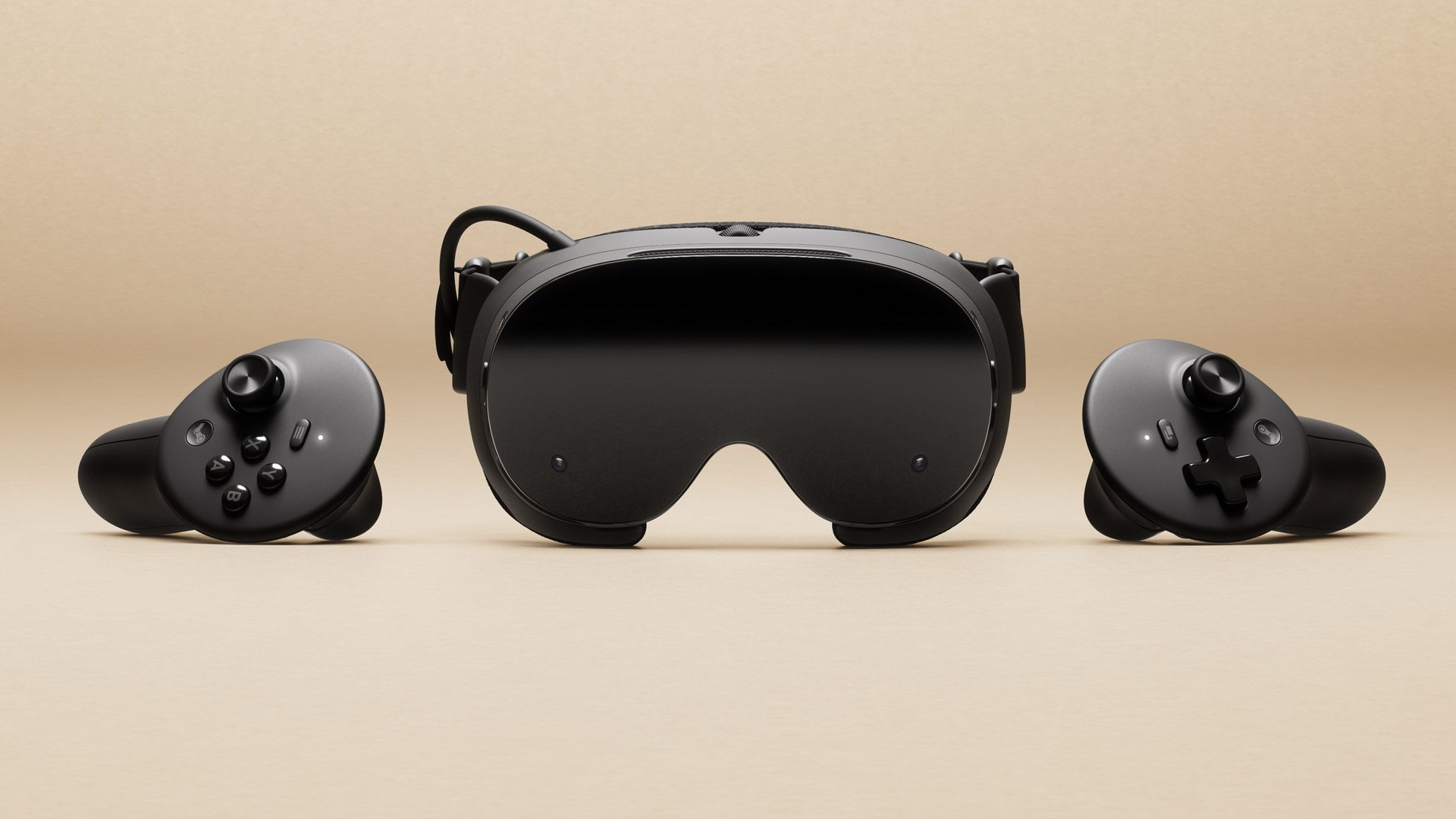
Valve: Steam Frame Doesn’t Support Stereoscopic Rendering of Flat Games but the Feature is “on our list”

50

Valve says that Steam Frame won’t be able to display traditional (‘flat’) games in stereoscopic 3D at launch, but they are looking into the feature for future development.

The News

The announcement of Steam Frame came with a lot of info but equally as many unanswered questions. One thing on my mind is whether or not the headset will be able to render flat games in stereoscopic 3D (assuming the game supports it). A Valve spokesperson told me that such a feature doesn’t currently exist, but the company is looking into it.

“For […] stereoscopic 3D content on [Frame], we don’t currently support it, but it’s on our list.”

The company further said it’s considering a system-level implementation that could display any stereoscopic 3D content, whether it’s stereoscopically rendered games, videos, or photos. Should the stereoscopic 3D feature be built, Valve told me it would “be our goal” to be able to display such content when streamed from a PC or rendered directly on the headset itself.

In an age of impressive conversion of 2D content into 3D content (like we’ve seen on headsets from Apple and Samsung), I also asked if the company was exploring any technology to automatically convert flat Steam games into stereoscopic output for viewing in 3D on Frame; unfortunately Valve said it isn’t something they’re currently looking into.

My Take

Without any automatic stereoscopic 3D conversion, the big question becomes: what content is actually available to users in stereoscopic 3D?

In 2025, there are very few flat games that natively support stereoscopic 3D rendering. But there’s a handful of third-party mods that inject themselves into the rendering pipeline to generate stereoscopic 3D frames from flat games. Since these aren’t developer-level integrations, such mods can work well for some games but not others.

SEE ALSO
Google Launches First-party 'PC Connect' Virtual Desktop App for PC Productivity & Gaming on Android XR

Side-by-side stereoscopic rendering (where the left and right eye views are packed into a single, final frame) is the most widely compatible format for stereoscopic 3D content today. So the lowest hanging fruit for Valve would be to allow Frame to view any arbitrary side-by-side content in stereoscopic 3D, whether rendered in real-time from a game or pre-rendered images or videos.

While there isn’t a singular and widely available marketplace of professional stereoscopic 3D media, some modern phones and XR headsets can capture stereoscopic 3D images and videos. And automatic 2D-to-3D conversions of photos and videos is becoming increasingly accessible. Most of these can be viewed in one way or another on modern XR headsets and Steam Frame could eventually be among them.


This article may contain affiliate links. If you click an affiliate link and buy a product we may receive a small commission which helps support the publication. See here for more information.

Ben is the world's most senior professional analyst solely dedicated to the XR industry, having founded Road to VR in 2011—a year before the Oculus Kickstarter sparked a resurgence that led to the modern XR landscape. He has authored more than 3,000 articles chronicling the evolution of the XR industry over more than a decade. With that unique perspective, Ben has been consistently recognized as one of the most influential voices in XR, giving keynotes and joining panel and podcast discussions at key industry events. He is a self-described "journalist and analyst, not evangelist."
  • Moyenitude

    a 3D Vision comeback!

    • MarcDwonn

      Hell yeah! But not soon, unfortunately.

  • Hussain X

    I really hope Valve does focus on stereoscopic 3D gaming of flat games, & encouragers developers to support it. Meta should also get Xbox to support cloud streaming of stereoscopic 3D gaming. A great way to sell more VR hardware & grow install base for high budget VR games.

    Reshade SuperDepth 3D is a great app to inject 3D into games. You can watch some videos on YouTube on Quest in 3D to get an idea what 3D gaming can feel like. E.g check out Spiderman game played by Paradise Decay using SuperDepth 3D. You can watch it in 3D, & immersion is next level. Way better than flat gaming it.

    I also love converting videos from 2D to 3D using IW3 by Nunif, freely available on GitHub. Uses AI, & conversions look fantastic, almost production level quality 3D. It increases enjoyment of video watching multiple times over. You can even watch videos in 3D at the same time it's converting. It's one of my most essential, need to have software to have ever released & I can never go back to flat viewing for high budget shows & movies. It's like I'm almost inside the world.

  • Stephen Bard

    The "Photon" app in the Quest Store converts any 2D video to 3D. You can convert 30 videos per day for free as long as they are less than 3 minutes. To convert full length movies or videos longer that 3 minutes there is a subscription available. The 3D depth is very good, but not as perfect as you can get with the Owl3D app on your PC.

    • Oxi

      Are there any apps that do it locally on your PC's GPU?

      • Stephen Bard

        Owl3D

      • Hussain X

        IW3 by Nunif, freely available on GitHub. Uses AI (locally converted by your GPU), & conversions look fantastic, almost production level quality 3D.

        Note: I was the first person to write a comment on this article. I wrote quite a lengthy post including about IW3 but Disqus regarded it as spam & comment is apparently waiting for human approval & I've waited days. Since you're asking, I thought I'd let you know.

      • Hussain X

        IW3 by Nunif, free on Github. Uses local GPU.

  • Stephen Bard

    One of my favorite 3D conversion capabilities is that I run "realtime" 2D/3D video conversion continuously 24/7 on my Lume Pad 2 glasses-free 3D tablet and it looks very good with few edge artifacts. Meta recently added a window to the new Quest Homes that shows Instagram videos converted to 3D. What I really hope to see is 3D realtime video conversion running on the Quest 3 Browser, so things like YouTube will actually run realtime in 3D. I understand that the Android XR OS does realtime 2D/3D video conversion on the Galaxy XR headset.

    • Blackspots

      Instagram does 3D video conversion on the Quest 3, and probably the Quest 2

    • Oxi

      There needs to be good VR emulation of those kinds of lenticular displays and content.

  • Herbert Werters

    Support like that provided by Acer's spatiallabs for their 3D monitor would be a dream come true. If Valve doesn't do it, then I'm sure some modders will. I'm so excited about these VR glasses, you wouldn't believe it.

    So what Acer can do should be a piece of cake for Valve. Take a look at the list of games that are already supported by the monitor. It's crazy.

  • Christian Schildwaechter

    Stereoscopic rendering is expensive. The 2026 Steam Frame will use a 2023 Qualcomm ARM SoC not optimized for x86 emulation, and run Steam games through a combination of Proton Windows to Linux, Fex x86 to ARM, and DXVK/VKD3D DX8-12 to Vulkan translation. According to what Valve engineers said during the hand-ons, Frame should run Steam games at roughly the same speed as the 2022 Steam Deck, which comes with a 1280*800 display. So don't expect any miracles in standalone mode. The Frame is a "streaming first" HMD, and that will apply to flat games too.

    The Steam Machine is six times as fast as the Steam Deck, comes with the dedicated WiFi-6E that also drives the streaming stick bundled with Frame, which allows for much more stable/plug'n'play (foveated) streaming at reduced latency and higher effective bandwidth when paired with the Frame's eye tracking. So I'd expect things like stereoscopic rendering to first be implemented for the combination of Steam Machine plus Steam Frame.

    While running PCVR games or stereoscopic flat games locally on Frame sounds nice, the hardware isn't really suited for that. Trying it nonetheless will probably drain the included 21.6Wh battery in slightly more than an hour, while running Frame as a streaming client will allow it to actually benefit from the low power capabilities of the ARM architecture. It can quickly load and decode (with faster than XR2(+) Gen 2 decoders) the roughly 10% of the image size required for foveated streaming compared to for example streaming to Quest 3 lacking eye tracking, brightly flash the display for a millisecond and then fall into a low power mode until the next frame arrives, which should result in a much longer runtime.

    The standalone VR mode will probably be most useful for a few casual, low performance x86 games, ports from other ARM standalones or Android OpenXR APKs already capable of running on different platforms. And of course Beat Saber, with Frame the only non-Meta standalone capable of doing so, even more important now that Meta has ended Beat Saber support for PSVR1/2.

    The standalone "flat" mode will be useful for running flat games on a virtual screen, performance limited to what the Steam Deck can run, Android games available as ARM APKs, and (native) Linux/Windows desktop apps in some kind of desktop mode hopefully allowing to place Windows in 3D that nobody has seen yet.

    Everything else beyond these applications with rather moderate requirements will probably still require streaming from either a Steam Machine (with lots of performance improvements to be expected when combined with Frame), or a PC.

    • Cfilorvyls

      But isn't steam frame's main purpose is to be used for streaming from PC anyway? There's no reason the stereoscopic conversion necessarily needs to be done on the headset.

      • Christian Schildwaechter

        Sure, Valve very explicitly labeled Frame a "streaming first" HMD, and if you render the stereoscopic view on the PC, performance won't be an issue. But Road To VR apparently asked about stereoscopy support on Frame directly, which can mean two things:

        1) Rendering flat games locally on Frame with stereoscopy to be displayed on the virtual display, which should provide a much more immersive experience, but will be performance limited on Frame.

        2) Simply showing content already rendered stereoscopic, like 3D movies or a game rendered this way on a PC. There is no general standard for how to transfer the two perspectives, for example some 3D videos contain the two perspectives side by side, either each shrunk to half the width, others side by side at full resolution resulting in an ultra-wide image. Some place the images on top of each other, and game support targeting shutter glasses will send the left and right frame one after another.

        So the Frame has to be able to somehow determine which part of the image to send to which display/eye at what time. And this of course complicates foveated streaming, because you may now have two separate parts of the image that have to be transferred.

        The company further said it’s considering a system-level implementation that could display any stereoscopic 3D content, whether it’s stereoscopically rendered games, videos, or photos.

        This sounds like Valve interpreted the question as mostly being about 2), but both local stereoscopic rendering with eye tracking and properly interpreting streamed or pre-rendered stereoscopic content are probably closely related technical issues.

        We've heard that there won't be any streaming official streaming apps like Netflix for Frame at launch, but even if Valve doesn't provide any stereoscopy capable viewer themselves, it will probably only take a very short time until someone has recompiled VLC that supports stereoscopic content in various formats to run natively on Frame. But it would of course be better if there was a system wide component that would enable viewing stereoscopic content everywhere instead of every app having to re-implement this by itself.

        • Herbert Werters

          I don't understand the problem with full/SBS 3D movies. There are tools that can do it, right? What's wrong with using them to play 3D movies? Virtual Desktop, for example, can do it.

          • Christian Schildwaechter

            There is nothing wrong with that. I of course don't know how Ben came up with this article, but it looks like they asked Valve how Frame would handle stereoscopic content in a sort of general way, to which Valve responded that they haven't implemented that functionality yet.

            The reason will probably be their focus on gaming, so they expect VR games either running locally or streamed to take care of properly rendering it, and themselves only render flat games correctly on a virtual screen, which are the basic requirements for running/streaming flat and VR games on/to Frame.

            Even if Valve hasn't yet created advanced options like playback for all sorts of 3D movie content or stereoscopic display of flat games that support this, nothing is stopping users or developers to come up with their own solutions, and there are already a large number of players available for ARM standalones. The whole question is more relevant regarding the expectations people have. Some people had hoped that Frame would come with sort of a Valve created universal UEVR, allowing to play all flat games in VR, which for many technical reasons wouldn't even be possible.

            At least for now Valve has apparently implemented basic VR and flat gameplay (no doubt with lots of optimizations), and even though they plan for more, people should start with that when considering to buy a Steam Frame. And not expect for example a media experience comparable to AVP, with Apple massively investing into immersive content production and playback.

          • Herbert Werters

            Yes, none of this is Valve’s core business. But what everyone forgets is that users will have all kinds of possibilities open to them. If the will is strong enough, you can do anything you want.
            I think Valve could introduce something similar to Acer with their spatial monitors and various games if they wanted to. But let’s see, maybe there will be something like Decky plugins for the frame that can generate 3D via the Z channel. I don’t know how the spatial app does that on the Acer monitor. Whether it’s real stereoscopy or extruded via the channel.

    • Blackspots

      Yes, but the Steam Frame will be using the 3rd gen Snapdragon 8, not the gen 2 as you state

      • Christian Schildwaechter

        TL;DR: I actually pointed out that it uses the SD8 Gen 3, though maybe in a confusing way. The newer SoC will make Frame (much) faster than existing ARM HMDs when running ARM binaries, but it still won't be enough for most x86 games.

        I said "with faster than XR2(+) Gen 2 decoders" to point out that the SoC in Frame is a Snapdragon 8 Gen 3, released in 2023-10, while pretty much all other HMDs use XR2(+) Gen 2 based on the one generation older Snapdragon 8 Gen 2.

        So I explicitly pointed out that the Frame would be faster, but that won't necessarily save it performance wise in standalone mode. Year-to-year performance increases for Qualcomm SoCs have been around 30%, giving Frame an automatic advantage, and the Snapdragons include a high performance core in addition to running their performance and economy cores at almost 50% higher clocks than the XR2s. Meta also underclocks the CPU in games to give the GPU more headroom.

        So on paper the Frame will be much faster than a Quest 3. But the XR2s use slower cores for a reason, as phone SoC aren't really designed to run at the max speed for a long time, they are tuned for alternating burst/idle cycles, while VR creates constant load. Valve will have to clock down the SD8 Gen 3 rather often even if their cooling is much better.

        Valve engineers talked a lot about that in the Gamer Nexus videos. They are working on game specific performance profiles for both the SD8 Gen 3 and all the different translation layers, so a turn based game requiring burst compute may utilize the high performance core, while one causing more constant load may only run on slower performance cores. How well this works remains to be seen, and SteamOS is excellent regarding power to performance ratio optimization.

        But this is still a mobile SoC, and those have had much lower CPU performance than even slow PCs. The Steam Deck pretty much wipes the floor with Quest 3 regarding CPU speed, which is important for things like game physics, while Quest 3's GPU performance is slightly higher. The Frame SoC should be faster, better cooled, higher clocked with highly optimized app-specific configuration optimizations that will allow it to run ARM APKs much faster than a Quest 3, significantly more than the 30% generational improvements would suggest.

        But it will take some time for these APKs to become available in relevant numbers, and most people will want to play their Steam PCVR games on Frame, which will come with a very high performance penalty from emulation. I trust Valve that they invested a lot in improving FEX and ARM Proton, but emulating another architecture is always very lossy and to be avoided if possible. Frame also has to render significantly more pixels than on the Steam Deck, so performance will be an issue with many Steam games.

        There were already tons of performance tricks on the Steam Deck like the 40FPS mode added to 30FPS and 60FPS, as its 25ms frame time is much smoother than the 33ms at 30FPS while saving a lot of power compared to 17ms at 60FPS. Frame could run the virtual screen at 120Hz for high comfort in VR, but run the flat content on it at only 40Hz to save a lot of power and performance.

        I'm sure Valve will have come up with lots of Frame specific performance improvements, esp. using eye tracking, but only actual tests and benchmarks will show how well that works. They didn't let anybody run any compute heavy VR apps like HL:A on Frame during the hand-ons, and they will have had a good reason for that.

    • Oxi

      It would be a selling point for streaming flat from a PC or steam machine to the frame, which is one of the core use cases they describe.

    • Paul Bellino

      It seams to me they should sell it with a Swappable battery head strap option. Also for the life of me why in the world did they not include a direct to display port option. This in a pinch would solve 2 problems, Power and options for people with the right PC hardware. Why shoot yourself in the foot by not appealing to as many players as possible.

      • Christian Schildwaechter

        TL;DR: the battery will very likely be swappable, the modularity allow for hot-swappable 3rd party straps; adding DP input is a lot harder on an ARM HMD than you might expect, and limited by the USB standard, so it is not likely we will see this on any standalones; foveated streaming may stop people to keep asking for DP input.

        Valve hasn't shown clear pictures of how the battery is connected, but it is very likely that it is just a USB-C connection on the Frame core module. So the battery will basically be just a USB-PD capable power bank that you could easily replace with a 3rd party strap, and these could come with a large battery that can be hot-swapped plus a small one that can run the HMD for a few minutes while you swap the main battery. The included battery will be able to communicate with the Frame to report things like current charge level etc., and I'm not sure if this is in some way standardized for USB-PD, or whether Valve will have to publish the protocol for 3rd parties to create replacements.

        Adding DP-in is a lot more complex. While all Qualcomm XR2 and Snapdragon can output a DP signal over USB-C, none of them can receive it. So you need a separate DP decoder that either somehow connects to the SoC, for example as a camera via one of its many CSI/MIPI connectors, or with a separate display controller connected to the screens. The Pico Neo 3 Link did this, adding a separate USB-C port that led to a daughter board for DP decoding. This of course adds some cost, but more importantly, complexity, volume and weight, not only from the board and port. And one of Valve's main design goals seems to have been low weight, resulting in a 185g Frame core module.

        Even if they added a DP-in port, your idea of both high resolution video and power has some problems. USB-C is a very powerful standard, allowing for high speeds, high power transfers, and long cables, but you basically have to pick two of those, you won't be getting all three with regular cables. The Frame can apparently draw more than 15W, meaning they need to use USB-PD, as USB2 was limited to 10W, USB3.2 to 15W, while USB-PD can deliver up to 240W. USB-PD uses USB-C, which has 20 wires in its full configuration. Eight of these are for four superspeed data lines, which can be used to transfer a DP signal in the USB DP Alt mode. But most charging cables you find will be either limited to USB2 speeds with less data lines and thicker wires allowing for more power, or limited to 1-2m, a result of increased resistance in longer, thinner wires.

        The Frame battery has a USB-C port with USB-2 data speed going back to the PC, allowing for longer cables. Switching to USB-3 at reliable speeds would require either short cables not really usable with VR, or special solutions like Pimax's optical 6m USB-C cable that combines a few thick wires with an integrated converter that sends the data over an optical fiber that not sensitive to resistance and length.

        You have additional problems with the resolution. DP 1.3/1.4 is defined to provide the bandwidth required for an uncompressed 24bit 4K@120Hz signal. The PSVR2 with 2*2000*2040@120Hz stays just below that bandwidth limit, though in the end Sony still used stream compression to allow for HDR and a faster transfer back to the HMD. They solved the power problem by using USB-C not with the DP Alt mode, but instead with the long dead VirtualLink Alt mode that allows for up to 27W, and adds an extra shielded superspeed line, which requires a special cable.

        Valve exceeds these limits with 2*2160*2160@144Hz, solved by using (basically invisible) DSC/display stream compression, which requires a matching DP 1.4 decoder. I'm not sure if or how exactly the Pico Neo 3 Link piped the decoded DP signal to its XR2 Gen 1. If it used the camera ports (of which the SD8 Gen 3 in Frame has less than the XR2 series), it would probably still be able to take the full Frame signal.

        But we know from the Bigscreen Beyond that available bandwidth is an issue even with the tether.The Beyond can decode DP at its native resolution of 2*2560*2560 only up to 72Hz, for 90Hz it only upscales a 1920*1920 image transferred with DP DSC. The limit here isn't DP itself, which should allow for the full 2560@90Hz with 3:1 DSC, it is more likely either the 5m cable or the DP decoder inside the HMD. Pimax solved this better on the Crystal with the above mentioned custom cable, but charges USD 80 for it when bought separately. So adding DP-in to any HMD not already capable of decoding it adds a lot of complexity, some weight and cost, and possible requires a lot more expensive cables if you want more than 3m distance.

        And the first impressions from Steam Frame hand-ons indicate that Valve managed to get a very high fidelity, very low latency signal with eye tracking driven foveated streaming plus a the dedicated 6GHz dongle that uses the much better Linux networking and only connects a Windows PC as a client. More tests are required, but this may relegate DP input to a few special cases like stationary simulators only used seated, high interference or high security areas, while everybody else is better served with foveated streaming plus cheap and long USB-C cables with sufficient power delivery at only USB-2 speeds.

  • Oxi

    I personally just don’t think “playing your games on a big screen wearing your Steam frame” is very compelling. It’s an LCD screen, the effective resolution is going to be much lower than a 1440p display, 4K display, maybe even 1080p display, and the controllers will likely not feel quite as natural as a game pad.

    So I have to assume valve has some form of value add they haven’t revealed for the use case. Is it adding depth to the image? Is it spatial peripherals like a virtual steering wheel, flight deck, and macros? Is it the ability to have a couch co op session with friends inside your frames? Can be frame even hook up to a dock when needed?

    • Christian Schildwaechter

      The effective resolution for the virtual screen will be below 1080p, the performance about the same as a Steam Deck for x86 games. So you can really think of Frame as a Steam Deck for your face, just with a much larger display. And ignoring everything else they may have cooked up, that alone may be enough for many, me included.

      I love my 1st gen LCD Steam Deck, my main issue is the small screen and that it is quite large to take with me, so I use it within my flat most of the time. And according to Valve, about 20% of all Steam Decks are sitting in Valve's own, rather expensive Dock, connected to a large display, plus an unknown amount doing the same with a 3rd party USB-C to HDMI/DP cable or hub.

      So there is an actual market for a Steam Deck like machine that offers a larger screen, and the Stream Frame folds into a very tiny package easier to fit into a bag than Steam Deck plus case for even better portability and undisturbed gaming everywhere. The Frame controller will offer full input parity with an Xbox/PS controller, and you can also use Frame with the new Steam Controller that includes the Deck's trackpads and gyro for games requiring keyboard and mouse, thanks to the incredible powerful Steam Input. The Steam Controller can even be 6DoF tracked by Frame like the PS4 DualShock in PSVR1 games like Moss.

      Stream Frame as a flat gaming console will be a niche device, and just like the Deck, will never reach anywhere near mainstream Switch numbers. But also like the Steam Deck, it will be great for those looking for a still mobile, but less compromised gaming option with all the flexibility a PC can offer. And that specific group might love the Frame very hard.

      • Oxi

        While I can imagine someone using it while traveling, I’m not sure that’s enough. It may work for you but if it does, why not a steam deck and XReal glasses?

        • Christian Schildwaechter

          I shortly considered the XREAL glasses, but quickly dismissed the idea, as I would only use them with the Steam Deck, for which they are too expensive. No doubt the image would be a lot larger, but still limited by the rather small FoV. And given that my Steam Deck use is mostly for short sessions in varying positions, I'm pretty sure I'd hate the extra complexity of having to deal with the Deck plus tethered glasses instead of just lugging around the Deck alone in one hand. I tried using the Deck with a Quest 3 and a tiny HDMI capture dongle. Did that once, was more annoyed than impressed, never tried it again.

          For me the Frame will come with a lot of added value. My number one is SteamOS, and I absolutely plan to use Frame as a laptop replacement running Linux desktop apps placed all around me, similar to what AVP allows with iOS apps. I always considered using a VR HMD just as a virtual display for a separate machine a very misguided idea that only got traction because people are used to physical monitors, and we currently don't have proper VR windows managers. They exist on Linux though, so instead of squeezing everything into a small rectangle covering only 50° of your FoV, you can simply place windows all around you, and the large FoV on Frame should help with keeping track of more windows/apps. And all that in a tiny 440g plus Bluetooth mouse/keyboard package, with an integrated portable large screen Steam Deck as a bonus.

          • Oxi

            “I absolutely plan to use Frame as a laptop replacement running Linux desktop apps placed all around me, similar to what AVP allows with iOS apps”

            I have serious doubts about whether Valve will really support the desktop mode/multi window side of this. They should, it would be ideal, but the way they’re selling the device and the way they handle things on Steam Deck doesn’t seem in line with it. People streaming from PC primarily won’t use SteamOS for desktop stuff, they’ll use windows. People who are only gaming wouldn’t use it much. People who want a spatial linux PC (myself included) want it but it’s a large amount of work for Valve to do to make it what it needs to be. When I look at the deck, when it is in desktop mode it in no way feels like a custom operating system made for a controller based device. Without steam running, the trackpads don’t even work. It’s not a custom Steam desktop GUI, it’s just arch with steam running on top and the flatpack store. Again, I’m talking about the desktop mode, not gamescope or game mode. So why would we assume valve would make the desktop mode any different?

            That leaves the question imo of whether valve would make the “game mode” into more of a spatial OS and while logically that would amazing, there’s no reason to assume that they will yet.

          • Christian Schildwaechter

            We already know there will be a desktop mode, just not how it will look. Whether Valve supports a fancy spatial window manager or not isn't really that important, as it will be a Linux machine, and SimulaVR doing exactly that has been available for several years for Linux.

            I'd expect Valve to make the desktop mode similar usable as on the Deck, meaning you can use it with just the controllers as pointers and a virtual keyboard if you are a masochist, but to really use it for productivity, a bluetooth mouse and keyboard have to be connected. I've done this a lot, with the Deck sitting in the original Valve dock which I bought because it was one of only a few with two monitor ports. This way I used the Deck as just a regular Linux PC sitting on my desk connected to a 4K + 2K dual monitor setup, not using the Deck's inputs at all.

            I don't expect Valve to push productivity use on Frame, for example creating spatial SDKs to better integrate flat apps into VR/MR, like Apple and Meta did. They simply lack the resources to do that. And the Frame with b/w passthrough and 2160p screens isn't anywhere as suitable for this use case as an AVP or GXR. But I don't really care.

            I expect the community to come up with interesting solutions quickly. I started using Linux about 30 years ago and can work around issues myself, and I own a whole zoo of portable bluetooth mice, keyboard, controllers with plans and already acquired components to build my own chorded keyboard that can be attached to a VR controller.

            What I want to do with Frame may be rather exotic, and 99% of all Frame users will probably stick to local and streamed games, which will receive a lot more support from Valve. But what I want to do wouldn't even be possible on AVP, GXR or Quest 3, simply because those companies won't allow me to use my own window manager. It is possible on Linux/SteamOS, the SimulaVR window manager is based on Godot and available on GitHub under the MIT license. And while I still doubt that we will ever see a Simula One XR HMD, SimulaVR already does a lot of what I am looking for, and allows me to implement my bizarre ideas in a game engine that will even allow me to develop directly on Frame (regardless of whether that is a good idea).

            I recently started looking into the homebrew HMD scene that has created a number of interesting projects of sometimes/often/mostly questionable use. One was an ARKit based Cardboard-like VR implementation for the iPhone 12 Pro including 6DoF room, hand/finger and eye tracking using nothing but the cameras on the phone and combining existing FOSS projects. And I fully expect to see for example hand tracking on Frame within weeks after release based on existing FOSS solutions, though not anywhere as good as on AVP/GXR/Quest. I don't need Valve to do more than provide the Frame hardware, SteamOS and a desktop mode, the rest I can solve myself.

    • VR5

      It's actually very compelling and if it's comfortable enough, Steam Frame users will hardly ever go back to small screen gaming. The only games I play on PC monitors (or even TVs) are 8bit pixel art games that don't really benefit from a large screen.

      Resolution is overstated (only really matters for text/work) and most people have LCD screens anyway.

      • Oxi

        That doesn’t sound convincing at all, quality of display clearly matters, that’s why people buy OLEDs and 4K monitors, and this use case has been tried before from the oculus go to the apple vision pro and it has never really become a winning pitch for the main use case of a product.

        • VR5

          Steam Frame is basically the same 4K display with pancake lenses as Quest 3 and that is an amazing quality display. Sure people buy OLED but even more people buy LCD. Acknowledging that OLED is high quality doesn't mean that LCD isn't. Resolution is a number, it's objective, it's easy to market and to impress people with. But for watching stuff (not reading), size of display is more important than resolution. As long as resolution is good, a large screen will always be an attraction. Case in point, when you have handheld consoles in different sizes, the larger ones sell better. When people upgrade their TV, it is usually a bigger one. And smartphones also have grown in size.

          HMDs basically end the size race and put jumps in resolution back on the map. 4K makes no sense for smartphones but for HMDs it did. 8K makes no sense for TVs but it does for HMDs.

          AVP is ridiculously expensive. Its relative success doesn't show anything, it's simply priced out of the mainstream. Nevertheless it's another example of the above mentioned pattern: it has higher res but lower FoV than Quest 3 and isn't selling as much. 3S has even lower res and is selling even more. Size is more important than resolution.

          • Oxi

            “the same 4K display ”

            Isn’t it 2K like the Reverb G2?

          • VR5

            Square 2K per eye is the same amount of pixels as a 16:9 4K display and often a single screen is used. Basically if you separate a 4K screen in the middle, you get two square 2K surfaces. Ideally you want two physical screens for IPD adjustment but in terms of pixels, it’s the same.

          • Oxi

            They're two panels showing roughly the the same 2K image so no, I would not say they're the same as a 4K image.

          • VR5

            No one said that. I said SF and MQ3 have comparable displays, both are square 2K per eye with pancake lenses. Which is true.

            The other thing I said is that a 4K screen (4000 x 2000 pixels = 8 million pixels) is the same pixels as two square 2K screens (2000 x 2000 pixels x 2 = 4 million pixels x 2 = 8 million pixels). Also true.

    • Herbert Werters

      Pick up a gamepad, close your eyes, and imagine it has been sawed in half. Then you'll know it will work.

  • eadVrim

    Reshade 3D depth works like a charme for most games.

    • namekuseijin

      yes, but it requires plenty of tweaking per game and even then some games simply won't work

      No good for a console-like product

  • Sven Viking

    Support for basic existing side-by-side 3D videos and such should be available immediately via existing VR apps. Having it built in would be convenient, but 3D for existing games would be something that could actually make a difference. I guess mods will take care of that as long as they have support for native 3D windowed applications though.

    Another thing is that ideally, it wouldn’t just be stereoscopic but head-tracked 3D, so it was genuinely like looking through a window frame into a 3D world on the other side even if you moved or tilted your head.

    • Oxi

      While there are 3rd party options, things that valve buys into feel like a class above. Proton, FEX, etc

  • Mash Alien

    So even less of a reason to get this over a Quest lol

    • MrSoul127

      Yeah. On top of things like, not an OLED and prob going to be a grand US lol

    • Fritz

      I agree. Frame does nothing to bring VR closer to mass-market even if it was available at $300 or less like the Q3 or PSVR2. Both of which are still niche market products with a few million unit sold.
      To reach mass-market level, both the available content and user experience needs to step up. Then it becomes an issue of comfort and ease of use. When you have all that at a premium price you get more and more early adopters and the price naturally goes down with units sold and more content is made natively for VR because it becomes financially viable. The Steam library in VR means nothing if its not 3D.
      I think VR is still the first phase of getting the user experience worthwhile to strap a device to your face. Wider FOV at fast frame rates is still needed to reduce sickness and provide more immersion. No sane person would be looking into binoculars while running around.
      What I was hopping for with Deckard, was a serious push to bring more 3D content and a better VR experience. It does neither and gives me no reason to buy it at any price point.

  • Nick

    Saying it's a feature that other headsets have is a little reckless. Those headsets have applications that have stereoscopic effects and SteamOS will allow developers to add similar apps. It's open. If adding the effect to your flat screen library is not officially supported someone will add a decky loader plugin to wrap your game with ReShade and enable stereoscopic on the virtual theatre screen. Hell, I'll do it if no one else does.

  • Paul Bellino

    Besides the VR side of things, Proper 3D implementation of Flat games and Media consumption in general is a very important part. That needs to be addressed ASAP. This headset needs to appeal to as many people as possible. Imagine playing GTA 6 on a gigantic wide screen in perfect stereoscopic 3D. People will lose their minds.

  • ZarathustraDK

    Unless it's a simple implementation, I'd probably want them to focus more on handtracking first to get that gaze-based navigation down.

    • Christian Schildwaechter

      The Monado project that built a full FOSS OpenXR stack for Linux has a experimental hand tracking solution based on OpenCV and the ONNX ML inference library. My guess is that it will take just days after the release of Frame until either this or another available hand tracking solution runs on Frame.

      It probably won't be anywhere as good as hand tracking on current standalones, and require per-app integration, so Valve coming up with a system wide implementation will still be better and hopefully arrive in the not to far future. Using Frame in game mode with a gaze plus hand gesture based UI will also depend on Valve implementing it, but if Frame is like the Steam Deck, you can launch games also from desktop mode, and there the sky is the limit for DIY GUIs created by the community.

  • Fritz

    If all you ever wanted was a 2D screen that you could wear on your face, you should be singing the Frame's praises on a Head Mounted Display website. Disregarding its low quality screens, lack of 3D content, small FOV, or even calling it VR is a disservice to us all here. It can't even run HL Alyx… A huge step backwards in showcasing VR and pushing the road to VR further in the future.
    Maybe pairing it with a steam box, or hopefully any PC will mitigate some of its shortcomings. In any case it's not for me and I'm willing to try almost anything.

  • Phill Sheldon

    vorpX has existed for ages now so completely moot imo