
Studio Behind VR’s Most Popular Golf Game Aims to Solve a Key Challenge with Golf Training Sims

5

The studio behind GOLF+ (2020) is aiming to expand the game this year in a bid to solve some of the most persistent problems in off-course golfing simulators: building real-world muscle memory in a virtual environment.

Golf+ CEO Ryan Engle announced that the studio’s popular golf sim is getting “major product updates” this year, which is set to include a new social lobby, UI improvements, and over a dozen new courses.

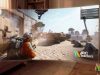
In addition, Engle showed off a fresh look at a mixed reality mode which ostensibly tracks real-world golf balls and clubs so players can work on driving, iron play and putting in a Sim Golf environment.

Check it out in action below:

Traditional golf simulators use large 2D impact screens and sensors to measure ball speed and direction. While they’re generally considered effective for practicing full swings and driving, they tend to be less reliable at the slower ball speeds used in putting and short-game shots.

Worse yet, these sorts of simulator screens lack parallax, as courses are projected at a fixed viewpoint. Looping in a mixed reality setup though could allow golfers to not only build muscle memory with a real ball and club, but have the benefit of golfing in a more realistic environment.

SEE ALSO
VR Design Unpacked: The Best Shotguns in VR (and what makes them feel great)

It’s unsure whether the studio intends on releasing the mixed reality implementation as an update to the current game, or releasing a separate version for location based golf sims.

Engle says however we should expect Golf+ on more platforms in the near future. Although it’s currently only available on Quest, the studio shared plans to expand the game to PC VR headsets.

Additionally, the studio says it’s exploring flatscreen PC gameplay, as well as offering a “unified experience with shared physics, multiplayer, and cross-play across all platforms.”

This article may contain affiliate links. If you click an affiliate link and buy a product we may receive a small commission which helps support the publication. See here for more information.

Well before the first modern XR products hit the market, Scott recognized the potential of the technology and set out to understand and document its growth. He has been professionally reporting on the space for nearly a decade as Editor at Road to VR, authoring more than 4,000 articles on the topic. Scott brings that seasoned insight to his reporting from major industry events across the globe.
  • Looks like a nice idea for professionals that want to train

  • Despistada

    Golf+ is already available on PCVR on the Meta store, just not Steam. The visuals on the video don't look like the Quest version. Note, there's a "launch monitor" where he places the ball. They're over $1k and you'll need to contain the ball when it's been hit. Current "enclosures" are several hundred dollars. I love the idea, but couldn't justify the total cost. Perhaps it's just great PR to get regular punters buying Golf+ and subscribing.

  • Duane Aakre

    It seems like they are spending a lot of time and effort on a really niche thing.

    1) What percentage of the people who play Golf+ even play real golf? Personally, I've played a grand total of 23 holes of real golf and that was over 35 years ago. I have no interest in playing real golf, as it is very expensive and probably hard on a 68-year-old body like mine. So, this whole simulator-thing has no interest to me, and I bet it's not going to interest very many other players.

    2) Who has space for something like this? I play Golf+ in my living room, and the ceiling is tall enough that I don't have any concerns about hitting the ceiling with an 18-inch golf club adaptor attached to my controller. But my ceiling is definitely not tall enough to risk swinging a full-length golf club. So, the only other option would be setting it up in my garage. But I live in Minnesota and the temperature in my garage is around 25F for four months a year. I mean the best thing about Golf+ is on a cold winter day I can put on my headset in my comfortable living room and escape for thirty minutes to some warm golf course in California, Hawaii, or New Zealand.

    • Christian Schildwaechter

      I have no numbers, but VR golfing turned out to be one of the major surprise VR success stories, similar to VR fitness. Both drew a completely different crowd than typical VR games. And while there will be some overlap, a lot of people use VR only for fitness or only for golf. Golf is probably also the category that created the largest number of VR accessories, and the number of 3rd party Quest head straps pales compared to the number of adapters to connect a Touch controller to an actual golf club.

      Consequenty there are a lot of people that bought a Quest just for virtual golf (training), with reviews hinting that gained experience actually translates quite well to the real world. Meta was very aware of this, and early on bundled Golf+ with the Quest 2, triggering some irritation among VR gamers. And Golf+ has been in the Horizon Store sales top 10 forever, basically since it launched.

      If you see Golf+ as a game, you may be turned off by all the hassle and cost involved with actual golf. But for people who already play golf, and who often consider it a social activity, adding a VR golf setup can be tremendously attractive, as it is extremely cheap compared to pretty much everything involving golf, and allows training at any time without having to drive somewhere or pay anything extra. Finding enough space for it will very likely be just a minor problem for them.

      And that is most likely the target group Golf+ is going after with this expanded physical VR golf trainer that probably won't be cheap. It's unlikely they are going after VR gamers that may play an occasional round of virtual golf between gunning down zombies or slicing opponents to pieces with swords.

  • Christian Schildwaechter

    TL;DR: stereoscopy is overrated, most of the VR magic comes from 3DoF head tracking.

    Worse yet, these sorts of simulator screens lack parallax, as courses are projected at a fixed viewpoint.

    Parallax really only matters for things close by. For everything further away than a few meters, humans rely on other depth cues like shadows, objects being partly occluded by others, getting smaller like in a row of trees, blur due to being outside the current focal length, or simply experience. Which is why you can navigate the world or drive a car with one eye closed, or train your muscle memory with a 2D projection of a golf course. Trying to thread a needle or grab a splinter with a pair of tweezers on the other hand can be really challenging with one eye closed.

    There is quite some misunderstanding about how important stereoscopy is for VR. It is mostly relevant for things involving our hands, and a large part of our brain is doing nothing but hand-eye coordination, as this is how we mostly interact with the world. And why a cartoonish game like Job Simulator can be so immersive.

    For "being in the world", 360° head tracking is way more important than stereoscopy. We only ever see a very small part of the world at high resolution. Humans have a ~270°/180° FoV with/without eye movement, and more than 360° if you include head turns, but we see sharply only within ~6° straight forwards, and decently within 18°. The brain constructs a full world view from that and hides that only a very small part is actually processed at any time.

    Which is great for VR, as it allows for performance optimizations like foveated rendering/streaming, or comfort features like vignetting during head turns without the user realizing it. As long as we can look behind us, we will believe it is there. Which is why looking around in a monoscopic 360° Google Streetview image in VR will offer much more of a feeling of presense than looking at a stereoscopic view of the same scene on a monitor, even if in the latter proper parallax will allow you to correctly perceive the depth of close by objects without relying on the other above mentioned depth cues.

    So my guess is that for more physical golf training, just wearing the HMD showing the course will provide the main benefit, as you'd learn to more properly estimate distances simply because it feels more real. Stereoscopy/parallax will only really come into play for putting. And we know that VR impacts memory very differently than flat projections simply because our brain accepts it as reality, leading to memories of things done in VR being very close to those of things experienced in the real world.

    So training on a golf course in VR with a real club will probably be better than on a conventional flat screen simulator because the context will become part of the training. And the next time you are on an actual golf course, these memories will automatically return, not only the muscle memory for the motion flow that the non-VR simulators train.