
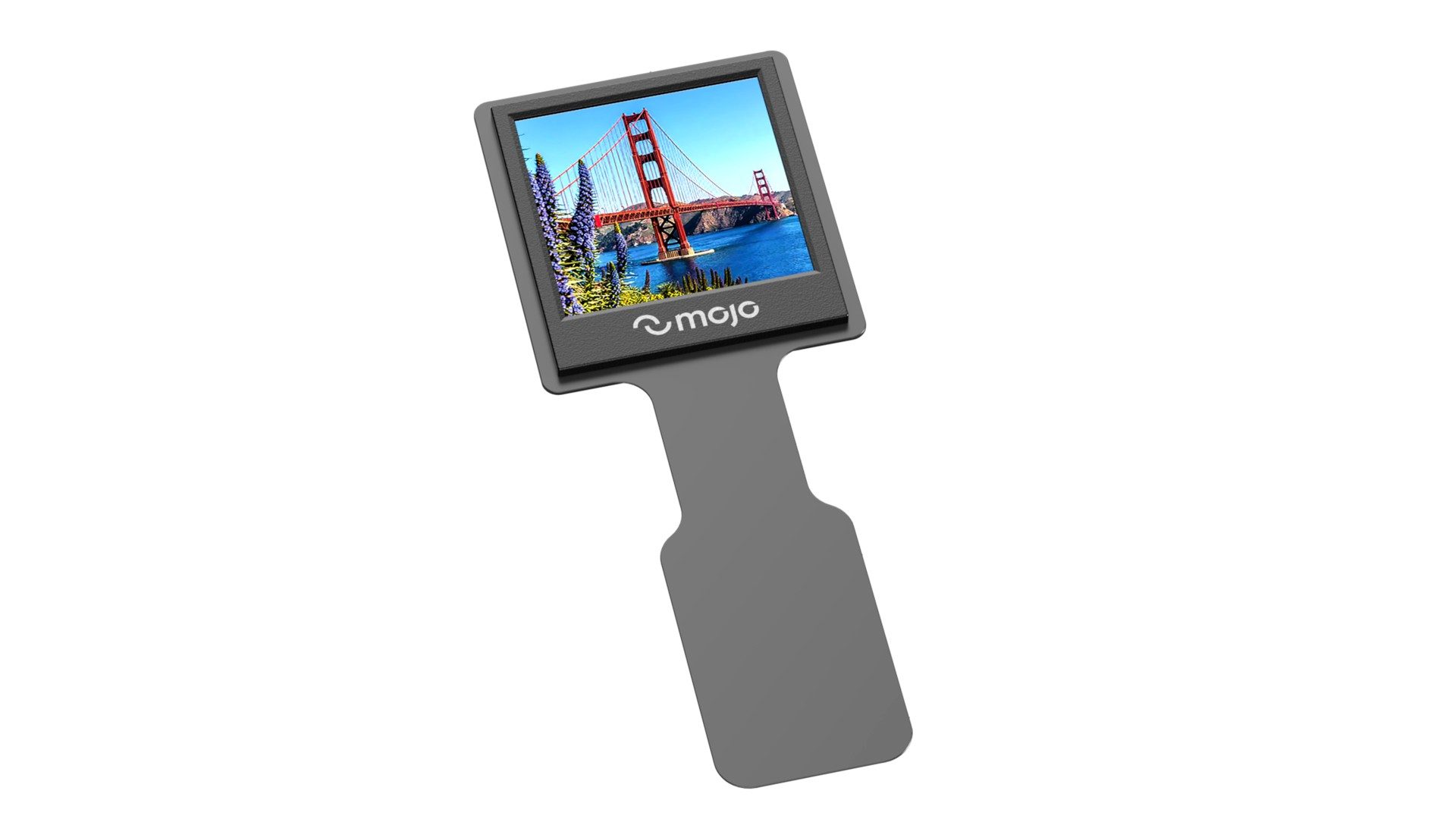
Mojo Vision Secures $75M Investment to Commercialize Micro-LED Displays for XR Glasses

5

Mojo Vision announced it’s secured a $75 million Series B Prime investment round, which the company says will support the commercialization of its powerful and flexible micro-LED platform for XR glasses.

The round was led by Vanedge Capital, and included investments from current shareholders Edge Venture Capital, New Enterprise Associates (NEA), Fusion Fund, Knollwood Capital, Dolby Family Ventures, and Khosla Ventures, and new shareholders, including imec.xpand, Keymaker, Ohio Innovation Fund, and Hyperlink Ventures.

This brings the company’s overall funding to $345 million, according to Crunch Base data; Mojo Vision’s penultimate round came in late 2023, amounting to $43.5 million.

While previously geared towards producing smart contact lenses, Mojo Vision is now all about the underlying micro-LED technology that initially generated headlines back in 2022.
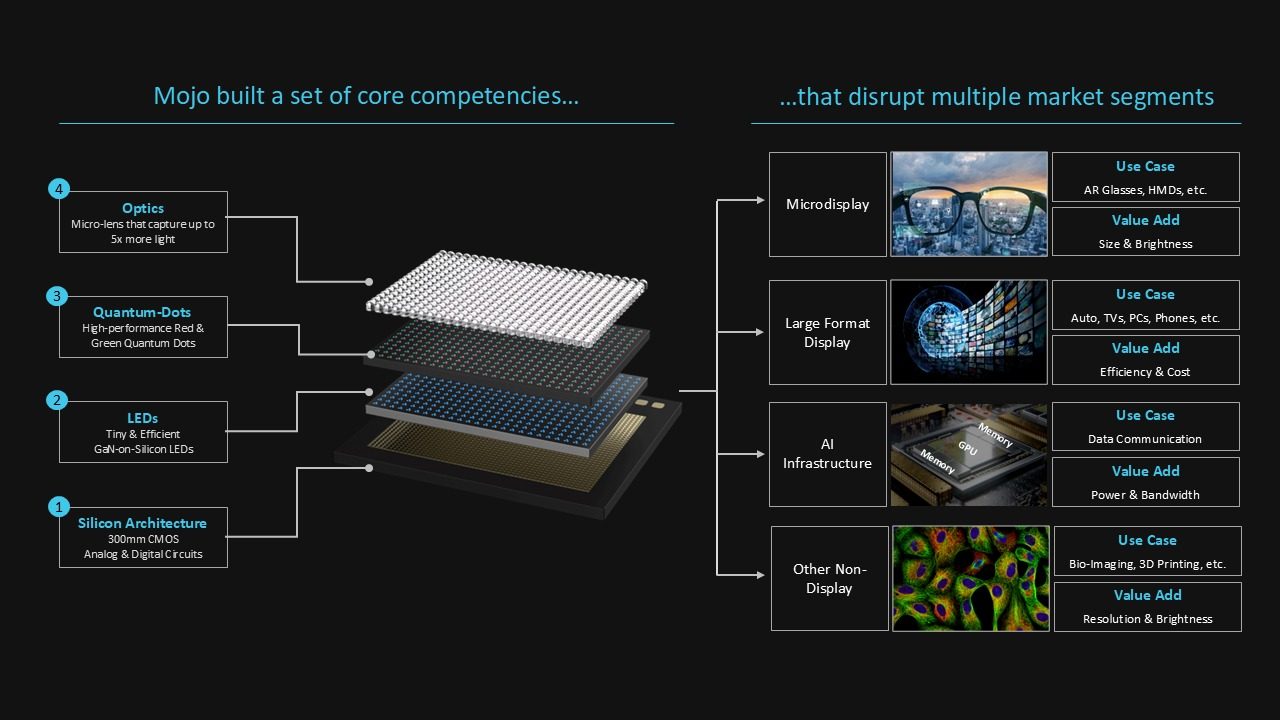
Image courtesy Mojo Vision

At the time, it was expected Mojo Vision would commercialize a contact lens with embedded micro-LED display, however in April 2023 the company announced it was pivoting.

Founded in 2015, Mojo Vision is now building a type of micro-LED technology that allows the mass-production of them onto silicon chips, combining advanced components like gallium nitride (GaN) on silicon emitters, quantum dots, and micro-lens arrays. According to Mojo Vision, this makes the displays very bright, very small, and energy-efficient.

SEE ALSO
'Aces of Thunder' Still Coming in 2025 Despite Recent Store Glitch Showing September Release

“Through our micro-LED technology development, Mojo has made significant advancements in establishing breakthrough performance standards while laying the foundation for micro-LEDs as a platform for AI innovation in large market segments,” said Nikhil Balram, CEO of Mojo Vision. “This oversubscribed funding round and strong industry support mark a new phase in the design and production of our next-generation micro-LED platform. The company is on an accelerated path to commercialize micro-LED applications that can power AI.”

The company says it’s targeting the micro-LED platform to build displays for XR glasses, but also large format displays and optical interconnects for AI infrastructure.


This article may contain affiliate links. If you click an affiliate link and buy a product we may receive a small commission which helps support the publication. See here for more information.

Well before the first modern XR products hit the market, Scott recognized the potential of the technology and set out to understand and document its growth. He has been professionally reporting on the space for nearly a decade as Editor at Road to VR, authoring more than 4,000 articles on the topic. Scott brings that seasoned insight to his reporting from major industry events across the globe.
  • Christian Schildwaechter

    TL;DR: MicroLEDs combine the high brightness of LCD using LED backlights with the high contrast of OLED, offering high durability and energy efficiency, but so far the still way too large pixel size makes them unusable in XR HMDs.

    MicroLED are sort of the holy grail of XR displays. Very simple in theory, just take the advanced LEDs we have nowadays and make them very small. A lot more complicated in reality. But if someone manages to do this, the resulting display should avoid all the weaknesses of current display technology.

    Most displays still use a somewhat uniform backlight and adjustable color filters. In LCDs the backlight is usually made out of white LEDs that can be very bright, but as the color filters cannot completely block it, you get gray blacks and reduced contrast. Some displays improve this by splitting the backlight into thousands of separate dimming zones, which helps, but is still far from controlling each of the millions of pixels. This is often described as miniLED, to make terminology even more confusing.

    OLED panels have self illuminating pixels that can be completely turned off, so they provide great contrast. But they are based on complex organic molecules (hence O-LED) that can't get as bright as LED, tend to break down over time, and unfortunately break down faster if you drive them at high brightness. That makes them unsuitable for the use with pancake lenses that lose about 90% of the visible light compared to only about 15% in Fresnel lenses, one of the reasons PSVR2 doesn't use pancakes. Apple works around the brightness issue in current iPad Pro's by placing two OLED panels on top of each other, but these tandem OLEDs are still rather expensive.

    MicroOLEDs work with pancakes, also using less bright OLED pixels, but pairing them with micro-lenses in front of each pixel that allow more of the light to enter the lens. The current ones all use white background OLED pixels combined with fixed RGB color filters, so they achieve the same contrast as OLED panels, but still waste 2/3 of the light by filtering out either RG, GB or RB. The Sony microOLED displays used in AVP again use two layers of white background OLED to improve brightness, again driving up the price. We expect eMagin/Samsung to release microOLEDs with true RGB OLED pixels, no longer requiring wasteful color filters, in the hopefully not too far future.

    MicroLED would allow for the high brightness of LED, provide the single pixel control of OLED that enables great contrast, without suffering from the degradation of organic molecules, and only emit the desired color, so no wasteful filters are required to remove the unwanted frequencies from white backlights. They are already sold, but with pixels sizes so large that they are only usable in video walls or large TVs, offering high brightness and contrast. Currently available microDisplays using microLED are closer to 480p VGA than the current 4K microOLEDs, so we'll still have to live with compromises for some time.

    • Sven Viking

      Any indication of whether they’d be likely to be much more or less costly to produce than OLED eventually? Or is it far from the point where that could be guessed at?

      • Christian Schildwaechter

        TL;DR: microOLEDs will be cheaper for some time, simply because by the time that microLED become available in XR HMDs, the process issues and low unit number causing the current high microOLED prices will have been resolved. The long term production costs might be roughly similar for both, the very long term (15 years+) production cost might favor microLED, which est. 10-15% yearly production cost reductions. My wild guess for the next few years would be a ~30% yearly price drop for (non-Meta) standalone HMDs using microOLEDs, starting from currently around USD 2000, with Quest 4 still being the most likely candidate for a sub USD 750 microOLED standalone by 2027.

        I assume that by OLED you mean microOLED displays. These and microLED are produced somewhat similar to silicon chips, allowing for similar fast progress with rapidly falling costs. But while our insatiable need for more transistors in CPUs and GPUs keeps driving up prices, pixel count increases at some point become limited by human vision, causing smartphones to now mostly stick to 2K displays, with only a few 2.5K/4K phones available. Companies still improve brightness, contrast and refresh rates, but by now decent 6" 2K TFT displays are sold on Alibaba for USD 15 and less. Longterm displays get cheap, and small displays not requiring a lot of raw materials get very cheap. I bought an unhealthy amount of small LCD and OLED displays for microcontrollers, often for less than USD 1 per display incl. worldwide shipping.

        You basically always have an initial time during which the technology is still somewhat lacking and very expensive, simply because it is new with immature processes, and sold in low numbers. Which is where we still are with microOLED. The Sony microOLED displays in AVP cost USD 700 partly because the new dual layer OLED backlight used to increase brightness resulted in low yields, they basically had to throw out a lot of them. And Apple apparently rejected cheaper microOLED from BOE due to quality issues. But there is nothing that would make microOLED tech fundamentally more expensive than other similar technologies like LCOS in the long run, it just takes a while to bring down the prices.

        The initial phase with lots of quirks is usually followed by a couple of years during which processes improve, but cost doesn't fall all that much because aspects like resolution or brightness etc. still rise, up to the point where further increasing it no longer makes sense, and prices fall a lot more. We are very far from that esp. regarding brightness, with only about 300nits or less reaching the eyes in AVP, while you want 1500+ nits peak for HDR for indoor use, much more outside. The Hisense 110UX miniLED TV already offers about 10K nits peak for small parts of the image, 2.5K nits for 20% of the display or 1K nits for the whole 110" display, and HMDs only get away with measly low brightness due to lightseals.

        How fast prices will fall is always hard to predict and depends on a lot of factors. In principle OLED panels (like in PSVR2, Quest 1, not microOLED) should be cheaper to produce than LCD (and much cheaper than microOLED), as you can basically inkjet print OLED between two plastic sheets serving as anode/cathode. Expect flexible OLED displays printed on milk cartons in the not too distant future. Practically LCD have been established over decades with very optimized, cost effective manufacturing, have some fundamental advantages regarding brightness and longevity, leading to (cheap) OLED phone displays still being about 30% more expensive than LCD displays.

        Estimates for falling production costs for miniLED are 10%-15% per year, while the cost for products based on miniLED is expected to fall 40%-50% from 2024 to 2025. Again because the first generation of products is still (expensive) first mover technology. I'd expect the production cost to fall at a similar rate for microOLED, with a few years of head start on microLED.

        I am not quite as sure how fast prices for HMDs using microOLED will fall, simply because these are currently still high price niche products selling in very low numbers. But based on falling production costs, improving processes, growing unit numbers and increased competition, a wild guess would be 30% per year for standalones, giving us 2025 USD 2000 (Project Moohan, Pimax Dream), 2026 USD 1400 (Deckard?), 2027 USD 1000 and then probably slowing down more towards the 10%-15% yearly reduction in production costs.

        For 2027 we already expect the Apple Vision Air at half the current price, so USD 1750, and the Quest 4 that will (hopefully) feature microOLEDs. Maybe only 2.5K ones, but (also hopefully) keeping a price similar to Quest 3, with Meta again selling it at cost for maybe USD 600, aimed at enthusiasts, with a companion Quest 4S still using Fresnel (and OLED panels???) for USD 300. A microOLED Quest 4 would be the first HMD selling in sufficient numbers to allow for lower prices for microOLEDs thanks to economies of scale.

        These predictions may fall flat on their face if some insurmountable obstacles show up, like nobody finding a way to significantly increase the brightness of microOLEDs. This could lead to less adaption, keeping prices high, while at the same time increasing investment in microLED to solve this issue, which could result in microLED becoming cheaper than microOLED. This isn't likely to happen, as HMDs with microOLEDs are already usable despite the low brightness, and the real problem being the inefficient pancake lenses. A HMD could switch to (heavier and larger) aspheric lenses like those used in the Varjo XR-4, offering similar clarity to pancakes, but losing only ~10% of the light compared to 90% in pancakes, and reach much higher brightness even with the current microOLEDs.

  • The word "AI" has been put in the press release just because now we should always mention it…

    • Sven Viking

      How will the AI read people’s prompts if it doesn’t have high-quality displays to read them from? This tech will allow them to build smaller AIs who work in smaller cubicles with tinier monitors, enabling a greater concentration of AI agents per cubic metre.