
Steam Frame vs. Quest 3 Specs: Better PC Streaming, Power & Hackability

VR games and user comfort are still big question marks

30

Want to know how Valve’s newly announced Steam Frame standalone headset stacks up against the competition? Read on to find out.

Steam Frame is a lot like Steam Deck; it can play pretty much all of Steam’s game library out of the box, which includes flatscreen content based on x86 architecture—basically everything on Steam—and also now PC VR games. That means you can download modern flatscreen and VR titles and play on-the-go, no wires or PC needed. More on that below.

Primarily though, Valve says it’s designed to stream PC VR games wirelessly, which it does through a Wi-Fi 6E dongle you plug straight into your computer (or the newly announced Steam Machine). Our hands-on with Frame’s streaming quality was promising.

Quest 3 can stream PC VR games too, albeit in a roundabout way that requires you to stream through your home’s Wi-Fi router, which can cause some bottlenecks since the video stream needs to go from your PC, to the router, and then to the headset. Valve’s solution cuts out that middle man.
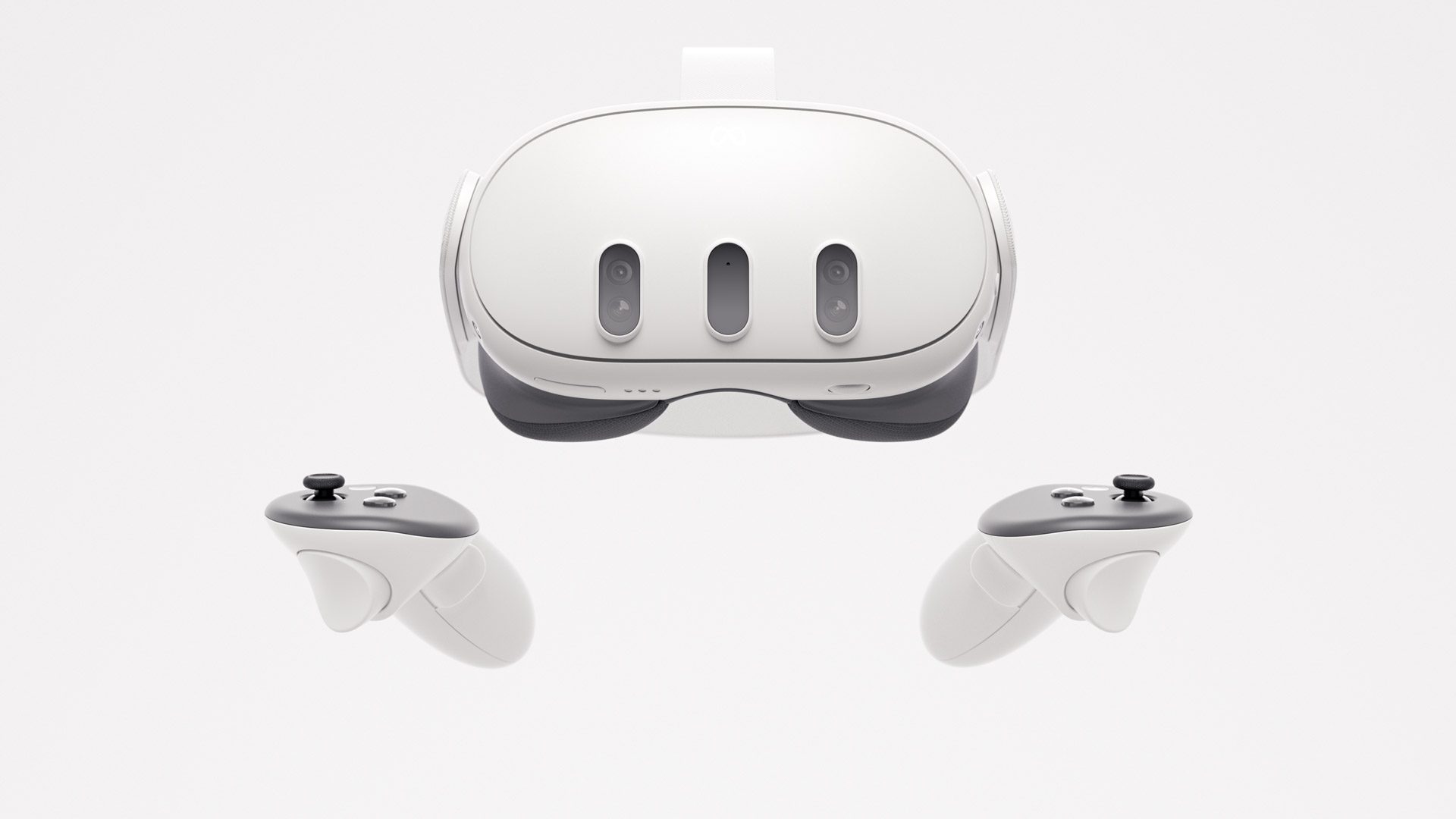
Meta Quest 3 | Image courtesy Meta

The big difference though is in power and game compatibility. While both Quest 3 and Frame feature ARM-based Qualcomm Snapdragon processors (Frame’s is more powerful), only Frame can natively play x86 Windows and Linux content thanks to its built-in compatibility layer.

Quest 3 can only natively play games compiled for ARM—albeit from a massive library, all of which are certified to work on the headset. The same can’t be said about Frame just yet.

Valve is distributing Frame dev kits ahead of Frame’s 2026 launch to make sure PC VR studios can optimize; we expect the company to also have some sort of badging system similar to Steam Deck too so users know what works great, okay, or not at all. That said, Valve isn’t stopping you from trying to download and play anything (x86) available on Steam.

Another big difference is the hackability of Frame. The headset natively run SteamOS, although you can technically install any OS on it you want (or realistically can), since it’s an open platform and gives you direct access to Linux for all of your hacking needs. That’s something you definitely can’t do with Quest’s Horizon OS due to its locked bootloader (i.e. no root access).
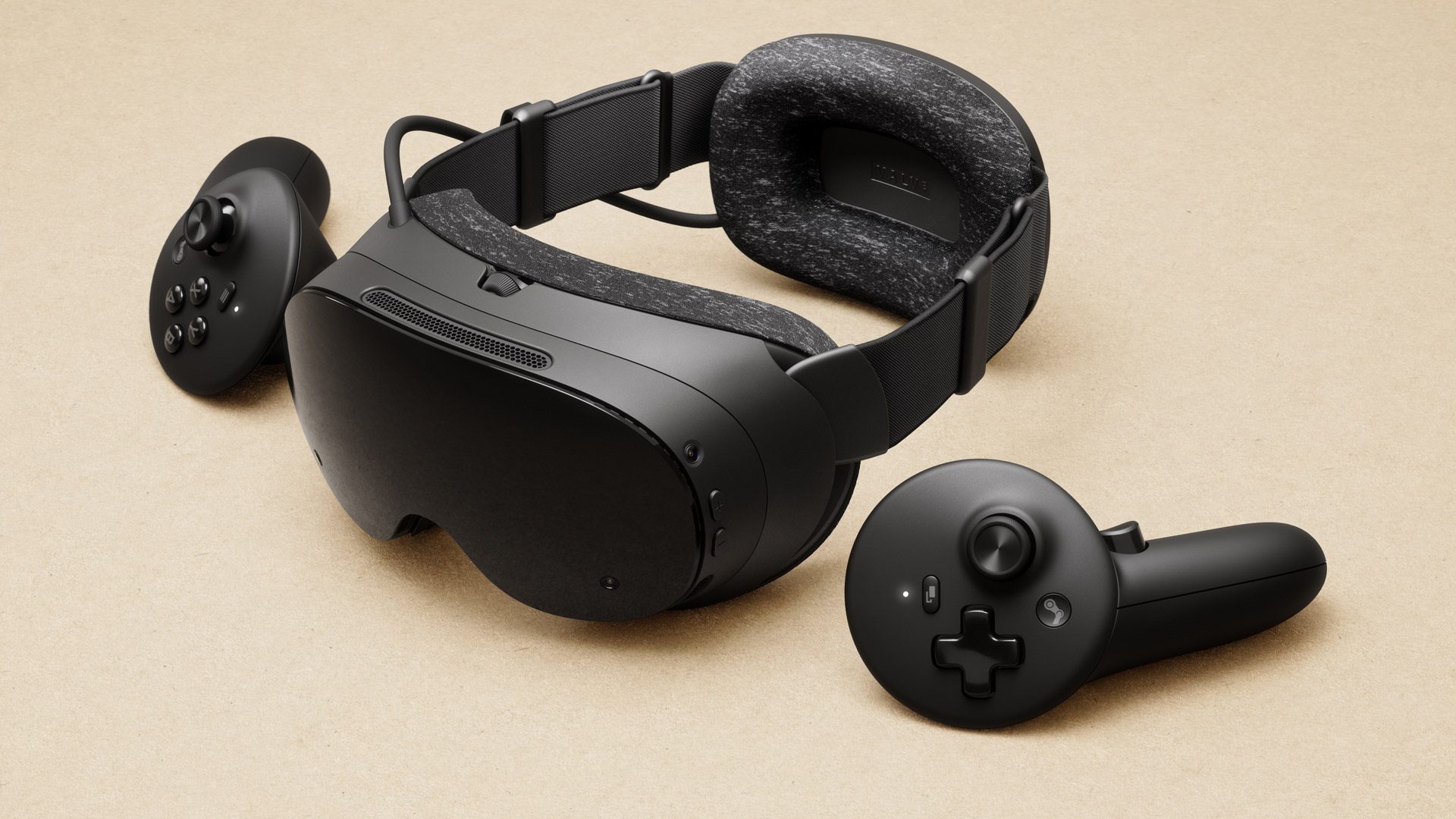
Image courtesy Valve

Valve is so confident in Frame’s SteamOS that the company tells Road to VR the operating system “would be great for other [VR] devices.”

What’s more, Frame also has a user accessible expansion gen4 PCIe port, which supports up to two 2.5 Gbps cameras… or anything you can think of. Additionally, Frame sports an microSD card slot for up to 2TB of additional storage—both of them clear wins for makers and gamers looking to expand Frame out of the box.

Steam Frame could also promise better comfort over Quest 3, although the jury is still out. The headset features a front ‘core’ component, including the displays and optics, which weighs in at only 190g, putting the bulk of the remaining 245g in the total 435g package to the headstrap, which features a rear-mounted battery (21.6 Wh lithium ion). The default config shipped in the box (above) notably lacks a top strap though, which Valve is selling as an optional add-on later to go along with Knuckles-style controller straps (below).
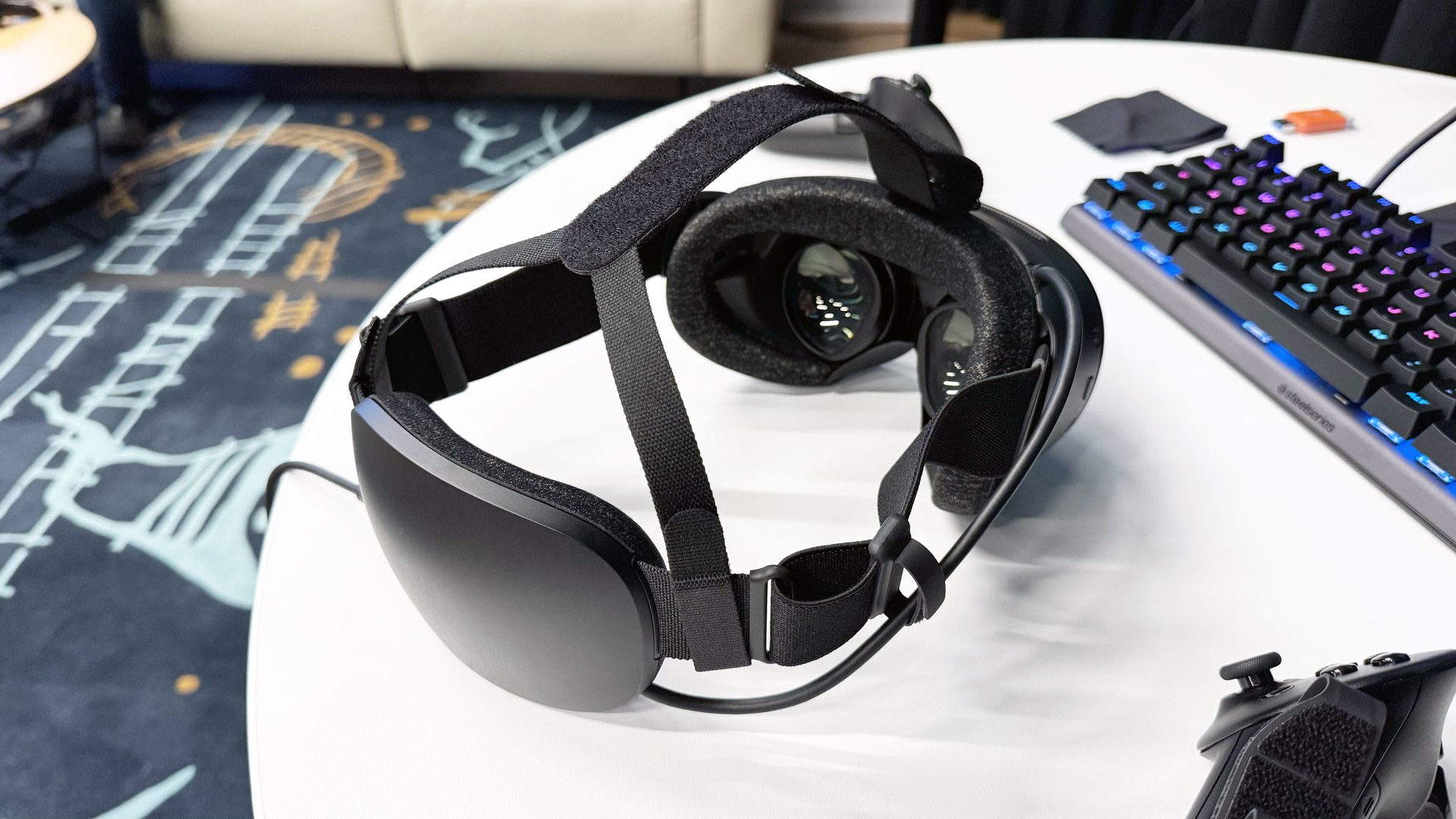
Photo by Road to VR

Where things even out somewhat (at least on paper) is the headsets’ displays. Quest 3 serves up a 2,064 × 2,208 per-eye LCD, while Frame has a 2,160 × 2,160 per-eye LCD. Both are clocked up to a refresh rate of 72-120Hz, although Frame is said to allow up to 144Hz in an experimental mode.

Still, Frame does let down in the passthrough department; it only has monochrome passthrough, harkening back to the Quest 2 days—an odd (and probably cost-saving) decision by the company. On the other hand, Quest 3 offers a full-color passthrough, which is undoubtedly the better way to not only checking on your surroundings occasionally while immersed in VR, but also play games on a giant screen in your living room.

It’s undoubtedly early days, but Frame could be a very compelling package over Quest 3. Besides the raw spec sheet (seen below), a big missing piece in the equation though is still price and release date. Valve says we’re sure to learn more on that front in “early 2026,” which they say could come somewhere below Valve Index, which is priced ‘all-in’ at $1,000.

In the meantime, you can read our deep dive review of Quest 3 and our hands-on with Steam Frame for more info.

Specs: Steam Frame vs. Quest 3
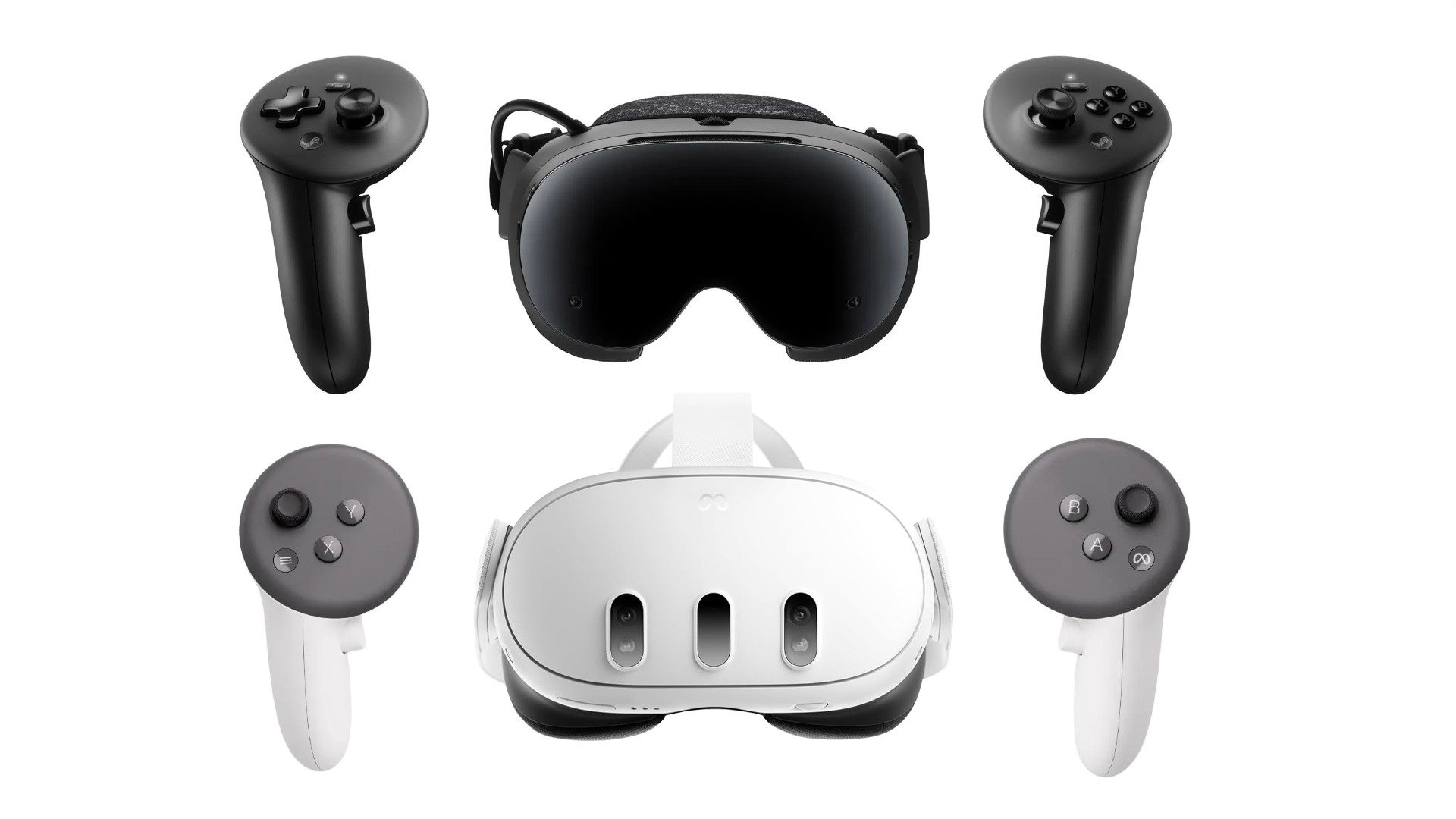
Steam Frame (top), Quest 3 (below) | Images courtesy Valve, Meta
Steam Frame Quest 3
Base Retail Price TBD (early 2026) $500 (released in 2023)
Weight 190g core, 435g (core, headstrap, incl. facial interface, audio, rear battery)
515g (with stock cloth headstrap)
Chipset Snapdragon Series 8 Gen 3 (SM8650), 8 core CPU ARM processor (4nm)
Snapdragon XR2 Gen 2, 6 core CPU ARM processor (4nm)
RAM 16GB Unified LPDDR5 RAM
8 GB Unified LPDDR5 RAM
Operating System SteamOS
Horizon OS (Android based)
Wi-Fi Wi-Fi 7, 2×2 – Dual 5Ghz/6Ghz streaming for simultaneous VR and Wi-Fi WiFi 6E
Storage 256GB / 1TB UFS storage options
528GB / 1TB storage options
Expanded Storage microSD card slot for extended storage N/A
Optics Pancake optics Pancake optics
Display 2,160 × 2,160 LCD (per eye), 72-120Hz refresh rate (144Hz experimental)
2,064 × 2,208 LCD (per eye), 72-120Hz refresh rate
FOV up to 110 degrees
110 degrees horizonal, 96 degrees vertical
Tracking 4x outward facing monochrome cameras for controller & headset tracking
4x outward facing monochrome cameras for controller & headset tracking (includes depth sensor)
Dark Environment Tracking Outward IR illuminator for dark environments N/A
Passthrough Monochrome camera passthrough (1,280 × 1,024)
Color camera passthrough (1,280 × 960)
Eye-tracking 2x interior cameras for eye tracking N/A
Rendering enhancements Foveated Streaming: eye-tracking drives video stream, sending highest resolution to where you’re looking Fixed Foveated Rendering: continuously renders highest resolution in center of display (no eye-tracking)
Other Wireless Adapter included, Wi-Fi 6E (6Ghz)
Wireless streaming via Link/Router chain
Audio Dual speaker drivers (per ear), integrated into headstrap
Dual speaker drivers (per ear), integrated into headstrap
Mic Dual microphone array
At least 3 microphones (unconfirmed)
Port USB-C USB-C
Expansion Port User accessible expansion port – ( 2x 2.5Gbps camera interface / gen4 PCIe ) N/A
Battery 21.6 Wh Li-On Battery
19.44 Wh Li-On Battery

More Steam Frame Announcement Coverage

Valve Unveils Steam Frame VR headset to Make Your Entire Steam Library Portable: Valve shows off Steam Frame, the standalone headset that can stream and natively play your entire Steam library—with only a few caveats right now.

Hands-on: Steam Frame Reveals Valve’s Modern Vision for VR and Growing Hardware Ambitions: We go hands-on with Valve’s latest and greatest VR headset yet.

Steam Frame’s Price Hasn’t Been Locked in, But Valve Expects it to be ‘cheaper than Index’: No price or release date yet, but Valve implies Steam Frame will be cheaper than $1,000 for the full Index kit.

Valve Says No New First-party VR Game is in Development: Valve launched Half-Life: Alyx (2020) a few months after releasing Index, but no such luck for first-party content on Steam Frame.

Valve is Open to Bringing SteamOS to Third-party VR Headsets: Steam Frame is the first VR headset to run SteamOS, but it may not be the last.

Valve Plans to Offer Steam Frame Dev Kits to VR Developers: Steam Frame isn’t here yet; Valve says it needs more time with developers first so they can optimize their PC VR games.

Valve Announces SteamOS Console and New Steam Controller, Designed with Steam Frame Headset in Mind: Find out why Valve’s new SteamOS-running Console and controller will work seamlessly with Steam Frame.

Steam Frame vs. Valve Index Specs: Wireless VR Gameplay That’s Generations Ahead : Valve Index used to be the go-to PC VR headset, but the times have changed.

This article may contain affiliate links. If you click an affiliate link and buy a product we may receive a small commission which helps support the publication. See here for more information.

Well before the first modern XR products hit the market, Scott recognized the potential of the technology and set out to understand and document its growth. He has been professionally reporting on the space for nearly a decade as Editor at Road to VR, authoring more than 4,000 articles on the topic. Scott brings that seasoned insight to his reporting from major industry events across the globe.
  • Ondrej

    The first ever mainstream PC on face (not running a joke of a restricted tablet OS like everyone else) and it's not a proper "spatial computer" because it has monochromatic cameras and I assume no hand/finger tracking.

    • AngryGinger808

      I assume not regarding the finger tracking, unless it is compatible with those lighthouse things required to track the index.

  • Stephen Bard

    Your "Hands On" article states that the Steam Frame has a noticesble "screen-door" effect, whereas the Quest 3 does not. This makes the Steam Frame an unacceptable alternative.

    • AngryGinger808

      This is going to depend on the price, but the specs don't look great, disappointing you might say. At least I'm not kicking my self having bought a quest 3 not even two weeks ago…

    • I was incredibly surprised by that, too

    • Christian Schildwaechter

      Let's hope that this can be somewhat fixed/reduced between the current early development units and the Steam Frame Valve will actually ship to customers.

    • MarcDwonn

      Could you pls link this "Hands On" article, i've not seen it yet.

    • Fred

      Screen door was acceptable on OG Vive for 95% of use cases and it'll be nowhere near that bad in the Frame.

  • polysix

    After all the hype and waiting LMAO.. what a complete disappointment! Not just LCD but CRAP LCD (no local dimming and years old resolution). It's like it's half good in the new stuff it does, but it's stuck on an really crappy sub quest 3 (and I'm no fan of quest or any LCD in VR) with mono pass through and a higher price. It's weird and not very desirable.

    Most core PC VR users are saying NO and will go to high end microOLED (word on the streets already) and most noobs/casuals are like 'why should I upgrade from my quest?'.. .the rest are on PSVR2 on PS5 AND PC (like me) saying "this is worse much much worse than PSVR2 with 200 nits vs 100 nits, HDR, better controllers, Haptics, display port, OLED!!!!!! wider FOV… 3 years available and only around $400…

    Who exactly is going to buy Frame for anything other than just above or just under quest 3 price? Only good thing is it's not META.

    • Vinay

      I would have considered and compromised with all the downsides if the FOV was better than index.

    • Some people hyped this too much and expectations were too high

      • Carlos

        I didn't know Vive was going to release a new headset and I found it pretty neat. If it's Quest 3 price I would definetelly but this instead of Quest. It has Eye Tracking, looks way more confortable and has this thingy to make the connection with wireless PCVR way smoother. I really don't care about passthrough, to be honest, I think Meta messed up spending money with Mixed Reality on a VR headset, It's terrible and does not make much sense to me.

      • Christian Schildwaechter

        There is an astonishing difference between the reception from VR enthusiasts vs a general technical audience. While here the overall reaction is mostly negative due to the underwhelming specs, on sites like Ars Technica with a very technical audience there are mostly positive reactions from people saying they have been interested in VR, but didn't want a Meta based HMD or anything involving a lot of hassle. They see the Steam Frame as the easy plug'n'play solution they have been looking for.

        These people haven't had years long discussions about LCD vs. OLED or minimal pixel count, they were just looking for a wireless Steam version of a PSVR2, something you connect to a PC and it just works. And this is probably where the Frame with its moderate resolution, supported by eye tracking foveated streaming/rendering will actually rule, allowing for near tethered low latency and high quality without having to deal with Wifi configurations, and running PCVR decently even from mid-range GPUs not costing thousands.

        So yeah, expectations have a very big influence on the reception.

        • Fred

          All that and the fact you have a fully mobile Linux PC on your head. I'm still on the OG Vive at home so it'll be a big upgrade for me.

    • kakek

      Overall, I kinda agree with you. But maybe tone it down a little, there's still a few good points.

      Dedicated wireless streaming dongle with foveated streaming could be nice.
      Passthrough is not a big loss.
      The Snap S8G3 is significantly more powerful than the XR2, at least on paper.
      OS could be an important factor, and steamOS on deck is pretty great at what it does..

      Also when comparing display you're ignoring the lenses. You can't do OLED plus pancake lenses, because they absorb to much light. Which is why psvr2 uses
      fresnel, with their small sweet spot and lower fov. If you want led with pancake, it's micro led. Which the vision pro, Samsung, and a few other premium headset do. But for an even higher price !
      LCD is the only choice if you want pancake lenses while keeping price under 1k.

      I'd say it has a few significant advantages over Q3, even if nothing groundbreaking. But that's only if it retails at similar price, and I don't think it will.

      • Christian Schildwaechter

        TL;DR: there are a number of things the Frame does great, and the performance could be quite good, but that depends a lot on what level of magic Valve pulled of regarding emulation speed and thermal controls for a SoC not designed for VR.

        The Frame lenses seem to be excellent, with basically no glare. The combination of foveated streaming and a dedicated 6GHz WiFi dongle also seams to offer an unprecedented solution that closely matches tethered HMDs in latency and clarity, at least according to Linus from Linus Tech Tips, a high frame rate, low latency fanatic.

        The SD8 Gen 3 can be significantly faster than the XR2 Gen 2. The XR2 uses only performance and efficiency cores, which run between 1.6GHz and 2.05GHz in Quest 3, while the matching SD8 Gen 2 runs them at 2.8GHz. And the SD8 Gen 3 features an additional, much larger and faster X4 high performance core at 3.3GHz, with the performance cores running at 3.15GHz.

        So its peak performance is much higher than any XR2, which is configured for permanent high load, clocking the cores lower to avoid thermal throttling. Qualcomm emphasized extra GPU performance with the XR2 Gen 3, adding about 150% compared to Quest 2, and Meta underclocks the CPU part to where you only see a 14% CPU improvement over Quest 2 in graphics heavy apps on (according to slides Meta showed during the Quest 3 introduction).

        This may be very important esp. for running (emulated or ported) PCVR games that are often physics heavy, expecting a much faster CPU than is available on mobile. The GPU performance may be the lesser issue here, as translation from DX8-12 to Vulkan is very efficient, and ETFR will further reduce the rendering load, but not the physics calulation load.

        The big problem is that the SD8 Gen 3 is a smartphone chip, targeting short high load bursts followed by longer idle times, where the phone would only use the efficiency or even just the extra low power cores, dramatically reducing power draw and heat production. SteamOS on the Steam Deck is basically the wet dream of mobile power optimization and power consumption, so there is a decent chance that Valve manages to pull off using a smartphone SoC in a VR HMD, when everybody else sticks to Qualcomm's XR2 line optimized for constant load without throttling, at the cost of lower clocks/performance.

        • Navhkrin

          A chip doesnt get optimised for high burst or constant throughput. A chip is simply made to execute generic code instructions as fast as possible. What defines that burst behaviour is the insufficient cooling on mobile phones. On equal footing Gen 3 annihilates XR2

          Given the amount of detail they have given to cooling (gamersnexus video) I have no doubt that it will be capable of driving Gen 3 on max constantly

          • Christian Schildwaechter

            A core by itself may not be optimized for high burst alone, but a SoC most certainly is. And in reality the reason why SoC now have several types of cores is exactly because they are optimized for either burst, sustained or low power performance.

            The SD8 Gen 2 had a 1/2/2/4 high performance/performance/efficiency/low power core configuration, while the equivalent XR2 Gen 2 had a 0/2/3/0 configuration. There is no way you can drive all cores of the SD8 Gen 2 at the same time, the TDP simply doesn't allow it, and you cannot simply overclock and cool it with liquid nitrogen. The XR2 Gen 2 is also produced on an older Samsung process that is sufficient for its significantly lower core clocks and reduces the price.

            So in effect you can run the highest performance level possible on the XR2 Gen 2 with "normal" cooling for a longer time. You cannot do the same with the SD8 Gen 2, where this would quickly lead to thermal throttling, but that is by design, as the high performance core is only used for burst activities. And the main reason for this is to allow the whole phone to be able to return to a low power state faster, which more than compensates the higher power draw of the burst core.

            I'd expect Valve to have come up with decent cooling for the SD8 Gen 3, and easily outperform the Meta headsets that underclock the CPU. But there is only so much you can do in a 195g core module, not allowing for some crazy overclocker cooling setup. So it is very unlikely that even Valve will be able to run the X4 high performance core at its max speed for more than a few minutes, let alone in parallel to the performance and efficiency cores. The SD8 Gen 3 with a 17W peak/8W sustained power TDP is simply not designed for that.

          • Navhkrin

            They can easily drive it at 17W sustained, they arent limited to super small form factor of smartphone that also carries battery and touch screen and needs to be water proof. 17W isnt even difficult to handle.

          • Christian Schildwaechter

            TL;DR: No, they cannot easily drive it at 17W sustained. They don't even try, because that would be stupid, and the Gamers Nexus video explains why.

            The Steam Frame is not a PC where you can add lots of airflow and cooling, and phone SoC work very differently from PC CPUs that are mostly designed for sustained load. Apple uses similar core configs on both Macs and iPhones, but Qualcomm relies a lot on alternating between burst and low power cores.

            And the rules for max power are pretty universal. On high core CPUs like Xeon the per-core clock goes down a lot when you run all of them in parallel. People using old Xeons in gaming rigs regularly disable extra cores to allow the remaining ones as higher speed, because many games need more single core peak than multicore performance, possible as the disabled cores no longer count against the total TDP. And while PCs and consoles can just throw more power at things to improve performance (up to the chips limits), in mobile devices everything is about saving power, and running anything at max TDP for a longer time is just plain stupid, as relative performance gains decrease with higher power, while it kills battery life. With a Steam Frame 21.6Wh battery, just the SoC alone would burn through this in about an hour at max TDP, even without the RAM or very bright displays and other parts eating more power. If we assume that Valve is aiming for at least 90min play time, the whole system mustn't draw more than 14.4W sustained.

            The SD8 Gen 3 is designed for a sustained TDP of 8W, with short bursts. And in the Games Nexus Steam Frame engineering deep dive the Valve engineers clearly state that to even test running the SD8 Gen 3's max thermal dispensation, they had to custom build a water cooled solution to drive it without throttling. Through clever PCB layout Valve was able to add a second heat pipe for improved cooling, but that still doesn't allow them to drive it at twice the designed sustained TDP, which would required for max load. They did a lot of clever things like very precisely measuring the separate power rails for the different SoC clusters to learn where exactly the power went, plus tons of thermal sensors all over the device, but this is to find the optimal performance/power balance, not to magically allow them to drive the SoC way beyond its physical capabilities.

            Instead they will be able to configure a game specific optimal power distribution. One game with sustained load might only use performance cores with the GPU fully enabled, another turn-based game with regular compute bursts instead use the high performance core for computation, increasing heat, but then allowing the whole SoC to cool down afterwards. It does not mean running the SoC at full power, it means running the SoC at optimal power/performance ratio. Pretty much what made up "Valve magic" on the Steam Deck.

            And they aren't even maxing out the cooling capacity of those two heat pipes because this would require a very large and noisy fan, with the Valve engineers saying they are aiming for a "sweet spot" for efficient cooling vs. noise generation. Just like on the Steam Deck, TDP will be user adjustable, so you will be probably be able to drive the fans at max speed and the SoC at 17W, but that will nonetheless quickly lead to thermal throttling. And they state that a lot of components like the Wifi chips and displays are thermal sensitive, so their performance will suffer when driving the Frame outside of the recommended TDP. Not to mention that wearing a hot HMD would suck.

            Just like on the Steam Deck, the user adjustable TDP will be most useful for lowering power consumption for specific apps to allow for longer battery run times. And Valve has invested a lot of effort to run the SD8 Gen 3 at the highest performance that makes sense for different games while keeping a lot of other factors like battery and comfort in mind. Not the highest performance that it could technically achieve (with a water cooler). If you didn't get that from the Gamers Nexus video, I'd suggest watching it again.

          • Navhkrin

            Nothing you said is contrary to what I said. Steam Frame is not a PC, but nor are the power draw levels remotely close to what one sees in PC (400-500W vs 17W)

            Assuming that Valve aiming to achieve 90 min usage due to battery does not mean their system is incapable of running Gen 3 at max load sustained (albeit with shorter runtime at choice of user).

            No, you don't need water cooler to cool at 17W chip (XD). They did that for testing purposes.

            My dude, you keep dropping these 5 paragraph messages and you mention things completely unrelated to what we are talking about like your assumption on how long Valve wants this to run. Keep it to context or I won't bother reading next time. We are specifically talking about whether cooling is adequate to keep SoC running sustained without thermal throttling.

          • Christian Schildwaechter

            Nobody said it would be hard to cool down 17W, that was never the question. What you claimed (before you edited your post) was that you were sure that Valve would drive the Frame at max performance all the time (17W TDP for the SoC plus more for RAM, displays, etc.) And that is just nonsense, and everything I wrote was regarding this being nonsense, both regarding technical feasibility with a phone SoC and the impact on battery life on a mobile HMD.

            And of course you don't need watercooling for a 17W SoC, but if you listened to the DF video, you'd have learned that they build one anyway. The reason was not to run the chip at 17W, but to observe thermal creep throughout the system when running all the cores at max load (like you suggested) while preventing the SoC from throttling down, thus changing the thermal profile. Basically driving the SoC beyond what would regularly be possible due to it throttling once it runs too hot, which would prevent to exactly locate the source/path of the heat from the chip segments to the surrounding system, as some parts would constantly clock up or down. This is how they found where most of the heat went and came up with the second heat pipe solution on the other PCB side.

          • Navhkrin

            You are seeing hallucinations now. I've edited my post before your response, immediately after posting it to fix a typo. I've never claimed that "I was sure Valve would drive it at max TDP all the time" nor would I ever make such an argument as it makes no sense whatsoever. There is no reason to drive it at max TDP out of game, no reason to drive it max TDP when streaming. I'd suggest reading posts more carefully before answering them as it seems you tried to counter argue without even reading the "capable of" part.

            I've listened to part where they talk about water cooling and as you yourself mentioned it had nothing to do with needing to cool final 17W chip. So again, it is pointless that you even brought that up to discussion because they literally used it to optimize design during development.

  • Agree on the analysis, but I think that more than the simple specs, it will be the ecosystems that will make a difference…

    • Arno van Wingerde

      Up to a point: Quest3 runs its own application PLUS Steam games on a PC. Steam frames runs Steam games smoother and have better PCVR streaming, but I suspect running Steam games standalone is going to be a very low end option…

  • Veks CZ

    Nice AI sheet. :D Quest 3 528GB (WTF) and 1TB variants? Give me them please!

  • David Barlia

    The murky resolution and distortion of Quest 2's passthrough were far bigger issues than the fact that it was black and white. But here's a thought: If the Snapdragon 8 Gen 3's AI capabilities are up to it, it may not even matter that the passthrough cameras are black and white. There are already real-time AI systems to transform the look of your passthrough.

    One more thought: With the inclusion of eye tracking and double the RAM, I suspect the perceived resolution of the Steam Frame may be significantly better than the Quest 3.

  • eStorm626

    The only fact this headset is NOT from meta is a huge factor of likeness, the reason I owned a vive back to the first days of VR, then an index is because it was the best available device I was comfortable to use regarding my privacy…
    Never ever I will buy a piece of tech from meta it is only sucking up personal data and will sooner or later use it against the users to turn the quest into some sort of giant advertising board with dark pattern mechanics like it does on his other platforms

  • Arno van Wingerde

    One aspect missing in the comparison
    is the effect of foveated rendering, which combined with the somewhat better processor will give the Valve a nice advantage in either standalone mode, coupled with a Steam machine to maybe get closer to a heavy game PC with way more TFLOPS than people might expect and also help with a heavy game PC. Combine this with better streaming and the Frames could deliver superieur graphics compared to the Quest3 across the board.

  • Zenek stachu

    Hope not dobule the price or else not worth it. It will be higher than quest 3 no dbout, the question is how much valve will go?