
Valve Expands ‘Steam Link’ PC VR Streaming to More Headsets and Opens the Door to Android XR

14

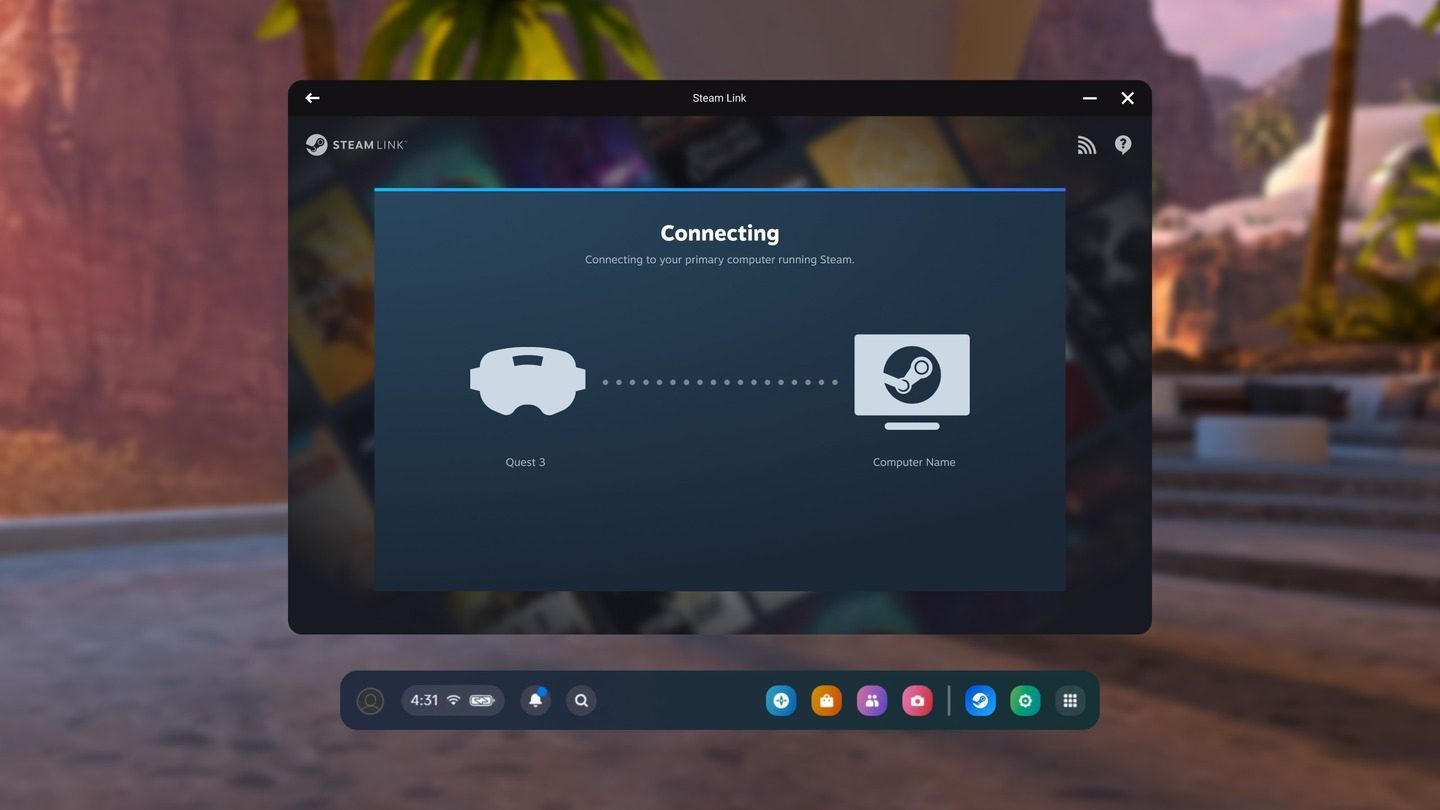
Valve today announced that it’s bringing its wireless PC VR streaming software, Steam Link, to five more headsets from PICO and HTC. The company also plans to make it easier for headset makers to bring Steam Link to even more headsets in the future.

The News

Valve has released Steam Link on the PICO Store and HTC’s Viveport store.

Supported Pico headsets include the Pico 4 Ultra, Pico 4 (and 4 Pro), Pico Neo3 (and Neo3 Link). The first supported HTC headset is the Vive Focus Vision, and Valve says support will be added for the Vive XR Elite “later this year.”

Steam Link makes it easy to play PC VR games by allowing supported headsets to connect wirelessly to a PC on the same network. Users can then access their library of PC VR content through the SteamVR interface, and delve deep into the largest library of PC VR games, many of which aren’t available on standalone headsets, like Half-Life: Alyx (2020).

SEE ALSO
XR Glasses Maker VITURE Secures $100M Investment as Wearable Segment Heats Up

As part of the announcement of Steam Link launching on new headsets, Valve said it also plans to release a Steam Link APK so that “other hardware manufacturers [can] validate Steam Link support on their headsets.” That should mean that future headsets will be able to more easily add support for Steam Link with little to no involvement with Valve.

Valve also said the APK will “allow users of unsupported headsets to explore compatibility and available features,” which means modders and tinkerers might be able to tap into Steam Link’s capabilities even on technically unsupported headsets.

My Take

Steam Link was first launched on Quest 2 and Quest 3 back in 2023. It was an unexpected move, but reaffirmed Valve’s commitment to make SteamVR accessible to as many headsets as possible. Adding support for a new wave of headsets shows that the company, despite its often glacial pace, still wants to make SteamVR a great platform for developers, users, and headset makers.

Compared to typical corporate behavior, Valve’s focus on making SteamVR as widely accessible as possible is shown to be a priority even higher than selling its own VR headset. In fact, Steam Link is the reason that Quest 3 became my main PC VR headset over Valve’s own Index headset.

While Pico headset support had been rumored for some time, the announcement of the forthcoming Steam Link APK release wasn’t something I saw coming.

This should make it much easier for headset makers to enable Steam Link support on their headsets, perhaps without even needing a thumbs up from Valve. This move appears to be in anticipation of future Android XR headsets, the first of which are expected to launch before the end of the year.

SEE ALSO
'Star Trek: Infection' Brings Sci-fi Survival-Horror to VR Headsets in December

And it sounds like users will also be able to get access to the Steam Link APK, which means people will be able to experiment with sideloading and modding onto other headsets.

It’s unlikely (since the APK is for Android OS), but there’s at least a chance that someone could reverse-engineer it and make a derivative version that works on something like Vision Pro. That remains to be seen and will depend heavily on how open Valve is with the Steam Link APK and associated developer documentation.

If you want an idea of where Valve’s broader VR strategy is likely headed—including future VR hardware—I wrote an extensive analysis of the company’s recent and rumored VR developments earlier this year.

This article may contain affiliate links. If you click an affiliate link and buy a product we may receive a small commission which helps support the publication. See here for more information.

Ben is the world's most senior professional analyst solely dedicated to the XR industry, having founded Road to VR in 2011—a year before the Oculus Kickstarter sparked a resurgence that led to the modern XR landscape. He has authored more than 3,000 articles chronicling the evolution of the XR industry over more than a decade. With that unique perspective, Ben has been consistently recognized as one of the most influential voices in XR, giving keynotes and joining panel and podcast discussions at key industry events. He is a self-described "journalist and analyst, not evangelist."
  • Andrew Jakobs

    I wonder if SteamLink is better as Pico's own connect (which was pretty solid last time I checked it out).

    • psuedonymous

      Like other streaming methods, that's a solid It Depends.

      Steam Link seems to be more tolerant for poor network quality than Oculus Link (but less so than Virtual Desktop), but also has a fairly low quality ceiling, and requires use of SteamVR rather than being API-agnostic like Oculus Link and Virtual Desktop – and that means SteamVR's performance overhead is present.

      I don't have a Pico device, but if their own streaming method does not require SteamVR then for any application that does not force SteamVR (i.e. anything using OpenXR) it may have lower overhead than Steam Link.

      • Erina

        well, SteamVR can be used as OpenXR runtime just like Oculus/Meta Quest Link and Virtual Desktop (with VDXR), so it's not that different

        Link → Meta Quest Link app
        SteamVR Link → SteamVR
        Virtual Desktop → VDXR

  • Imagine people still using android phone based card-board like headsets are gonna go wild with that Apk

  • The real question is what they mean by releasing an APK. If they just release an APK, this is useful-ish, in the sense that it may work out of the box (good), or it may not work and so it is useless. What would be great if they take an approach similar to NVIDIA with CloudXR: they release an APK, but also some of the source code of it, this way the various vendors may customize the system to make it work with their runtimes

  • yes but but but… Vision Pro with PS2VR controllers? i know ALVR but i want 1st party support!

  • conor lynn

    How is steam link on VR? Because it's pretty much unusable on Android even with a gig wired connection due to high latency issues. PC to android sunshine & moonlight are much better.

    • Andrew Jakobs

      That must be something with your device then as on my android device (original firetv 4k) it works perfectly.

  • Christian Schildwaechter

    The Steam hardware survey lists iVRy at 0.35%, Riftcat Vridge at 0.22% and Iriun VR at 0.03%. These are all mobile phone VR streaming apps, totaling to 0.6%, more than Pimax or Bigscreen Beyond. There are more options like the free ALVR client PhoneVR, some of which will be part of the 0.72% "Others", and probably some holdouts still using Trinus VR, released a mere two months after Google introduced Cardboard, which makes it the oldest untethered PCVR solution by far. youtu_be/994j9agMc0s

    I've always been a huge fan of Cardboard for "democratizing" VR. Sure, enthusiasts wouldn't touch it, but nothing else has given regular people a more accessible intro to VR, with the Cardboard app having been downloaded more then 10M times by 2016-09 on Google's Play store, and 160M Cardboard app downloads by 2017-03. Cardboard app still stands at 10M+, so it hasn't crossed the 50M threshold that would show next, and we don't know how often it was downloaded for iPhone, but estimates for distributed Cardboard (like viewers) are 25M-50M, with the NYTimes alone shipping 1M+ Cardboards in 2015 to its subscribers.

    I still occasionally play a round of pre-Job Simulator Owlchemy Labs on an ancient Android phone, which also still has a Trinus VR client installed. Admittedly mostly for nostalgia, but I used it for a lot of spontaneous VR demonstrations, paired with a plastic VR viewer that folded to smaller than a pack of cigarettes. I also spend a couple of hours running through Skyrim with an Xbox controller using VR Desktop on the Oculus Go, mostly because I could, and it's actually fine in 3DoF. Sure, not the same as running it fully modded with proper 6DoF controller support, but way more impressive than just playing it flat, and doable with a very cheap phone viewer too.

    It was a wasted opportunity when Google went after Gear VR with Daydream, locking down the very open Cardboard platforms to just one viewer and a handful of compatible phones. Sure, it resolved issues like drift, but effectively killed the platform by significantly raising the entry bar, when the beauty of Cardboard was that all you needed was a foldable piece of carton with two plastic lenses available for USD 2 incl. shipping from AliExpress. And with todays much faster phones with improved sensors, Cardboard could provide a much better experience. Who knows, maybe a Valve Deckard also allowing to play flat games on a large virtual screen will trigger a renaissance of cheap phone based viewers running Steam Link.
    https://uploads.disquscdn.com/images/4ecd15b77be8ec71499257fdf4152359536f96aa8da612d6426a7b31a633b946.jpg

    • iVRy

      The spirit of GoogleVR, as I'm sure you know, lives on in the Google Cardboard API, which is still being updated.

      • Christian Schildwaechter

        Sure, and I'm glad they open sourced it, so it can no longer end up on the Google graveyard. And the person committing occasional bug fixes works for Google, though it is not clear whether this is paid for by Google or a private initiative. The last bigger changes were from 2022 with code cleanups and adapting Cardboard to Unity's new input system, so it is more kept alive than updated.

        It's just a shame, because todays smartphones would be so much better for VR than when Cardboard launched in 2014. Google apparently has no intention to go against Meta in the low price market, instead starting AndroidXR at USD 2000 with Samsung's Project Moohan. And by now about half of the worlds population uses a smartphone, many of which won't be able to afford a dedicated AndroidXR HMD for another decade.

        I'm not expecting Google to massively feature Cardboard ever again, but they don't even mention it. They could keep themselves an active player in the low end mass market with very little effort, like for example using their ARCore SDK that has been around since Android 7 and is now pretty much available on every phone, to add 6DoF head tracking to Cardboard, for a big bump in usefulness. It's kind of sad they don't, as esp. some of their educational programs around Cardboard were pretty neat.

        I'm glad some people like you still ensure that the potential isn't completely lost, and I really hope that somehow from somewhere phone based VR with its super low entry barrier gets another push.

        • iVRy

          Thanks, 120Hz Cardboard with ARKit/ARCore tracking on a modern Samsung or iPhone is not a bad experience at all. Controller support is still an issue. That form of VR engagement is still relatively popular, especially in Brazil & USA.

  • iVRy

    Reading between the lines, the APK will be an OpenXR client. For Android, that would mean using something like Monado. For a platform that doesn't have OpenXR or an Android VM, there isn't much the APK could be used for. Now, if they made their streaming protocol public…

  • I have been seeing posts that there is a Steam Link 2 beta being used on the Dream MR Headset and possibly the Samsung XR, that this person feels is a leap above the current incarnation.

    Let’s not forget the strong rumors for Valve’s own update to the Index and ‘Steam Box’ which I have already tried Steam Link Quest 3 on, based on my SteamOS 8 ’Main’ based AMD 780M GPU test system.