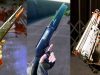
‘Athena’ is a New Lighthouse Tracked VR Gun Controller from Ilium VR
Ilium VR are working on a new VR-centric gun peripheral which plans to use Valve’s SteamVR ‘Lighthouse’ tracking to bring realistic weapon control to virtual reality games.
THX has announced the development of a new audio amplifier chip which the company claims offers “the world’s lowest levels of distortion and noise,” along with “incredibly low power consumption,” positioning the amplifier for mobile VR headsets, wireless headphones, and VR PCs.
After a recent bout of news articles detailing an experimental Alzheimer’s Disease therapy that has showed promising results in mice, the child of an afflicted father made a plea to the VR community to create a VR app which would recreate the therapy with a VR headset.
The annual Consumer Electronics Show (CES) has served as a good way-point for VR’s progress over the years. With CES 2017 kicking off next week, here we take a look back at the highlights (and low-lights) from 4 years of VR at CES to gauge how far the industry has come and look for clues as to where it goes from here.
There’s been more than 30 years of research into the medical applications of virtual reality, but it’s not until the recent consumer VR revolution that the technology has been cost-effective enough to use. The research shows that the combination of immersion with interactivity can help to reduce pain up to 70%, and in some studies do as well or better as using morphine. AppliedVR was spun out of Lieberman Research Worldwide, and so they’ve been looking at previous medical VR research, creating new VR experiences, and then doing clinical research studies to prove out the efficacy of using virtual reality to manage pain and anxiety before, during, and after hospital procedures.
I had a chance to catch up with the President of AppliedVR Josh Sackman at the Experiential Technology Conference in May 2016. We talked about how VR can improve the overall patient experience metrics, the clinical metrics that VR could impact, and how VR can create a sense of connectedness, pleasure, and empowerment in patients. We also discuss the future of integrating biometric feedback like heart rate variability as a control input for VR experiences.
The Eye Tribe, a Denmark-based eye-tracking startup, today confirmed they’ll be joining the ranks of Facebook’s Oculus VR.
Larry Hodges is a professor of human computer interaction at Clemson University, and he was one of the co-chairs of the very first IEEE VR academic in 1999. Hodges also co-founded a start-up named Recover, which originated from a successful research project into stroke recovery done by his student Austen Hayes. Inspired by the latest research into neurorehabilitation & skill relearning, they create a Kinect-based experience that gamifies the rehab exercises that 85% of people don’t do because they’re either too boring or painful. They’re able to inspire stroke recovery patients to do extended rehab practices while also progressively increasing the difficulty of the tasks over time as they slowly get better.
I had a chance to catch up with Larry at the IEEE VR academic conference in March 2016, where we talked about the history of the IEEE VR conference, his work with stroke rehabilitation and virtual therapy along with some of the results that they’re seeing, as well as some of his research on treating PTSD with virtual reality.
Sairento VR is a new made-for-VR first person action game which manages to distil everything that was cool about SUPERHOT VR, Raw Data and adds its own locomotion system for something which promises to be even cooler than either of them.
Senso is a new virtual reality glove input device that offers per-finger haptic feedback and the ability to simulate differences in temperature – all tracked via a camera-less IMU-based system.
Lumus Ltd. recently confirmed a $30 million funding round led by Quanta and HTC. Lumus is a leading provider and developer of augmented reality technology.
Dating Lessons is an interactive dating course created by VR developers Cerevrum Inc. and self-styled seduction coach Manish “Magic” Leone. Supposedly tailored for heterosexual men with low self-esteem or shyness with the opposite sex, the dating course offers 11 lessons and 7 practical interactive sessions that promise to “give men tools to enhance their power of attraction and develop behavior patterns to handle stress and anxiety.”
Felix & Paul Studios have been innovating on their own immersive VR camera technology since they pioneered the first-ever stereoscopic VR video with Strangers with Patrick Watson. They went on to sign a deal with Oculus Studios to produce a number of different 360 videos including the Introduction to Virtual Reality and a series of anthropological documentaries with Nomads.
I had a chance to catch up with Félix Lajeunesse and Paul Raphaël at Oculus Connect 3, where they were debuting their third VR collaboration with Cirque du Soleil with KÀ: The Battle Within, which features some of the most mind-bending, physics-based acrobatic choreography that I’ve ever seen. They continue to innovate with their camera technology to do things that other camera systems cannot, including maintaining decent stereoscopic effects within the near-field, better dynamic range and control over the framerate. In their Through the Ages: President Obama Celebrates America’s National Parks VR experience, they adapted their camera so that it could capture some awe-inspiring, time-lapse sequences at Yosemite National Park.
Australian startup Immersive Robotics are poised to deliver what they claim is a truly universal wireless solution for PC VR headsets that delivers tether-free virtual reality with minimal compromises in quality and extremely low latency.