All 53 Oculus Touch Launch Titles Confirmed
Oculus has today confirmed all 53 launch titles that will be available on December 6th for the launch of the Touch controllers.
Launching today for $10 on HTC’s VR app store, Viveport, Remembering Pearl Harbor commemorates the 75th anniversary of the attack on Pearl Harbor, the 1941 tragedy that led the US to join World War II. A collaboration between TIME’s LifeVR, HTC, and Deluxe VR, the experience is told through the eyes of Lt. Jim Downing, one of the oldest living survivors of the attack.
San Francisco based Osterhout Design Group (aka ODG) announced today that they’ve raised a significant $58 million Series A investment to accelerate production and R&D of its smart glasses products.
The lengthily-named Star Wars Battlefront Rogue One: X-Wing VR Mission is due to launch free for all owners of the PS4 version of Star Wars Battlefront on December 6th. Developed exclusively for Sony’s PlayStation VR headset, it will be playable by attendees at this weekend’s PlayStation Experience event in California.
Data visualization is one of a handful of topics that VR evangelists like to count off on their fingers as spaces that virtual reality could radically change. But how, exactly? And what’s wrong with data visualization today? This article digs into specific issues with traditional data visualization and the challenges of understanding abstract information, and how VR is ready to change everything.
Evan is program manager at virtual reality data visualization company Kineviz. He previously worked as a data scientist for HID Global, and he graduated from U.C. Berkeley with a degree in Cognitive Science. When he’s not working for Kineviz and exploring VR, he writes and researches the human decision-making process.
In 1983, Amos Tversky and Daniel Kahneman asked college students the following question:
Linda is thirty-one years old, single, outspoken, and very bright. She majored in philosophy. As a student she was deeply concerned with issues of discrimination and social justice and she also participated in anti-nuclear demonstrations. How likely is that:
They found that 86% of undergraduates believed that #8 (Linda is a bank teller and is active in the feminist movement) was a more likely scenario than #6. While it is easier to imagine Linda being both feminist and a bank teller; ‘feminist bank tellers’ are only one kind of bank teller, and thus there are less feminist bank tellers than total bank tellers.
Not only is this example well known, most people find it confusing. Notice how much easier it is to understand when it is visualized:
Which is more likely: that Linda is a Bank Teller, or a Feminist Bank Teller? Assume the circles are sized proportional to reality.
Virtual reality has the potential to make probabilistic reasoning easy, just like this diagram made the so-called “Linda Problem” much easier.
– – — – –
Talking about data and virtual reality is a bit of chicken and egg problem — it’s difficult to build a suite of VR tools that people will use without knowing how said people will use VR data tools. That being said, virtual reality can help with a) probabilistic thinking (illustrated above), b) high dimensional data visualization, c) high information density, and d) providing context to fully understand what is going on.
“Graphs are essential to good statistical analysis.” – F.J. Anscombe
Provided your dataset has two dimensions or fewer, the respective data is relatively easy to visualize with graphs or charts:
Anscombe’s famous quartet, taken from Wikipedia. Each data set has the same mean, correlation, variance, and best-fit line.
For each dataset above, the mean of all of the X coordinates is 9, the mean of all of the Y coordinates is 7.50, the variance of the X coordinates is 11, the correlation between the X and Y coordinates is .816, and the equation for the best-fit line in each case is Y = 3 + 5x.
In other words, these four datasets are seemingly statistically identical, even though their true nature is betrayed by visualization. However, we had it easy—we were only working with two dimensions of data.
– – — – –
If you have three-dimensions worth of data, you could conceivably use a three dimensional plot. If you have high dimensional data (aka plenty of columns in an Excel spreadsheet of your data), you are mostly out of luck. While it is easy enough to think in 2D, the trouble with having a lot of columns (like 10,000, for instance, but also anything greater than 3) in your dataset is that it is impossible to visualize more than three spatial dimensions.
However, there are other ways of representing dimensions. A triangle, for instance, could be used to represent three dimensions of data, if you mapped each dimension to the length of a side. You could, if you really wanted, utilize a red-blue spectrum and a light-dark spectrum to color in the middle of the triangles and blamo! You’ve got five continuous dimensions all in one visualization. Compare each triangle, and you might spot anomalies or heretofore hidden patterns and relationships. That’s the theory, anyway.
Herman Chernoff explored a variant of this idea in the ’70s — instead of lengths of triangle-sides, he mapped dimensions of data to different characteristics of cartoon faces.
I’ll let you judge how well this worked by way of an L.A. Times infographic:
Eugene Turner — Life in Los Angeles (1977), L.A. Times. The four facial dimensions, the geographic distribution of each face and the community line information mean you are looking at six dimensions of data.
Your gut reaction will be to dismiss this method of data presentation, as it looks silly, vaguely racist, and hard to interpret. But I urge you to give it a second look — can you spot the buffering row of communities in between the poor and affluent parts of town?
One reason Chernoff faces don’t get wider use, I submit, is that they look too cartoonish (and seeing how science is very Serious Business, it wouldn’t be proper for plots to be cartoon faces…). While realistic Chernoff faces solve the cartoonishness problem, they highlight another issue: though they seem like they could be intuitive, we all have too much experience with faces and real emotions to evaluate arbitrarily constructed ones.
In the depictions below, parameters of Tim Cook’s face — like the slope of his eyebrows — have been mapped to various Apple financial data-points for the year in question.
From Christo Allegra. Each version of Tim Cook’s face represents Apple’s financial data for the year in question. The width of Tim Cook’s nose represents the amount of debt taken on by Apple; the closed-ness of Cook’s mouth represents the revenue of that year; the size of his eyes represents the earnings per share, and so on. For serious uses of Chernoff faces, check out Dan Dorling’s work.
Clearly, there are some issues with this approach too. One thing that stands out is that not every aspect of a face conveys emotional information on the same scale as, for instance, the smile. In other words, the perceptual difference between one face and another doesn’t match the actual differences between the data. This, I submit, is one of the properties that makes plots and graphs so useful. It’s why visualizing the Linda Problem makes it much more intuitive. It is also something that is missing from current approaches high-dimensional data visualization.
– – — – –
Virtual reality can solve several of the aforementioned issues. Instead of faces, a Chernoff-like technique can be applied to control how neutral objects look, move, interact and are distributed. For example, all of the following properties of tables can be used to represent different data dimensions: height, area of table-top, color, leg-length, degree of table polish, as well as type and location of stains and burns. If you have 15-dimensional data, you could do worse than translate the dimensions to parameters that would control how tables might look.
Each measurement can be utilized to visualize another dimension of data. From mycarpentry.com.
The advantage of VR is that it allows you to perceive the true, intuitive, meaning of a table that is twice as tall as another; or the meaning of having different coefficients of friction on the table top. Some testing could ensure that the differences in dimensions carry the same perceptual weight.
Moreover, the methodology for how to go about this has been thoroughly explored in the realm of psychophysics and color perception — researchers have spent a vast amount of time measuring how people perceive both tiny and large differences in different kinds of sensations. In other words, VR and a little psycho-physics could make understanding complex data as easy (or stress inducing) as walking through IKEA.
Cultivating presence is one of the main goals for a lot of VR experiences, but our brains are like a black box of perceptual soup that makes it hard to know all of the right ingredients to achieve this. Kimberly Voll is a cognitive scientist, programmer, and VR developer who is a part of the Fantastic Contraption team, and she has a framework for cultivating presence that she refers to as the ‘VR Fidelity Contract’.
In a rather curious move, Chinese game developer Snail Games has announced that they’ve licensed the IP for the popular PC game Ark: Survival Evolved and are using it to create Ark Park, a dinosaur theme park VR experience.
Futuremark have now released the full version of their long awaited, dedicated virtual reality benchmark, VRMark. And, after months of research and development, the company has found itself having to redefine its own views on how the difficult subject of VR performance testing should be tackled.
The first ever Develop:VR conference debuts in London tomorrow, December 1st. We preview the event by speaking with five speakers presenting at the show.
I had a chance to talk about storytelling in VR with three of the co-founders of Oculus Story Studio during Oculus Connect 3. Saschka Unseld, Maxwell Planck, and Edward Saatchi were showing off a preview of their third VR experience Dear Angelica as well as their immersive storytelling tool of Quill, which enabled them to create a VR narrative experience entirely within VR.
Valve is continuing to improve upon the design of the ‘Lighthouse’ Base Stations, the laser-beacons that form a crucial part of the SteamVR Tracking system. Future iterations are expected to become dramatically simplified, reducing size, noise, and perhaps most importantly, cost.
Pinball FX2 VR arrives tomorrow on Vive and PlayStation VR along with a popular new The Walking Dead themed machine. Originally a launch title for the Oculus Rift, the game will now be available on all three major VR platforms. We take a look at Pinball FX2 VR on the HTC Vive.
The Steam Autumn sale is once again upon us, and this time around this time Valve have flagged close to a whopping 300 VR titles for discounts, including games that support both the Oculus Rift, HTC Vive, and OSVR.

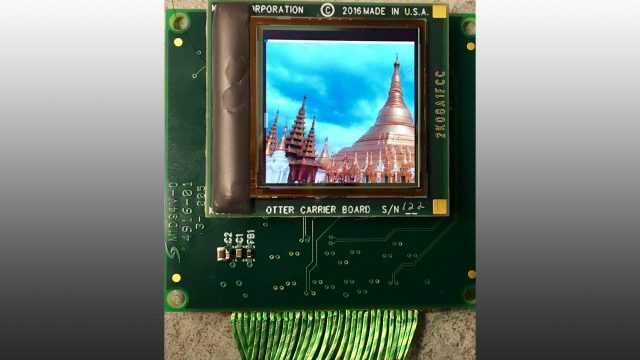
JDI, a display conglomerate consisting of the display businesses of Sony, Toshiba, and Hitachi, announced this week the development of ultra high resolution panels that are made specifically for virtual reality headsets.
Oculus has officially confirmed that Toybox, the highly anticipated multiplayer sandbox application built from the ground up to show off the Oculus Touch motion controllers, will be made available to every touch owner for free after launch.