Correction: Apple, Valve, and LG Didn’t End Up Investing in OLED Microdisplay Maker eMagin

22

According to documents filed last month with SEC, participation of a new stock issuance of some $10 million by OLED microdisplay maker eMagin was offered to Apple, Valve, and LG, among others, though those companies didn’t end up participating in the deal, Emagin says.

NBA All-Star and Weekly Regular Season Coverage Comes Live to VR via TNT and Intel

2
Image courtesy TNT, Intel

TNT and Intel have teamed up to bring NBA All-Star coverage to VR on Gear VR and Daydream.

Sony Reveals 14 Minutes of New ‘Moss’ PSVR Gameplay Ahead of February Launch

0

With PSVR adventure game Moss set to launch this month, Sony is ramping up the hype for Quill, the game’s adorable little mouse buddy, with 14 minutes of new gameplay.

‘EVE: Valkyrie’ and ‘Wands’ Free Weekend Coming This Month

8
images courtesy CCP Games and Cortopia Studios

Even with a wide selection of gameplay videos and written reviews, it’s hard to know if you should buy a VR game without ever having tried it yourself. Oculus’ solution: extended all-access free weekends on select titles. To that effect, Oculus is putting out two free weekends this month for magic dueling game Wands (2017) and space dogfighter EVE: Valkyrie (2016).

Magic Leap Takes on Funding from Media Company Axel Springer

9
Image courtesy Magic Leap

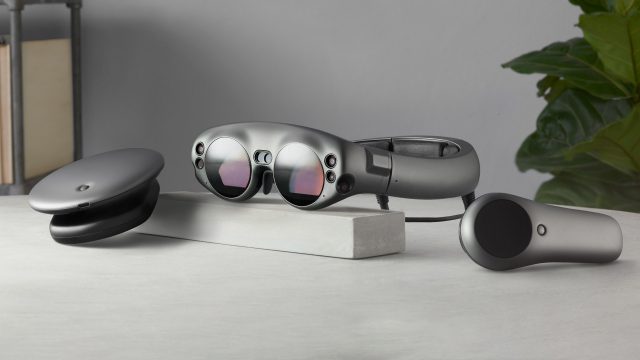
German media company Axel Springer today announced that it has taken part in a new round of financing of Magic Leap. The company hasn’t disclosed the amount of the investment, or mentioned whether other companies have also taken part in the new round.

Balancing Player Control & Authorial Control with “Virtual Virtual Reality”

2
danny-cannizzaro
Danny Cannizzaro

Virtual Virtual Reality by studio Tender Claws is a Daydream-exclusive interactive story that won the best VR experience at the 2017 Google Play Awards VR, and it’s one of my personal favorite interactive narratives within VR. Virtual Virtual Reality (aka VVR) does a great job of balancing your control as a player with the authorial control of the story. You have the ability to openly explore the worlds, but it’s all within the context of a narrative that subtly guides you through a futuristic world where AI has taken over and is providing you an immersive hero’s journey experience.

Arcade Boxer ‘Knockout League’ to Land on PSVR February 13th

14

Sony has finally released word on when PSVR owners will be able to get their hands on the popular VR boxing title Knockout League; it’s officially coming to PlayStation VR February 13th. The game has been in Early Access on SteamVR, Viveport, and the Oculus Store for almost a year. It’s uncertain if the PSVR release will mark the game’s exit from Early Access on the platforms listed above.

AR & AI Storytelling Innovations in ‘TendAR’ from Studio Tender Claws

2

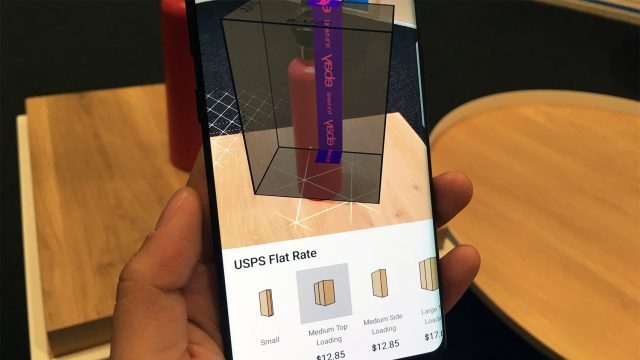
samantha_gormanTender Claws, the creators of the award-winning interactive VR narrative Virtual Virtual Reality, premiered a new, site-specific, interactive AR narrative experience at the Sundance New Frontier called TendAR. It was a social augmented reality experience that paired two people holding a cell phone and sharing two channels of an audio stream featuring an fish guiding the participants through a number of interactions with each other and exploring the surrounding environment. The participants were to instructed to express different emotions in order to “feed” and “train” the AI fish. Google’s ARCore technology was used for the augmented reality overlays, the Google Cloud Vision AI API for object detection, as well as early access to some of Google’s cutting-edge Human Sensing Technology that could detect emotional expressions of the participants.

Grabbing Virtual Objects with the HaptX Glove (Formerly AxonVR)

7
Image courtesy HaptX
Jake-Rubin
Jake Rubin

The HaptX Glove that was shown at Sundance was one of the most convincing haptics experiences that I’ve had in VR. While it was still primitive, I was able to grab a virtual object in VR, and for the first time have enough haptic feedback to convince my brain that I was actually grabbing something. Their glove uses a combination of exoskeletal force feedback with their patented microfluidic technology, and they’ve significantly reduced the size of their external box driving the experience from the demo that I saw at GDC (back when they were named AxonVR) thanks to a number of technological upgrades and ditching the temperature feedback.

Humble Store VR Sale Offers up to 66% off Top VR Titles This Weekend

4
image created by Road to VR

The Humble Store is having a big VR sale currently, putting some of the best-rated games for HTC Vive and Oculus Rift on deep discount. There’s not much chaff in the list below, so we hope you still have some cash left over from buying that Valentine’s Day gift.

How to Watch the 2018 Winter Olympics in VR

10
image courtesy NBC

The 2018 Winter Olympics is about to kick off in PyeongChang, South Korea today, and this year you’ll be able to watch a total of 30 events in VR, shared across live and on-demand 360/180 recordings.

Viacom Shutters VR Studio Viacom Next in Cost-cutting Move

0
image courtesy Viacom

Viacom Next, the company’s technology group tasked with producing immersive experiences, is no longer. David Liu, former Creative Director at Next, announced the news via twitter.

Apple’s Latest VR Patent Describes a Compact VR Headset with Eye Tracking

17
Image courtesy Apple

In a patent filed in 2017 and issued today by the United States Patent Office, Apple describes a VR headset designed to be compact and comfortable.

‘Sprint Vector’ Review – Innovative Locomotion Makes Adrenaline-soaked Foot Racing a Reality

Image courtesy Survios

Sprint Vector (2018) is a VR racing game of a different stripe. Dubbed an “adrenaline platformer” by production studio Survios, the developers behind Raw Data (2017), it actually sticks to some pretty well-established arcade racing tropes pioneered by the Mario Kart franchise. Still, it’s something entirely different; it’s not only a fast-paced, technical sort of game that depends on the user’s ability to memorize every map’s twists and hazards, and ultimately understand how to best get from point A to point B, but it’s almost what you might call legitimate exercise.

Sprint Vector Details:

Official Site

Developer: Survios
Available On:HTC Vive (Steam), Oculus Rift (Steam, Oculus Store), PSVR (PSN)
Reviewed On: HTC Vive, Oculus Rift
Release Date: February 8th, 2018

NoteSprint Vector is discounted 20% off the retail price of $30 through February 22nd

Gameplay

You can’t really talk about Sprint Vector without first mentioning the main reason for its existence: a unique locomotion method Survios dubs “Fluid Locomotion,” a system which requires you to pump your arms as if you were running in place in order to move. You can also think about it as if you were skiing with ski poles, but instead of pushing off the ground with a pole, you thrust your arms downward while activating the trigger button on your controller, thus moving you forward.

Survios has put a certain amount of faith in the median VR user’s ability to change from what they know, i.e. lackadaisically pushing a single button to move. Thankfully, that faith is well-founded. I’ll get more into this in the ‘Comfort’ section of the review, but suffice it to say that Sprint Vector‘s locomotion scheme is magnificent.

One more thing. If you don’t like breaking a sweat when you play in VR, maybe now’s the time to look into another game. If you don’t mind getting your headset a little damp, then you’re in luck. According to my Fitbit, when I play Sprint Vector, I consistently boost my heart rate into the ‘fat burning’ zone.

Image courtesy Survios

At launch, Sprint Vector offers 9 solo challenge maps with 3 modes each, and 12 competitive maps which can either be played solo vs AI, or in an 8-player online races. As a point of comparisons, Mario Kart 8 (2014) boasts 32 competitive maps, several cups, and a battle mode. I would have liked to see more maps, although 12 seems to be a good starting baseline.

Competitive maps are linear, and not looped, which means you only get one run to determine the winner. I kind of wish they were looped, if only to get more practice on each track, but I see why they aren’t: racing requires physical effort, and a 15-minute race might just scare away your competitors.

On competitive maps, there’s a standard mix of strategically placed powerups that fall in line with other kart racing games; nitro, bombs, slow-downs, guided missiles, etc. Unlike other kart racers though, you’re expected to get vertical by climbing, riding ‘slip steams’, double jumping and soaring forward through the multilayered level, leaving your opponent with several ways to get around your carefully placed trap. Many competitive maps are also densely packed with environmental traps like crushing pistons, nuclear waste spills, giant fan blades, and explosive barrels, making for an incredibly dynamic gameplay experience. Despite some minor flaws, Sprint Vector is ultimately a visceral, heart-pumping racer for genuine speed freaks.

Solo Mode

Like many kart racers, Sprint Vector‘s AI essentially follows the ‘rubber banding’ principle – the game will give human players the ability to catch up by slowing down the NPCs in front of them. When this is done right in games, you don’t really notice it. When it isn’t, well, you get NPCs doing silly things like nonsensically skating back and forth on the track with no urgency to find the fastest possible route, or waiting for no apparent reason. The latter example is unfortunately the case with many single-player AI races I played in Sprint Vector.

As far as I can tell, there’s no way to manually change the AI’s difficulty setting. The game also doesn’t offer any of the cups or standard single player racing progressions. With only a few different leader boards to beat, the game’s competitive emphasis is clearly on the online multiplayer portion. That said, the solo challenge maps, which features time trial, coin collection, and a non-stop nitro-fest called ‘hardcore one-life’, are a welcome addition that makes up somewhat for the lack of cup races.

Multiplayer

The skill differential from single player to multiplayer wasn’t huge when I played the pre-release version (identical to launch version), but you can chalk that up to the general level of inexperience in my fellow racers. Once people start to intimately understand the in and outs of each track though, multiplayer is probably going to get pretty tough. In one such online race—after thinking I did fairly well playing the same track in single player mode moments before—the first place racer finished a full minute ahead of me. Since races take about a 2-3 minutes to complete, it was a stark realization that there must have been a secret passage that I missed, or a booster that I should have found.

The only way to interact with others is through the game’s powerups, so there’s no way for you to, say, punch a fellow racer or push them off a ledge. This would have been a fun addition, but I rarely found myself within that sort of range anyway, so it’s a bit of a non-issue.

Image courtesy Survios

As far as I can tell, characters don’t seem to have any differentiating qualities besides their exteriors, which is kind of a shame. Unlike other arcade racers which give you a selection of max speeds and accelerations, it appears as if you’re basically just choosing a skin to wear. This too is a minor niggle, but still worth mentioning.

Immersion

Sprint Vector works on many levels. The worlds and characters are interesting and visually cohesive, the locomotion system is rock solid, and the environment offers consistent interaction across the board. These are some of the most important ingredients to achieving Presence (yes, I used the capital “p”), that moment when you fully engage with the virtual world and mentally leave your office or bedroom behind.

As for the world around you, I’ll say this: It’s not easy creating an entire universe for the benefit of a single racing game, but Sprint Vector manages to make you feel at home in its absurd reality show-driven future. Considering it’s not relying on existing IP like, well, freaking Mario, this is a great accomplishment. To that, I’ll add that voice acting is on point, and character design and rigging is well done. I would have loved to get more of a chance to interface with the world besides just racing through it though, but that’s far from an admonishment.

Also, if you have a hard time focusing, or you’re not into social multiplayer games, you’ll be happy to learn that you can mute nearly everything in Sprint Vector, including the jabbering announcers, AI characters, and your fellow multiplayers, leaving only the pulsing soundtrack in the background if you so please. You can also mute that, although I personally enjoyed it.

Comfort

Creating a comfortable VR game is hardly a mistake. Even in this early stage of development, there are some tried and true methods for creating a fast but comfortable experience, and Sprint Vector uses every trick in the book.

Giving VR users a way to associate virtual locomotion with larger physical movements seems to side-step some of the issues that may cause nausea in VR games. Like Echo Arena (2017), the zero-G multiplayer sports game, Sprint Vector (in a way) makes you use the world around you to move, which is why I compare it to using ski poles instead of running. Executing good form in your arm’s stride determines your speed, and the smoother you can get that stride, the faster and more consistently you’ll move. You have to pay constant attention to this relationship though, more so than just jamming down on a button mapped to the accelerator.

Not only that, but accelerating, flying, or drifting places particle effects in your near field of view, which keeps your vestibular system happy as you fling across the map at 50 mph. Because of this pseudo-cockpit effect, fast acceleration and deceleration isn’t nearly as jarring as it could be too.

There’s also the option to enable click turning for players on Rift and PSVR, something I didn’t use too frequently thanks to drift-turning.

‘Quill’ Gets Animation Tools to Bring Your VR Paintings to Life

6

Quill, Facebook’s VR painting tool, has been a great way to sketch in VR since its launch back at the end of 2016, but today a new update transforms it into something entirely new. Now, with tools for animating Quill artwork directly in the app, users have a new dimension for artistic expression: time.

39,929FansLike
13,574FollowersFollow
66,541FollowersFollow
27,800SubscribersSubscribe

Latest Headlines

Features & Reviews