Cyberith Omnidirectional VR Treadmill Launches ‘Virtualizer’ Kickstarter on July 23rd

13

Virtualizer2We’ve been following Austrian company Cyberith and its virtual reality locomotion ‘controller’  the ‘Virtualizer’ for a while now. The Virtualizer is an omnidirectional treadmill which uses a flat base with low friction which enables a user to run, crouch and jump with movement data captured and mapped to in game controls. The team have come  along way since their public debut at Gamescom last year, where they barely made it to the show with a functional prototype.

Since then they’ve been all over the world promoting the Virtualizer, scooping awards and spreading the word that there is a viable alternative to the Virtuix Omni, one that you can jump and crouch in no less.

Now, the company have re-branded themselves and announced that the long awaited Kickstarter campaign, hinted at back in our original interview with Cyberith’s CEO Tuncay Cakmak almost a year ago. The Kickstarter launches on the 23rd of July and will give backers the opportunity to get their hands on the third revision of the Virtualizer. In it’s latest promotional literature is keen to emphasise differentiators between it and it’s only real rival right now, the Virtuix Omni. From the press release:

To guarantee for an optimal immersive experience, the Virtualizer has a flat base plate, resulting in a natural walking sensation.

Using a flat base plate ensures a completely immersive experience. By using e.g. a bowl shaped base plate, the user’s feet hit the slope of the bowl earlier than expected. The resulting discrepancy between visual and tactile information immensely breaks immersion.

Virtualizer1Omnidirectional treadmills are by definition, never going to be subtle devices. However, the company is keen to emphasise the portability and practicalities of owning such a thing:

The Virtualizer can be taken apart into its five core parts in a matter of minutes. The three pillars are 100cm (39.4”) high and the base plate has a diameter of also 100cm (39.4”). The distance between the center of the base plate and one pillar is 80cm (31.5”).

As a consequence of the vertically moveable ring-construction, the Virtualizer is accessible for a lot of different body shapes. The height of the user is thus almost irrelevant, but the theoretical limits are at 1m (3ft 3”) as minimum and 2.10m (6ft 11”) as maximum. The Virtualizer supports weight up to 120kg (265lbs). Importantly, it should be noted that the user’s hip measurement should not exceed 125cm (49”) in circumference.

This is a serious piece of gaming equipment, but it only requires a single USB connection for power and hooking up to your PC – what’s more, you can play in your socks!

No details yet as to the structure, goal or rewards to be offered by the Kickstarter campaign, but we’ll of course let you know the minute we know more.

We wish the Cyberith team the best of luck with the Kickstarter campaign, and we hope to get our hands (feet) on the latest prototype at Gamescom this year. In the mean time, check our their brand new website here.

Samsung ‘Gear VR’ Smartphone Adapter Rumored to be Announced in September at IFA 2014

7

samsung-gear-vr-smartphone-adapter-virtual-reality

An exclusive report from SamMobile has dug up what it alleges are official assets surrounding Samsung’s rumored VR smartphone adapter. The report claims that the device will be called ‘Gear VR’ and be announced at IFA 2014 in early September.

News Bits: With 5 Days Remaining, Zero Latency Passes Crowdfunding Goal for Full Body Zombie Experience in Melbourne, Australia

0

Zero Latency, who has been developing a full-body virtual reality zombie experience, has just passed their $25,000 crowdfunding target with five days remaining. The funds are being raised to further develop the system and the backer rewards offer tickets to experience the action for yourself, assuming you’re near Melbourne, Australia.

Exclusive: Early Oculus Rift DK2 Unboxing, “The color, contrast, and motion is leaps and bounds over the DK1”

20

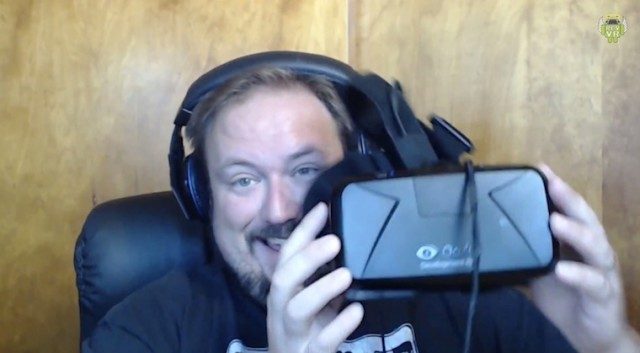
It’s DK2 month, with swaths of developers and enthusiasts eagerly awaiting a knock on the door from their local delivery man. An anonymous source has revealed an unboxing of the highly anticipated Oculus Rift DK2.

Oculus VR Announces ‘Oculus Connect’ VR Developer Conference with Keynotes from Abrash, Carmack, and Luckey

2

oculus connect conferenceOculus VR today announced that the company will be hosting ‘Oculus Connect’ a VR-focused conference in Los Angeles, California this September. The company has also announced the acquisition, and open-sourcing, of RakNet, a networking middleware used in the games industry.

News Bits: New Atajrubah Dev Update Includes UE3 vs. UE4 Video

2

We wrote about Atajrubah recently and noted that the development team had moved to Unreal Engine 4 after spending much of the game’s life up to that point as a UE3 project. The Oculus Rift enabled open world survival game with an Arabian flavour looked great in example screenshots from the time.

Developer Nexy Media has released a new developer update announcing 3 new team members, update on gameplay elements  and a new video which shows the stark contrast between UE3 and UE4’s rendering capabilities. It’s yet more affirmation that UE4 has been gathering a great reputation with indie developers like Nexy. We reported not long ago on White Lotus Interactive’s shift yo Epic’s new game engine and their almost universally positive experience when they too made the leap from UE3.

You can catch the full developer update here and catch our previous article on Atajrubah, here.

VRLA Meetup #2 Invades MxR Labs, Photos and Impressions from the Event

0
Me trying the Syria experience

vrlalogo2VRLA (Virtual Reality Los Angeles) is the brainchild of one Cosmo Scharf, a Film Production student at the University of Southern California and a self confessed VR Evangelist. Although one of the newer meetups on the block, VRLA has made quite an impact on the VR community and even gathered industry and community members alike at it’s recent VR Mixer event at this year’s E3 Expo last month.

For VRLA’s second meet up, Cosmo managed to arrange access to the Mixed Reality Labs (MxR) where the event was held. Cosmo was kind enough to bring us up to speed on who was there and what there was to see.

Cosmo’s Impressions of VRLA #2

VRLA #2 was held this past Monday at the MxR lab, a facility dedicated to cutting-edge virtual reality research. While the MxR lab is usually closed off to the public, they opened their doors to a few hundred guests to host VRLA. Inside their building, they gave demos of Project Blue Shark, redirected walking (which creates the illusion of moving through infinite space), rapid avatar scanning, portable immersive viewers on devices like the iPad, and several others.

Exhibitors were set up outside on their parking lot while guests were waiting to go inside the MxR lab. Sixense was showing off their STEM system while Epic Games was giving demos of Couch Knights on the DK2. Control VR wowed attendees with their finger-tracking glove while KOR-FX impressed with its haptic gaming vest. Several indie games were also represented such as Classroom Aquatic, Rhea, Diplopia, and Eden River from Unello Design.

All in all, everyone had a great time! The event would not have been possible without the support of Apogee, leaders in audio recording hardware and software. Many thanks to The Grilled Cheese Truck for providing delicious food to our hungry guests.

One of the Exhibitors was Unello Design‘s Aaron Lemke, responsible for the likes of Eden River and Lunadroid 237. Aaron shared with us pictures and his impressions. Hover over the pictures for descriptions or click for larger annotated gallery.

Aaron’s Impressions of VRLA #2

VRLA was a great experience. I had a booth so much of the time I was there demoing Eden River for people, but I did manage to sneak away and get a tour of the MxR Lab.

There were several different VR related systems set up in the lab: a large stage for high res 3d body scanning,  Blue Shark had a virtual mockup of a battleship interface, a Kinect system for scanning avatars (they were scanning people on the tour and rigging and animating them on the spot. So you would see the avatar of someone who just got scanned, on a tv screen jumping around and doing backflips), a virtual journalism environment depicting a military incident in Syria, and a demo of Redirected Walking. The only demos I tried were the last two.

The journalism experience was interesting. These types [of] experiences could do a lot for making the various military conflicts the US is involved in more tangible to the general public. The Redirected Walking demo was fantastic. Redirected Walking takes advantage of a perceptual phenomenon called change blindness RW can be used in VR to convince people they are walking in a much bigger space than they actually are. You walk into room and when you aren’t looking the game switches the placement of the door that you walked in through. For more on change blindness check out the video below:


I also got the chance to try the Control VR system. I was very impressed. The latency on the finger tracking was very low. Calibration seemed to a be a bit of an issue as my virtual fingers didn’t quite match up with my real ones, but they assured me that the final version would work better.

Overall it was a great experience, I saw lots of familiar faces but also met many interesting new folks as well.

Huge thanks to both Cosmo Scharf and Aaron Lemke for taking the time to document their experiences. For more information on future VRLA events, head over to their homepage here. You can find more about Aaron at Unello Design’s homepage here and you can follow him on twitter here.

News Bits: Control VR Finished Kickstarter Successfully, 176% Funded

0

Control VR is one of the first systems we’ve seen to offer a viable and technically promising finger tracking solution, or VR Glove, to VR enthusiasts. In fact, the Control VR team were so confident in their fully upper body tracking system, they sent an open invite to the VR community to come on over and try it out for themselves. The resulting feedback was almost universally positive.

That positivity and confident openness seems to have transferred into genuine interest as their Kickstarter campaign, started on June 5th has now concluded at 176% their original $250k target – cool $442,227 in all. It’s encouraging to see such fervent support from enthusiasts, especially considering one of the major complaints about Control VR was the price, $600 for tracking both arms and upper body.

Backers have been told to expect an estimated shipping date of December 2014, but as we’ve seen repeatedly now, Kickstarter campaigns involving hardware rarely ship to time – for numerous reasons.

In the mean time, you can catch the video above for Ben Lang’s interview with Control VR’s CEO Alex Sarnoff and CTO Ali Kord above.

Congratulations to the Control VR team, best of luck delivering the goods.

Nintendo Patents Eye-Tracking Tech Bringing 3D to 2D Displays

9

nintendo-eye-tracking

Nintendo has always danced to a tune all its own. Refusing to accept the status quo in the often relentless inevitability of the gaming world has lead to both incredible successes (introducing natural motion with the Wii) to abject disasters (the Virtual Boy), in either case though the Japanese gaming giant usually intrigues with its innovation.

Now, a patent just published (albeit filed in March) in the US indicates Nintendo’s possible targets for pushing immersive boundaries in gaming. The patent details a system which utilises glasses and a tracking camera, mounted above the gaming display which aims uses gaze tracking to alter the image presented to the user.The system seems to suggest tracking based both on a users head position and their gaze direction, with the rendered view altering in relation to those positions to give the illusion for the user of 3D depth. More than that though, the patent details interactive benefits and enhancements such as dodging virtual projectile travelling towards the user in 3D space by merely moving one’s head.

The technology and its desired effect seems to share strong commonalities with the now famous experimental videos posted by Johnny Lee which, ironically, used a reverse Wii-mote and sensor bar system to render a 2D view relative to the user’s head position, adjusting the viewing pane to give an illusion of 3D depth. The videos probably give a good idea of the effect Nintendo desires, albeit enhanced further by tracking gaze as well.

The patent’s extensive background detail also gives examples of immersive enhancements that could join this eye-tracking technology to enhance a player’s connection to the game world. Clearly Nintendo recognise that relying on merely static 2D displays, as featured in the Nintendo Wii-U or even the autostereocopy found in the company’s handheld 3DS will cut it for gamers in the near future.

Nintendo has commented recently on its interest (or lack thereof) in virtual reality, citing the technology as interesting but too solitary at present. Although Nintendo’s famous Shigeru Miyamoto did make his way over to Oculus VR’s stand to try out the DK2 at the E3 Expo recently.

Patents sometimes give insight into a company’s technical direction, but more often than not it’s merely the sign of them exploring all avenues they can to find something they feel works for them and their audience. But Nintendo would be foolish to dismiss virtual reality entirely as a viable avenue for them. And personally, a VR Zelda with camera mechanics similar to Lucky’s Take, the 3D platformer published by Oculus VR, sounds pretty damned awesome!

New Free Unreal Engine 4 Bootcamp E-Book Offers Superb Intro for Wannabe VR Devs

2

UE4Logo-EG-254x207Unreal Engine 4 launched to developers around the world back in March and immediately impressed. Epic’s successor to its near ubiquitous UE3, which dominated much of the last generation of game development, was designed from the ground up to offer a powerful, portable and above all accessible way for developers to create the games they want within the minimum of fuss and frustration. What’s more, it’s extremely affordable and it ships with ground-up support for the VR Headsets like the Oculus Rift and Sony’s Morpheus. Given all of this, there’s an understandably high level of interest in the platform.

Ryan Shah, Project Lead at Kitatus Studios – the devs responsible for the in-development 3D platformer ‘Super Distro’, has just released a new e-book designed to launch the uninitiated into the world of developing with UE4. The book adopts a no-nonsense, minimal jargon approach to its subject matter and aims to enlighten beginners and experienced devs alike.

After spending a little time with Unreal Engine 4 as a non-developer type, I was struck by it’s power, immediacy and simplicity. And in truth, Epic have not been frugal with it’s documentation or it’s video tutorials either. But there’s always room for more.

Ryan Shah’s ‘Master the Art of Unreal Engine 4 – Blueprints’, which introduces the reader to UE4 by walking them through the creation of 2 distinct game projects (3rd person and side scrolling platformer), is refreshingly straightforward with its language and offers up an excellent, exhaustively illustrated end-to-end guide for these simple projects. Both example games leverage the power of Unreal Engine 4’s ‘Blueprints’ and demonstrate the ease at which those in possession of only limited or no coding knowledge (I can hack, but I ain’t no coder).

For the most part game development is drag and drop, but the book does take you through some of the finer points of media production and insertion too – for example how to deal with and map animated textures for in-game portals etc. But throughout, the author doesn’t lose the reader despite tackling some relatively complex procedures.

‘Master the Art of Unreal Engine 4 – Blueprints’ is a superb way to ease yourself into the powerful and intuitive world of this cutting edge game development engine, Ryan Shah should be commended not only for his skill in delivering the subject matter clearly and without fuss but for giving his work back to the community for free. Not only that, but this is just the first of 3 planned e-books on Unreal Engine 4 development.

You can grab a copy of the e-book at one of the download links in this thread here.

News Bits: Get DOSBox in Virtual Reality with DOSCulus

2

So to continue the retro / nostalgia theme that started with the release of MemoRift, we bring you news of somewhat more hardcore retro and emulation option for those wanting to try and bring their enjoyment of retro PC games and software into the virtual realm on their Oculus Rift VR Headset.

DOSCulus is a port of the popular DOSBox PC and DOS emulator (‘Disk Operating System’, Microsoft’s first operating system prior to Windows) . Many older PC games that were written for older IBM Compatible OSes that pre-date Windows require emulation for them to work. DOSBox wraps the game, providing hardware emulation for old sound cards and graphics cards enabling you to spin up, for example, Wolfenstein 3D from your shiny new Windows 8 operating system.

DOSCulus essentially keeps DOSBox’s functionality intact but implements a floating, virtual screen that reacts to head tracking – as if you had a virtual monitor. DOSCulus also allows zooming of the view to accommodate the resolution limitation of Oculus’ first Developer Kit (DK1). Otherwise, it’s business as usual for loading and playing your favourite games.

I’m not sure how attractive this proposition is, but I guess playing games on a huge virtual monitor might be cool. Either way, if you give it a try, let us know your experiences and thoughts on it.

You can grab DOSCulus and keep up with it’s development at the Oculus Developer Forums here.

CastAR AR/VR Headset Anticipates Delays, Hints at Two-camera Tracking Solution

0

castar ar vr headset render castar wandIt’s the news no Kickstarter backer wants to hear, but every Kickstarter backer ought to be prepared for… delays. Some 62 ‘Early Dev Glasses’ of CastAR, the forthcoming AR/VR headset, were originally planned to be sent out in April and May to gather feedback for the final mass-produced units in September. Now into July, without the early units shipped out, the CastAR team say backers should expect delays.

Radial-G Gives F-Zero and Wipeout Fans the VR Ride They’ve Been Waiting For, Kickstarter Now Live

1

660760dde6b944c12b455ef7f72a5e6c_largeIf I were to say I liked the original Playstation game Wipeout, it would be disingenuous. I adored it! Back when ‘next gen’ consoles really delivered genuinely groundbreaking home gaming experiences, Wipeout lead the charge of 3D gaming that managed to make gaming cool. Its cutting edge visuals, thumping soundtrack and seriously challenging gameplay delivered a zero g racing rush that for me was only bettered with the advent of it’s PS3 offspring Wipeout HD.

b688bca3dbec4fa31043069067ea0c72_large‘Radial-G: Racing Revolved’ fuses some of the look and feel and breakneck thrills of Wipeout with the vertigo inducing cylindrical raceways of F-Zero GX and it does all that with ground up support for virtual reality, and more specifically the Oculus Rift VR headset. The game hurls you along the track at speed while you negotiate coloured gates which offer boost or brake, depending on the colour and your skill. It’s a great experience and you can try it for your self as the team recently made the demo available on Oculus Share.

Now, the Brighton (UK) based Tammeka Games are taking their game to Kickstarter with a target goal of £50,000 and are offering some interesting pledge tiers for those keen on getting their hands on the title early. Standard tiers are onhand, early bird access to reward-matrixthe forthcoming multiplayer demo and access to a digital download of the 1st release, expected to include 3 worlds with 3 tracks each. Push the boat out further however and you could grab a custom 3D printed Altergaze unit, Dinner with the developers or a customized Oculus Rift DK2. For a breakdown of the rewards associated with the tiers, Tanmeka have provided this handy matrix on the right (click for larger view).

Radial-G represents the new wave of independently developed games which are embracing virtual reality, slick visuals and polished gameplay and one of the best sensations of speed anywhere inside an VR Headset right now. If you’re even a passing fan of either Wipeout or FZero, you owe it to yourself to at least check out the demo.

Once again, the Kickstarter page is here and you can also support Tammeka in their Steam Greenlight campaign here.

Oculus VR Showing Sword Art Online Demo for the Oculus Rift at Anime Expo—Breaking

80
Image courtesy Aniplex
sword art online oculus rift virtual reality
Main characters from the show: Kirito (left) and Asuna (right)

Today marks the start of Anime Expo 2014 in Los Angeles, where Oculus VR is representing with a booth at the show. The company is showing a never-before-seen Sword Art Online demo for the Oculus Rift, a popular action anime show which focuses on virtual reality and MMORPG themes.

Rev VR Podcast (Ep.71): Building Google Cardboard from Scratch with Elizabeth

2

rev-vr-podcast-feature-image

I sent my wife, Elizabeth, to the store to gather up all of the items we needed to build Google Cardboard from scratch. An hour later, we had it built and in this episode of the Rev VR Podcast, we give our impressions.

39,929FansLike
13,574FollowersFollow
66,541FollowersFollow
27,800SubscribersSubscribe

Latest Headlines

Features & Reviews