
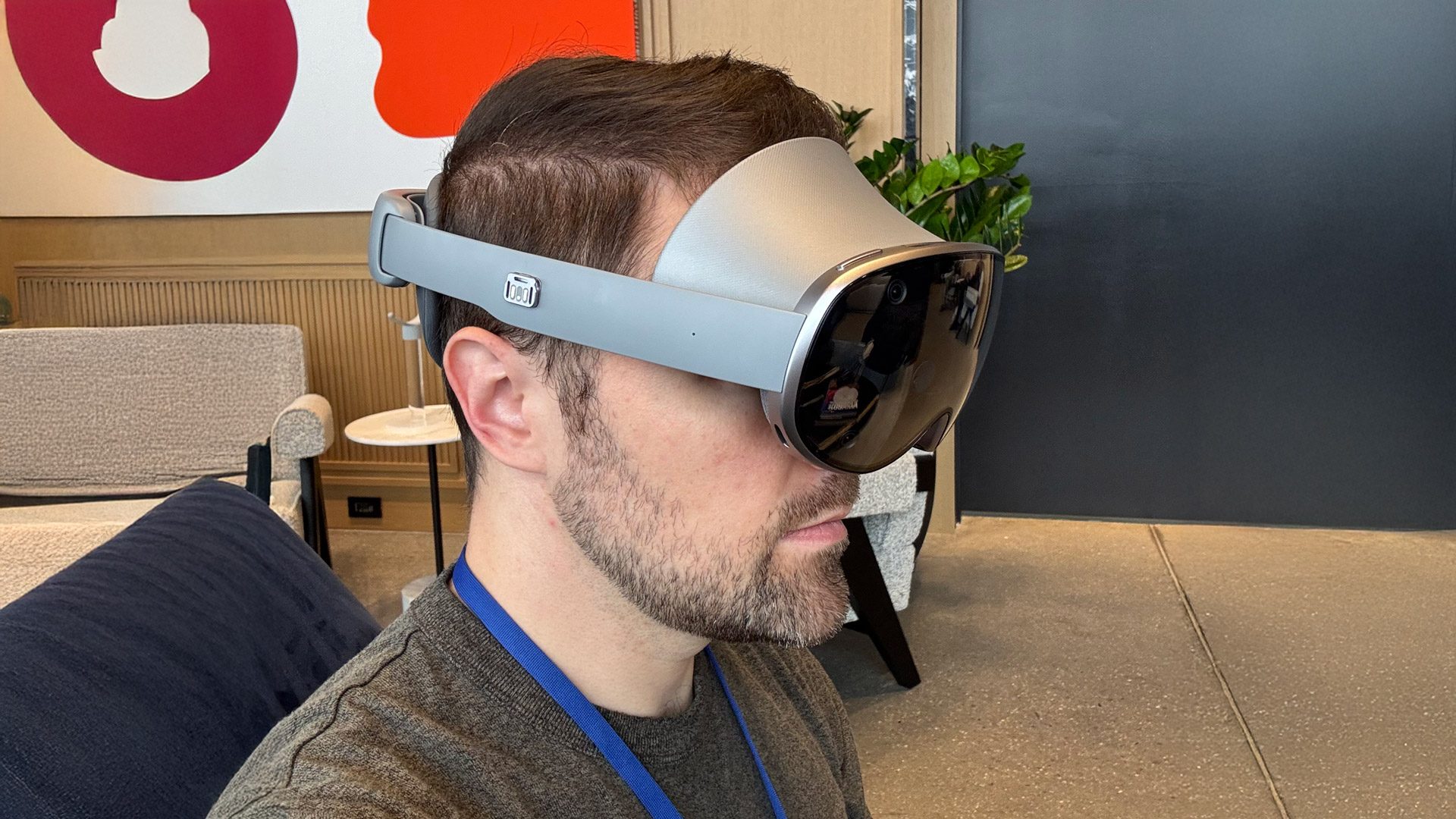
Samsung’s Galaxy XR is finally here, and with it, a perfect middle-ground of price and features to simultaneously turn up the competitive pressure on both Meta and Apple.

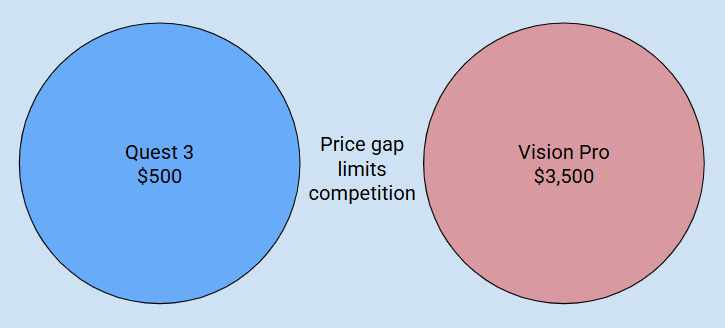
Over many years I had been patiently waiting for Apple to launch its own headset in order to finally give Meta some real competition. Even though the Quest and Vision Pro headsets are so far apart in price, there’s already plenty of examples of Meta adding or improving features on its headset in direct response to Apple’s work.

But there’s only so much competitive pressure that a $3,500 headset can put on a $500 headset like Quest 3. In the end, they aren’t in the same price class (hell, they aren’t even in adjacent price classes), and the potential audience for each headset doesn’t have a huge overlap.
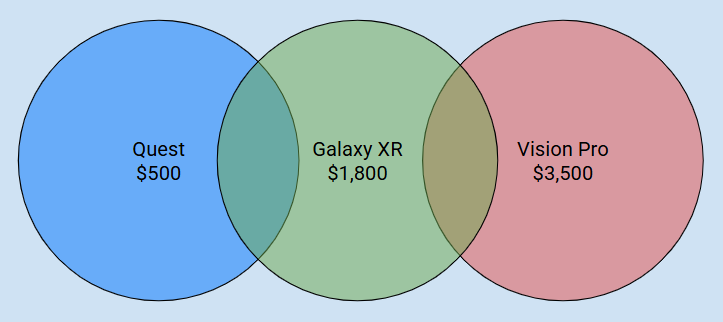
But now we have Galaxy XR which has managed to land right in the middle of Quest and Vision Pro, on price and features. This is a single headset that’s bringing new competition to both of these other headsets.
On the lower end, Quest 3 is primarily a gaming machine.

Thanks to Galaxy XR’s optional controllers (and Android XR’s compatibility with OpenXR and Unity), it has the potential to be just as much of a gaming machine as Quest 3. We’ll have to see if the headset gets enough traction to get a critical mass of VR game ports from the Quest library, but that path is at least much more straightforward for developers than it is to port a Quest game to Vision Pro.

On the much higher end, Vision Pro is a ‘spatial computing’ machine focused on media, browsing, and flatscreen productivity.

Thanks to Android XR’s replication of Vision Pro’s major features, it has the potential to do most of the same tasks—like media playback, browsing, and flatscreen productivity—at a much lower cost.
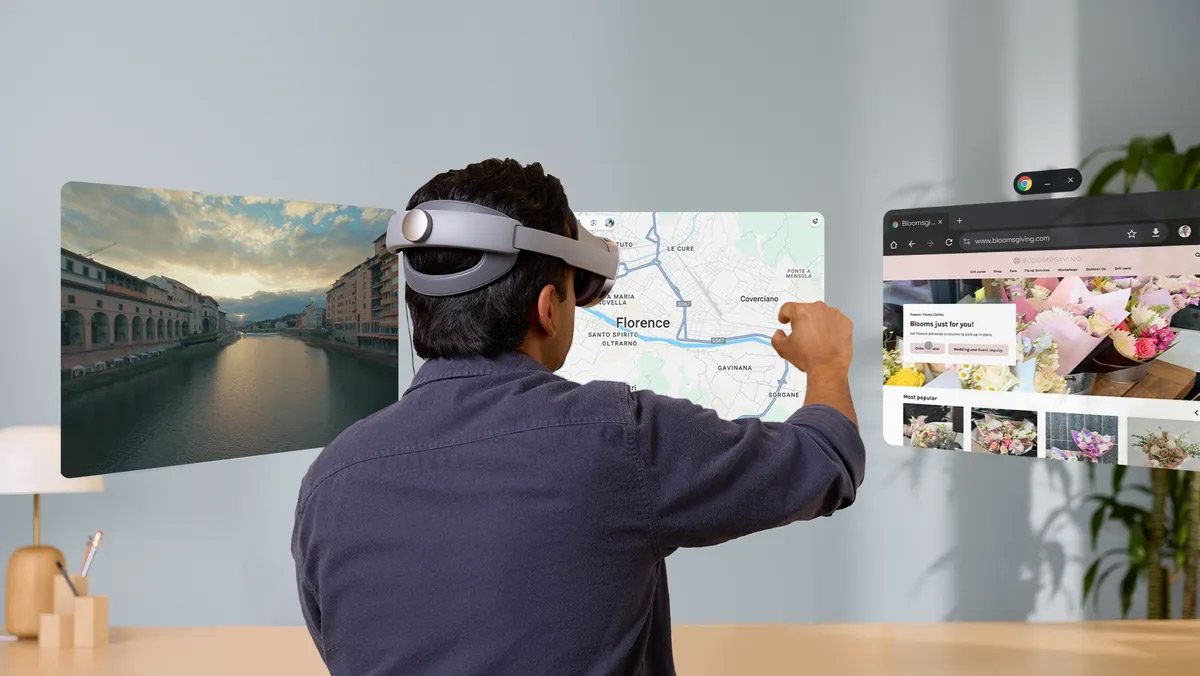
Image courtesy Google

In a way, Galaxy XR is proving that it can do much of what Vision Pro does at a fraction of the cost, while also supporting the gaming-focused capabilities of Quest. If the finished product is polished enough to actually be worth using, it’s in the perfect position to put real competitive pressure on both Meta and Apple at the same time.

That’s not to say that Quest 3 doesn’t also do many of the things Vision Pro does at an even lower cost. But it’s origin as a ‘gaming console’—and its lack of access to the massive flat app libraries of Google’s Play Store or Apple’ App Store—has left it with some notable deficiencies in the ‘spatial computing’ department.

SEE ALSO
'Little Critters' Brings Lighthearted Mixed Reality Home Defense to Quest 3 Today, Trailer Here

Competition is always good for consumers as it tends to mean better products at lower prices, which accelerates the pace of innovation.

The consumer XR industry has been firmly in the Quest 3 and Vision Pro era for the last two years or so. Things have been steady, but nothing has moved the needle enough to bring a step-change in the number of users. For that, the industry is going to need to offer smaller, cheaper, and better headsets.

Galaxy XR’s fusion of the gaming capabilities of Quest and the spatial computing capabilities of Vision Pro is just the right thing, at the right time, to accelerate and take XR to its next phase of adoption.

Newsletter graphic

This article may contain affiliate links. If you click an affiliate link and buy a product we may receive a small commission which helps support the publication. More information.

Ben is the world's most senior professional analyst solely dedicated to the XR industry, having founded Road to VR in 2011—a year before the Oculus Kickstarter sparked a resurgence that led to the modern XR landscape. He has authored more than 3,000 articles chronicling the evolution of the XR industry over more than a decade. With that unique perspective, Ben has been consistently recognized as one of the most influential voices in XR, giving keynotes and joining panel and podcast discussions at key industry events. He is a self-described "journalist and analyst, not evangelist."
  • JakeDunnegan

    $1800? Oof. If it's comparable to the Apple, then that certainly should help, but I still don't see that competing on price with something that's less than a third of it's cost. If they got to say, $1k (e.g. twice Quest 3's cost) – I could see it being real competition for it.

    I guess it comes down to how well it can compete with Apple's product. I still don't think Galaxy XR would become anything remotely like "mainstream" however. And I think we all want something that will actually do that.

    Mainstream devices likely won't come until they are at least in a "glasses" form factor if not actually being some type of "contact lens" equivalent. I just hope these billionaires continue to invest in the tech, as I'd surely like to see it get there.

  • Nevets

    It can't and won't compete with people who can only just scrape together £500 for a Q3 and who would consider £800 to be over-budget. The lack of controllers will severely restrict porting, given the peripheral status and absurd cost of the controllers. I would love to be wrong but I don't share your optimism here. NEXT MOVE: Valve.

    • Ben Lang

      Maybe my thesis wasn't communicated well.

      I'm not saying that an $1,800 headset is what people should be buying.

      What I'm saying is that Galaxy XR is in just the right spot, in terms of price and features, to push Meta and Apple to do better on future headsets.

      On Meta's side, there's strong pressure to make a better system interface / capabilities and get access to leading flat apps.

      On Apple's side, there's strong pressure to reduce cost and have better AI features.

      I see it as just the right headset to make future headsets better and cheaper for everyone.

      • Christian Schildwaechter

        Pretty sure that Samsung mostly ignored the Quest 3 when coming up with a Galaxy XR price, and instead targeted "half the price of the AVP" mostly for the headlines, with actual production costs not the real driver either. While Meta's HMD costs really reflect what is technically/financially possible, both Apple and Samsung currently sell at fantasy prices to "send a message". With Apple saying that this is not a cheap gaming VR headset, but a luxury spatial computer for/from the future that is also the perfect media device, and Samsung saying that they can do everything Apple does at much lower costs/better value.

        The first Apple and Samsung HMDs will both drive Meta to offer a more polished experience and more non-gaming features, as they still have to compensate for not having access to a large software store with millions of flat apps. But I doubt that Galaxy XR is "just in the right spot" or that Meta is really concerned with it. They will be much more worried about future AndroidXR HMDs at much lower prices that may actually draw away customers from Horizon OS, not an HMD four times as expensive as the Quest 3.

      • Jonathan Winters III

        Good clarification – thank you.

      • Albert

        Your thesis was very well communicated and right on the money.

    • Andrew Jakobs

      But the Galaxy XR isn't really targeted at regular consumers/gamers like the Quest 3 is, it's targeted at business.

      • Christian Schildwaechter

        TL;DR: The only real target group Samsung seems to have is AndroidXR developers and people wanting to be convinced that Google Gemini is the best thing since sliced bread. They have no history of enterprise targeting hardware and are barely trying with Galaxy XR, currently offering even less for business users than for gamers.

        Samsung is a conglomerate doing everything from building ships, biotech, facility management to selling displays, RAM and flash to Apple. Samsung Electronics, responsible for smartphones and Galaxy XR, also offers their Knox security software suite targeting the enterprise use of Galaxy devices, but this is a pure software solution. In contrast to Apple, who for decades have targeted professional users in graphics, music, video and recently AI with expensive hardware like the Mac Studio or Pro Display XR, Samsung doesn't offer dedicated business hardware, only consumer hardware usable by businesses too, or slightly prosumer products like the Galaxy Note and DeX.

        And with the Galaxy XR they barely try. If you go to apple_com/business, you'll get pretty much immediately directed to the Vision Pro for enterprise site. If you to to the "business" tab on the Samsung Galaxy XR page, you can read a lot why Gemini is great (for business), some references to their Knox device management, the generic informations that consumers also get, and then a list of the bundled YouTube Premium, YouTube TV, Google Play and NBA League pass, apparently important for enterprise customers.

        I agree that Galaxy XR isn't really targeted as regular consumers/gamers, but I don't really see it targeted at business either. Or if it is, they did a very half-assed job that pretty much boils down to an unspecific "Gemini AI is good for you". They show zero case studies or industry projects, not even hypothetical ones. Their "partners" listed on the Galaxy XR business site are Google's Gemini AI Pro subscription, Adobe's Pulsar creative App for 3D text and spatial effects, and "Calm Premium with serene meditation environments and wellness exercises for employees".

        So I don't buy that Galaxy XR is targeting business. That seems to be the logical conclusion since it is too expensive for consumers, but as mentioned, Samsung Electronics doesn't do dedicated business hardware, only reused consumer hardware. The one thing they could advertise is the more open Android environment, but they don't even mention creating custom apps anywhere. And the XR2+ Gen 2 is weak compared to the M2, even weaker with the extra R1 doing all the sensor processing and passthrough in AVP, and compared to the M5 hopelessly underpowered for compute heavy enterprise applications. Initial impressions from Brad Lynch hint that this already impacts how sharp text is rendered on the Galaxy XR's 4K displays.

        This is a consumer device that is too expensive for consumers, and currently lacks apps that would make it attractive for more than a few people. It could be great for some niche uses like PCVR streaming or as a virtual display, but other than that it still looks a lot like a (Gemini AI/AndroidXR) prototype or test ballon. And they apparently only planned to build/sell 100K units, at least initially.

        I don't see Samsung really trying to go after enterprise users like Apple very clearly does with adding enterprise specific features in visionOS 26, lots of partnerships and maybe the release of the M5 AVP itself, having for years already offered dedicated enterprise support with monthly per user/device fees. Instead we will see the real Galaxy XR a couple of years down the line, which as all other Samsung Electronics compute devices will target consumers at a much more moderate price, with business users again getting a few extra enterprise management software tools.

      • Jonathan Winters III

        Yes so it actually competes with Apples headset, not much with Metas.

      • ViRGiNCRUSHER

        doesn't stop people from treating it like a gaming device lol. People getting mad why its not up to par. Because it never was advertised as a gaming first device. All these people comparing to the Quest 3 seems natural to them when the XR is for a different use case.

    • ZarathustraDK

      While I don't expect Valve to hit that market-segment with their pricing, what may happen is that they engineer and open up their linux-based VR OS to be easily compatible with other Standalone headsets. Sort of like what SteamOS on Deck did/or is intending to do to other handhelds. From that perspective the Deckard would simply be the flagship reference model that showcases what Steam(VR)OS is capable of, enticing thirdparties to jump ship on Meta and Google's comparatively closed offerings.

      • Christian Schildwaechter

        Valve is selling hardware basically at cost like Meta, making all their money from sales on Steam. Rumors put Deckard at USD 1200, and given AVP build cost estimates of USD 1400-1800 in early 2024, a Deckard sold two years later at cost for USD 1200 could pack a lot of powerful hardware. That price would still be a lot higher than a Quest 3, but I'd expect the hardware (AMD APU standalone) to also be a lot faster and more capable than Samsung's Galaxy XR sold for 50% more. And you'll definitely get the controllers for free with Deckard, so a couple of people might be willing to stretch their budget a bit more than planned.

        The problem with Deckard/SteamOS is that all the real earnings are going to be from Steam game sales. SteamOS is very open compared to HorizonOS and AndroidXR that only allow their own store. You can run whatever you want from wherever you want on a Steam Deck. Microsoft's game pass already generates about 1/3rd of Steam's revenue, and Epic's Fortnite alone made up to half of it in a single year, but Steam is still the 800-pound gorilla in the PC gaming world, sucking up a lot of all sales thanks to user convenience. This leaves only some niches like much more expensive higher end gaming handhelds for competing companies.

        The problem with all headsets has always been how to generate money from them, and Deckard/SteamOS solves this only for Valve, not anybody else. Nobody will release a cheaper Steam Deck anytime soon, and nobody will be able to release a cheaper Deckard for a long time, as even with less costly components, everybody else has to add a certain margin on top to survive.

        • Dragon Marble

          How can you be so optimistic when they are still selling the Index at $1000? Besides, any processing power not needed for tracking and streaming is essentially paperweight on my face, and I don't want that.

          I agree with the article that the Galaxy XR has occupied an sweet spot in pricing. Anything lower gets crushed by Quest and higher than that you get outcompeted by Galaxy XR.

          • Christian Schildwaechter

            I think Valve treat their hardware like consoles, with many years between each generation and stable prices, artificially low and barely breaking even at the launch, while PCs tend to update all the time, with older/weaker hardware falling in price. They actually said that it would be "unfair" to users to frequently update the Steam Deck.

            So the 2022 Steam Deck will cost USD 399 until it is replaced by a newer version, even if production costs fall over time. And just like the 2020 PS5 never dropped below its USD 499 launch price, the Index will stay at its launch price until it gets replaced or discontinued. At least Valve didn't increase the prices like Sony and Microsoft did for their several years old consoles.

            And as I commented many times, I very seriously doubt that Valve will bother with providing a streaming-only wireless Index2 for the few with a powerful VR PC lusting after that, and instead go for an as powerful as technically feasible streaming-also standalone for both convenient flat and VR gaming wherever the users want. Which is exactly the benefit that drove the Steam Deck's success.

          • Dragon Marble

            The Steam Deck’s “success” is less than 1% of all Steam users according to Google AI. It explains how it got that number.

          • Christian Schildwaechter

            I'm not sure what exactly you asked the Google AI, but the answer was rubbish. IDC reported 5.972M sold Steam Decks in 2025-02. The last official number of active Steam users is 130M, posted by Valve in 2021, which would boil down to 4.6% of all Steam users owning a Steam Deck. And it is rather unlikely that the Steam user count increased by 360% in four years, which would be required for it to be just 1%.

            Asking the Google AI about Steam Deck sales gives the IDC number plus estimates for 2025:

            By 2025, Valve's Steam Deck has shipped approximately 5.972 million units worldwide. Market analysis from early 2025 projects an additional 1.926 million units to be shipped by the end of 2025, bringing the total to nearly 8 million units.

            So in about nine weeks, the percentage should have risen to 6.1%, or roughly one iin sixteen. Not bad for less than four years. Again asking the AI for a current Steam user count results in 147M, bringing it down to 5.3%. But that's not a proper number to evaluate success either, as for one a lot of recent Steam growth has come from Chinese internet cafe users, so people who don't own any gaming PC, and, like most of the world, couldn't even buy a Steam Deck. For the first year it was available only in Northern America and Europe, then got to Japan and South Korea. Australia and New Zealand only got itin 2024-11, 33 months after launch.

            So the real indicator for success would be the percentage of active Steam user that even could order the Steam Deck only available directly from Valve and did so. Let's ask the AI again how many active Steam users there are in the regions where the Steam Deck is actually sold:

            There are an estimated
            31 million active Steam users combined in the US, Canada, Europe, Japan, Australia, and New Zealand, based on user data from 2025. This is a calculation based on individual country figures: the US (13.7 million), Canada (3 million), Germany (3.6 million), Japan (1.6 million), Australia (1.4 million), and New Zealand (0.26 million) plus an additional ~10 million from the rest of Europe, as Europe's total user count is approximately 13.2 million.

            Hm, that would mean that 19% of those that could buy a Steam Deck did so, and by the end of this year it will be 25%. I really believe in the Steam Deck, and the sales and user numbers are sound, but not even I believe that one four Steam users in western countries bought a Steam Deck.

            So either a lot of people bought a second one when the OLED version release, or replaced Steam Decks accidentally dropped in toilets, or forgot some country where it was sold, or some other reason. But whatever you asked the AI didn't give you anything even remotely resembling an indicator for how successful the Steam Deck actually is.

      • Dragon Marble

        What exactly is the Steam VR OS is for? A new platform for standalone VR games (who's going to develop for it), or playing existing Steam VR games in potato mode (who wants that)?

        • ZarathustraDK

          Assuming it's linux-based, you have the entire open source ecosystem and sourcecodebase to draw on. Compared to Android that's a a solid base to develop a proper VR OS from.

          I can't be the only one who, when trying current standalones, don't feel like I'm using an operating system, but rather some curated interface designed to sell me services and software to rope me further into some dependency. Kinda like what Windows 11 people are complaining about these days.

        • flynnstigator

          I would assume the goal is to cement Steam’s position as the dominant platform by running PCVR games on-device. That would mean a huge library on day one with the best version of every VR game. It would take some serious Valve Magic to pull it off performance-wise (part of why I don’t think it’s going to launch in 2026), but there’s no way Valve would segment the Steam store when their every move for the past 20 years has been for the purpose of bringing all of gaming under a single Steam umbrella.

          • Dragon Marble

            I agree that it makes no sense to further segment an already niche market. That's why "the goal" is not possible. No standalone headset can run MSFS2024, for example. Not in 2026, or 2030.

            I think Samsung Galaxy XR already has the best a high-end PCVR user can ask for. I don't think Valve can offer anything significantly better.

            The Galaxy XR was delayed after Samsung saw the Apple Vision Pro. The Galaxy XR may have sent Valve back to the drawing board. I have lost hope that the "Steam Frame" will ever see the light of day.

          • flynnstigator

            There will always be certain games (like MSFS2024) that won’t run well or at all on a device like that, but if Valve can get the popular titles to look good and run well, that’s a big advantage over the competition. I think the key is going to be leveraging upscaling and frame-gen with lenses that make the image look sharp even if it’s being rendered in a much lower resolution than the competition.

            For instance, the Steam Deck runs games at much lower resolutions and framerates than some of its handheld competition, but Valve chose display components that would look just as good to most people. You or I might be able to spot the difference, but most people would just shrug. There are certain games that really struggle to run, but the Deck has a strong enough user base and mindshare that you can easily look up settings to get these games running.

            Do I expect it to run VR as well as my PC? Absolutely not, but I do expect games to look a lot better on the Steam Frame than stand-alone Quest games, even if the Quest 4 ends up being technically equal or superior on a spec sheet. There are so few games that really push a Quest 3, even years after its launch, that the whole library has a reputation for cutesy mobile graphics that don’t hold a candle to the Rift Store’s offerings from 2016, when a midrange PC wasn’t any more powerful than a Quest 3. Even if the Steam Frame’s stand-alone performance is nowhere near a midrange PC, it’s still going to blow the Quest library away.

            Then add the capability to run flat games well in a big, resizeable window and you’ve got a pretty compelling device for $1,200. I can see a lot of teenagers asking for a device like that so they can chat with their friends, play games, and generally tune out, and preferring it over a laptop. I can see PCVR gamers appreciating the SteamVR integration and wired+wireless streaming options, and I can see a lot of them being surprised how much they like running some of those games on-device. I can see frustrated Quest gamers itching for a better ecosystem that doesn’t shove Worlds, AI spyware, and pixellated gorillas in their faces. If Valve pulls it off, it would really hit the right notes for a lot of people.

          • Christian Schildwaechter

            MSFR 2024 might be a challenge even for Valve Magic, but I wouldn't count out running it in a playable way on a standalone Valve HMD just yet. There are a lot of optimization options, and thanks to a couple of updates, it already supports ETFR on HMDs like the Pimax Crystal with Tobii eye tracking, and FSR 3.1 with frame generation.

            A Deckard using an up-to-date AMD APU would very likely add FSR 4 on RDNA 3.5 with much improved ML based upscaling, providing similar results to current DLSS. And dynamic foveated rendering driven by eye tracking gets more efficient with larger FoVs like on Index, as the physical area you have to render at full resolution stays the same, causing the actual pixel count in this area to lower with a higher FoV that puts more pixels into the peripheral vision, which then can be rendered at lower resolution, or simply generated from previous frames.

            Add SteamOS and its Gamescope compositor, and Valve can introduce these features to a number of SteamVR games without the developers having to actively support them. Which could be a pretty big deal. The Steam Deck already offered a lot of these nifty hacks that make it a better gaming experience than Windows.

            And a really big advantage the Steam Deck or AMD APUs in general have over the XR2 based Quests is a much more powerful CPU, required for physics heavy games like HL:A or MSFS 2024. In contrast the XR2 line runs a reduced number of slower CPU cores compared to the SoC's Snapdragon counterparts, at significantly lower speed to give the GPU more thermal room for improved graphics. And Meta then underclocks the CPU cores to just half the speed of a matching phone in GPU heavy games. There are a lot of technological tricks Valve could build their magic on for Deckard.

          • Dragon Marble

            Now you are contradicting yourself. You are now proposing a highly segmented market: The Valve standalone headset can run only some SteamVR games, and they are between Quest and PC quality. How many targets can you expect the developers to optimize for?

          • flynnstigator

            Developers already try to set their minimum requirements as modestly as they can. There's no point trying to sell a game if most potential buyers can't run it. As long as the performance is comparable to a midrange PC from 2-3 years prior, which is what devs already target, it shouldn't take much effort from devs. This is completely different from making a Quest version that has to run on a Qualcomm architecture and where you don't want to leave out the millions of Quest 2 owners, meaning you have to target "potato" performance.

            I understand the fear that a stand-alone device will hold back PCVR, but even if you could somehow ban all stand-alone VR, we wouldn't go back to the halcyon days of 2016-2019 where companies were throwing tens of millions of dollars at PCVR games that never made their budgets back. It didn't pencil out for them financially, and they only did it because they were afraid VR might take off and they would miss the boat. If Valve is going to corner the VR market and keep Steam as the dominant platform, they need a stand-alone device running the same Steam store as PCs, and running it well. A tethered "Index 2" might sell decently with enthusiasts, but it wouldn't help their overall goal of Steam supremacy, and Valve doesn't sell hardware unless it gets more people into Steam.

          • ViRGiNCRUSHER

            If Valve are going to rely on Qualcomm Snapdragon XR2+ its already cooked from the start. They will always be years behind the newest generation.

        • Herbert Werters

          It will be a wireless PCVR HMD that may eventually allow you to play small PC flat games mobile on a virtual screen. VR games may not run on it, except perhaps small indie games that require very little power.

          But these possibilities alone are already convincing me to switch from Meta to Valve, and I don't really care about the price.

          • Christian Schildwaechter

            Not sure why you are so pessimistic regarding performance. AMD posts multiyear roadmaps for their APUs, and from these we knew that by late 2024/early 2025 there would be mobile APUs with a 15W TDP about as fast as the GTX 1060, a GPU fast enough to run HL:A. The Steam Deck with a 2021/2022 APU performed about as fast as a 1050(Ti), and people streamed HL:A from the Deck (with VDesktop and reprojection at low settings), playable at least during the first few chapters. So a 2026 APU will definitely be able to run it and other demanding games without any tricks.

            The sole issue is that an GTX 1060 can run HL:A without reprojection on a 1.75MP/eye Rift CV1, while 4K microOLEDs have 13.6MP/eye, almost 8x the resolution, something even expensive desktop GPUs struggle with. So the question isn't whether an AMD APU based Deckard would be able to run most PCVR games at all, which it definitively will. The question is how far above let's say Quest 2 resolution Valve can push a 15-25W TDP APU with optimizations like ETFR, smart upscaling, (partial) frame generation and more tightly integrated into the system.

  • Christian Schildwaechter

    We already knew that it was possible to do what the Vision Pro does at a fraction of the USD 3500 retail price, when teardowns revealed that it takes Apple (less than) half of that to build AVP. And this was including USD 700 for 1st gen 4K microOLED displays plus expensive custom chips produced only in very low numbers. The big unknown is the current price for microOLEDs, but based on the used technology I doubt that the GalaxyXR incl. a pair of controllers costs more than USD 1000 to produce.

    I still see both AVP and GalaxyXR mostly as prototypes/developer units, not really intended to compete against other headsets. That will come with future generations, and the rumors about a 2027 Vision Air at half the price and 40% lower weight indicate that at least Apple sees it the same way.

    So comparing the market potential between a USD 500 Quest 3, USD 1800 GalaxyXR and USD 3500 AVP is probably a bit premature. And we will only see how they really position against each others two or three years down the line, when HMDs targeting much larger unit sales release with much cheaper components and lower assembly costs, sold at significantly lower prices. Except for those from Meta that already sell at cost.

  • Paul Bellino

    With the Samsung….why not build one good headset for Everyone….. Flat, Mixed, VR, AR, Gaming, Productivity and Media Consumption In other words why limit yourself. It makes no sense at all. I have a PC, it does everything….I have a laptop it does everything….That's why my money is on the Steam Frame…..

  • Stephen Bard

    I am happy with my versatile Quest 3, but at some point I would like a headset with OLED displays. I could never tolerate a headset with FOVs any narrower than the Quest 3, but almost all of the many $2000 micro-OLED headsets currently available have claustrophobic FOVs much narrower than Quest 3. The Galaxy XR headset seems to actually have FOVs similar to the Quest 3, so I now see that as the primary choice for OLED, followed closely by the Play for Dream, which also has pretty good FOVs, but maybe the Pimax Dream Air will have even better FOVs if it is ever released. In any event, with 3 OLED headsets with acceptable FOVs, the insultingly overpriced AVP, with bad FOVs is completely obsolete.

    • Christian Schildwaechter

      Do you count how often you have already ignored someone replying to you that the FoV on AVP is actually pretty good if you use the proper paddings that allow the eyes to be closer to the lenses? Or do you just reset your ignore counter every time you post the same claim again?

      • Stephen Bard

        Everyone knows that you can modify the AVP to improve the horizontal FOV, but you choose to ignore the fact that it also has the narrowest Vertical FOV of all major headsets. Yes, I am obsessed with the immersion allowed by wide FOVs, but you seem to be obsessed with illogically defending overpriced inferior Apple products.

  • polysix

    Don't care who ends up 'winning' but Quest needs to die. It's ruined VR for years with its LCD, crap overlap, poor FOV but at subsidised pricing that limits what others can do to compete (even with far better spec).

    Essentially META raced to the bottom and VR paid the price, they set us back years. Standalone VR (Games) are not the answer, even for Galaxy XR or an M5 AVP for that matter, but at least they are micro OLED and addressing the 'other side of VR' (media and virtual tourism) properly without the novelty/gimmickry of quest trash.

    • Sonyboy

      II use to think Oculus was going to be so good by this point. Even the Go which was severely limited still managed to get you hyped for future.
      But nope its like they threw everything in the trash and went in the worse direction possible (at least for me)

  • xyzs

    If the side proprietary battery connector is also a display port / usb interface allowing it to be turned into a PCVR headset, I'd be very interested, if it's not the case: opportunity missed.

  • Christian Schildwaechter

    TL;DR: I'm (mostly) serious about the news about the GXR as a product (not the category or AndroidXR OS) being lackluster compared to a simple, insanely over-engineered strap from Apple and its longterm impact. But admittedly there was a lot of long term strategic expectation, big personal problems with VR comfort, and some mean offset for Ben's somewhat over-enthusiastic placing of the headset involved.

    I'm somewhat/mostly serious, but the wording was picked very careful and deliberate. The Dual Knit band is NEWS in the way that we really didn't know about it, and that it solves a big problem for a very expensive product in a cheap, but effective way. When AVP released, we already knew it was 1) ridiculously expensive, 2) had only a few use cases, and was mostly for developers and a way for Apple to get feedback for future HMDs. What we didn't know and what surprised everybody was 3) how horribly bad the ergonomics were for most. The Dual Knit now actually solves one of these three issues.

    We already knew most of the hardware specs for GXR (so not really NEWS), which are similar to other HMDs like Play for Dream, all based on Qualcomm's reference HMD and Sony microOLEDs. What's different is AndroidXR, but last year's Project Moohan hand-on already focused mostly on Gemini used with Google apps, and that's what we got (so not NEWS either). GXR is much more a Gemini prototype than an AndroidXR prototype, and most of its features would make a lot more sense for smartglasses than XR HMDs. The main surprise (NEWS) was that the controllers are not only not bundled, but that they produced so few they immediately sold out.

    I really don't believe in the current GXR as a product, and neither seem Google or Samsung, given the limited units produced, lack of content for consumers or offers for businesses, and availability in just two countries. Asking Gemini: "Will Galaxy XR be released in Europe?" Answer Gemini: "No, the Samsung Galaxy XR has not been released in Europe yet and there is no official release date for the region. The headset is currently only available in the US and South Korea, with Samsung planning to monitor market response before expanding to other regions." So if it doesn't sell like hot cake in the US and South Korea, that's it.

    I actually believe that Apple thinks spatial computing is something a lot of people will use for work, communication and media consumption, at least partially replacing laptops and tablets. And paired with a Mac Mini it already works as a super tiny portable workstation. Which is why they heavily invest into things like Immersive video, sports events live streaming, or personas actually usable for conferencing in FaceTime.

    I seriously doubt that Google sees GXR as any more than a stepping stone to more powerful smartglasses a few years down the road. If you go to their AndroidXR page, it starts with a big headline: "Android XR is an AI-powered operating system coming soon to headsets and glasses". Doesn't mention VR/MR/AR anywhere. I always saw Google leaving VR as only temporary, with development going on in the background or with ARCore on phones, but I also bought a Daydream phone plus viewer and got burned. I'm very sure there will be Apple Vision models in ten years, I'm not so sure about AndroidXR HMDs, which may by then have all been replaced by souped up smartglasses great for Gemini, but not necessarily for VR. In a case of doubt, look at the iOS tablet market compared to the Android tablet market, plus the support these get.

    There is a personal side too. My main issue with VR has always been comfort. I was fine with Cardboard partly because it was so mobile, carrying around a foldable viewer the size of a pack of cigarettes, without any pressure comfort issues thanks to being just held in front of the face. I loved the strange experiments people came up with on DK1. The Quest 3 is no doubt much, much better, but to wear it more than a couple of minutes at a time I need a heavily hacked DIY strap, because even the 3rd party replacements I bought were uncomfortable.

    So for me personally the Dual Knit providing an actual solution for a very heavy 4K HMD without the compromises of hard/halo straps is a big deal, while I don't give a rat's ass about an underpowered 4K HMD with a non-replaceable hard strap who's main purpose seems to be to force me into an endless conversation with Google's AI that makes little sense in an indoor setting. My immediate thoughts where that what I really want is a 4K Deckard with the Dual Knit band hacked on, though this may not work if Valve releases a properly balanced HMD with the battery at the rear of a hard strap.

  • Christian Schildwaechter

    But your experience is based on now almost ancient hardware. The Steam Deck was supposed to ship in 2021 with an APU that will be five years old by 2026. And it was intended for a handheld targeting AAA games, but only at 1280*800, so the emphasis was on CPU, not on GPU. It also wasn't optimized for either VR or Windows, and you had to install Windows to use something like Virtual Desktop with SSW reprojection to run a game like HL:A at bearable speeds from the Steam Deck.

    Whatever Valve/AMD are cooking up would not only be several generation newer, but very likely targeting 2* 4K displays. As this is simply impossible to drive with a mobile APU for anything but simple graphics, a standalone not streaming from a powerful PC would have to heavily rely on ETFR and FSR3/4 upscaling, which now works on leaked drivers for RDNA 3.5 that the latest mobile APUs use.

    Considering that the basic Steam Deck sold for USD 399 from day one, containing a lot of hardware besides the APU itself, it is very unlikely that its APU costs anywhere close to USD 150. Barebone AMD Strix Halo mainboards incl. RAM now start at about USD 550, and a Deckard would probably feature something similar, possibly cut down a little to reduce power consumption, and produced on TSMC's latest process that AMD got access to before even Apple. Given Deckards rumored price of USD 1200, the APU price itself probably won't be a major obstacle.

    And it is a misconception that APUs are expensive compared to high end ARM chips, esp. those from Qualcomm, who have been increasing prices a lot since they switched to the Snapdragon 8. We know that Apple paid about USD 110 to TSMC for producing the 2022 A16 SoC on their 4nm process. The SD8 Gen 2 with similar chip size produced on the same process was sold by Qualcomm for USD 160. This is the chip the Quest 3's XR2 Gen 2 was based on, though with reduced cores and on an older process. The SD865 on which the 2020 Quest 2 XR2 Gen 1 was based still sold for USD 85, close to what Qualcomm for years had charged for their top of the line SoC with only moderate increases. But for the SD 8 Gen 3, Qualcomm raised the price to USD 200, with USD 240 rumored for the SD8 Gen 4.

    ARM is cheap in the low/mid end, due to very small SoC sizes produced in the billions, but not all that cheap at the high end, partly due to Qualcomm almost holding a monopoly there. The main driver for ARMs success in the high end is the improved power management compared to x86, allowing for longer runtimes in phones and ultrabooks. Which is important for devices that mostly idle, while a VR HMD runs at full load most of the time. And there is a reason why the PlayStation 4/5, Xbox One/Series S/X are based on AMD APUs, and it has a lot to due with price/performance ratio.

    But of course only Valve/AMD knows what/if/when Deckard ships. Pretty much all the rumors based on data mining SteamVR releases bet on Valve using a Qualcomm chip, but I think this is a misinterpretation of Valve using these chips in prototypes simply because only very recently AMD APUs have become somewhat competitive regarding power usage. A pure streaming HMD using ARM might make at least some sense, even though it would be targeting only a rather small group of users, which is (one reason) why I don't expect Valve to release one.

    An ARM standalone would be braindead given Valve complete reliance on selling x86 games, with a 5K+ VR supported games library serving as an argument for buying an x86 Deckard, and x86 emulation on ARM comes with a brutal performance hit that would pretty much wipe out all optimization efforts Valve might have made to run PCVR level games on a mobile standalone HMD. A Steam Deck still easily beats any high end ARM phone running Steam x86 games via Gamebox/Proton/Wine, and not just a little bit.

    Regardless of what I think makes most sense, I hope we'll learn what Valve is actually planning in the next few months.

    • Herbert Werters

      I don’t think Valve will release a $1200 VR headset with a powerful APU. I suspect they’ll release a VR headset for around $600 and a gaming console for the TV for around $600, to which you can connect the VR headset just like on a PC, using a USB dongle that will be included with the headset. The VR headset will also have 2K LCD displays with pancake lenses — basically similar to a Quest 3.

      I would be very happy if I were wrong about that. But to me, it just seems logical, because anything else wouldn’t sell well. Valve is going to shake up the console market, I’m sure of it. Xbox is moving away from it, and Valve will take the open spot.

      • Christian Schildwaechter

        Why would anybody pay USD 600 for a 2K Valve streaming-only HMD, when you can get a 2K Quest 3 for USD 500 that also runs standalone apps? Valve would have to put a lot of faith in flat gamers buying HMDs for this, and a USD 600 console won't exactly be a powerhouse that would get PCVR users to switch to that bundle.

        It might be faster than the PS5 Pro and offer all the optimizations mentioned above for speeding up VR, similar to what Sony did with the PSVR2, but it would be a very tough sale for both VR and flat gamers at USD 600 for the console and the HMD, even more expensive than Sony's initial USD 550 price for PSVR2.

        IMHO Deckard as a luxury Steam Deck allowing to play VR and flat games on a giant virtual screen everywhere would actually push the needle for Valve and fill an actual void instead of pairing a mediocre HMD with a mediocre console like PC. I may of course be very wrong here, but so far Valve has always tried to advance flat/VR gaming in some form, so I seriously doubt that their motivation would be filling a not yet existing Xbox gap.

  • Vaske

    "spatial computing for productivity" is a complete joke designed to swindle naive enterprises into jumping on new thing. It's greatest strength is the potential for additional virtual monitors to be able to drag tabs to and such, but for $1800 you can just buy three more monitors! Its only sensical, practical use is still in simulators/games

  • Peter vasseur

    It’s never going to compete with meta at $1800.00. Most vr gamers bitch about $500 costing to much let alone $1800.