
Magic Leap Announces Multi-year AR Hardware Partnership with Google

8

Magic Leap announced this week at the Future Investment Initiative (FII) in Riyadh, Saudi Arabia its latest AR hardware plans along with a renewed partnership with Google.

The News

Google and Magic Leap announced in May 2024 a “strategic technology partnership” to secure key technology needed to make compact AR glasses. We’ve heard little about the partnership since, however now Magic Leap has provided an update.

The Plantation, Florida-based AR unicorn today announced it’s extending the partnership through a three-year agreement with Google that will position it as “an AR ecosystem partner to support companies building glasses,” including work on display systems, optics, and system integration for AR devices.

Additionally, Magic Leap and Google showed off an AI glasses prototype at FII, which the companies say will serve as a prototype and reference design for Google’s Android XR ecosystem. Android XR is designed to run on a variety of XR devices, including the recently launched Samsung Galaxy XR (ex-Project Moohan), as well as future AR glasses, and smart glasses from a variety of hardware partners, including Samsung, Warby Parker, and Gentle Monster.
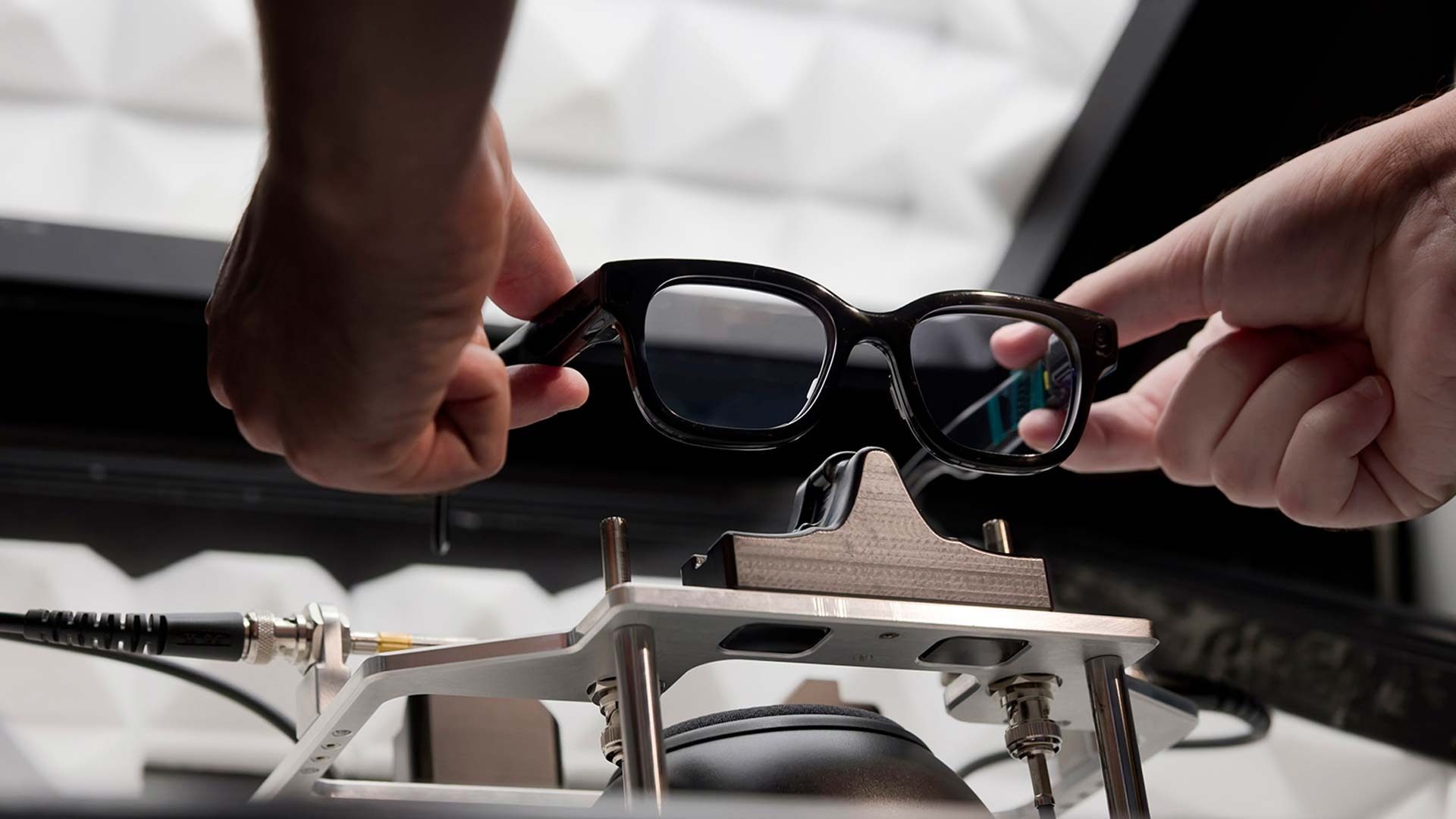
Image courtesy Magic Leap

“The demo shows how Magic Leap’s technology, integrated with Google’s Raxium microLED light engine, brings digital content seamlessly into the world,” Magic Leaps says. “The prototypes worn on stage illustrate how comfortable, stylish smart eyewear is possible and the video showed the potential for users to stay present in the real world while tapping into the knowledge and functionality of multimodal AI.”

Note: It’s uncertain whether the prototype above is new, or actually Google’s previously teased smart glasses seen at Google I/O this year. We’ve reached out to Magic Leap and will update when it’s more clear.

“Magic Leap’s optics, display systems, and hardware expertise have been essential to advancing our Android XR glasses concepts to life,” said Shahram Izadi, VP & GM of Google XR. “We’re fortunate to collaborate with a team whose years of hands-on AR development uniquely set them up to help shape what comes next.”
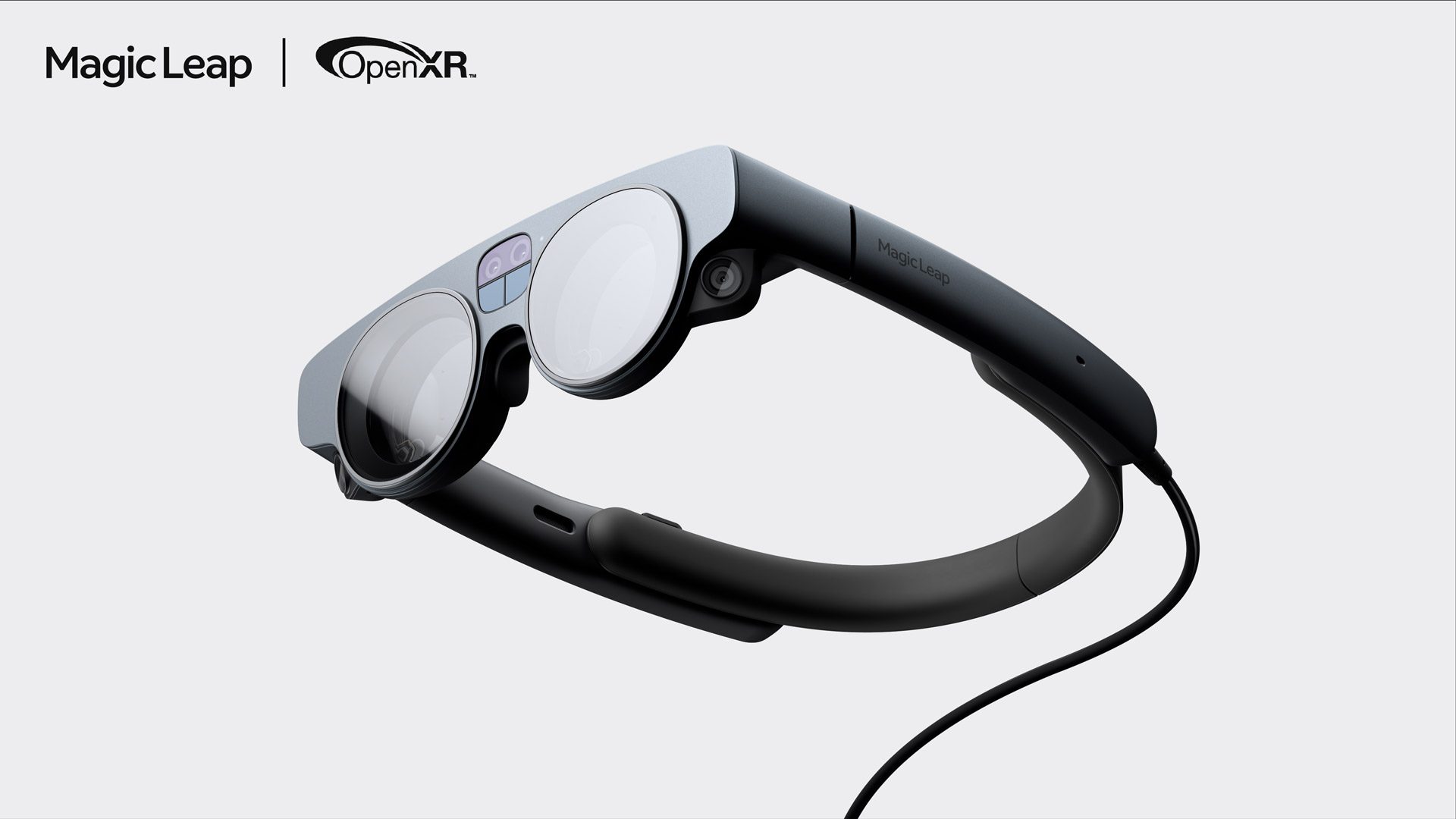
Magic Leap 2 | Image courtesy Magic Leap

Founded in 2010, Magic Leap promised to revolutionize AR with its lightfield display technology, raising over $4 billion in funding from major investors like Google, Alibaba, Qualcomm, AT&T, Saudi Arabia’s Public Investment Fund, and Axel Springer.

Its first headset, Magic Leap 1 (also stylized as ‘One’) however underperformed and struggled to find a viable consumer market when it launched in 2018, forcing the company to pivot to enterprise and medical applications. This came alongside a leadership shakeup that would see founder Rony Abovitz step down as CEO in 2020, making way for Pegggy Johnson, formerly of Qualcomm and Microsoft.

A year after the enterprise release of Magic Leap 2 in 2022, Johnson would be replaced as CEO by Ross Rosenberg, previously of Bain Capita, Danaher, First Solar and Belden. Rosenberg currently leads the company.

SEE ALSO
VR Games Showcase Brings Fresh Game Reveals on November 13, in Partnership with Road to VR

My Take

At the release of Magic Leap 1 in 2018, and consequently the height of consumer PC VR headsets, Magic Leap held conferences, courted influencers and media, and funded a fleet of expensive third-party apps aimed at gamers and casual users. The world didn’t even have a viable standalone VR platform yetand Magic Leap was hoping to kickstart AR headsets—not glasses—as the next dominant consumer computing platform.

The company also presumably burned through a good portion of its multi-billion dollar runway in the process to launch something that the market, developers, and even Magic Leap itself didn’t really seem ready for. I, like most in the early days of XR, was skeptical. Too many pie in the sky (or ‘whale in the sky’) marketing videos. Never enough substance or clear direction to tell where things were really going for the company.
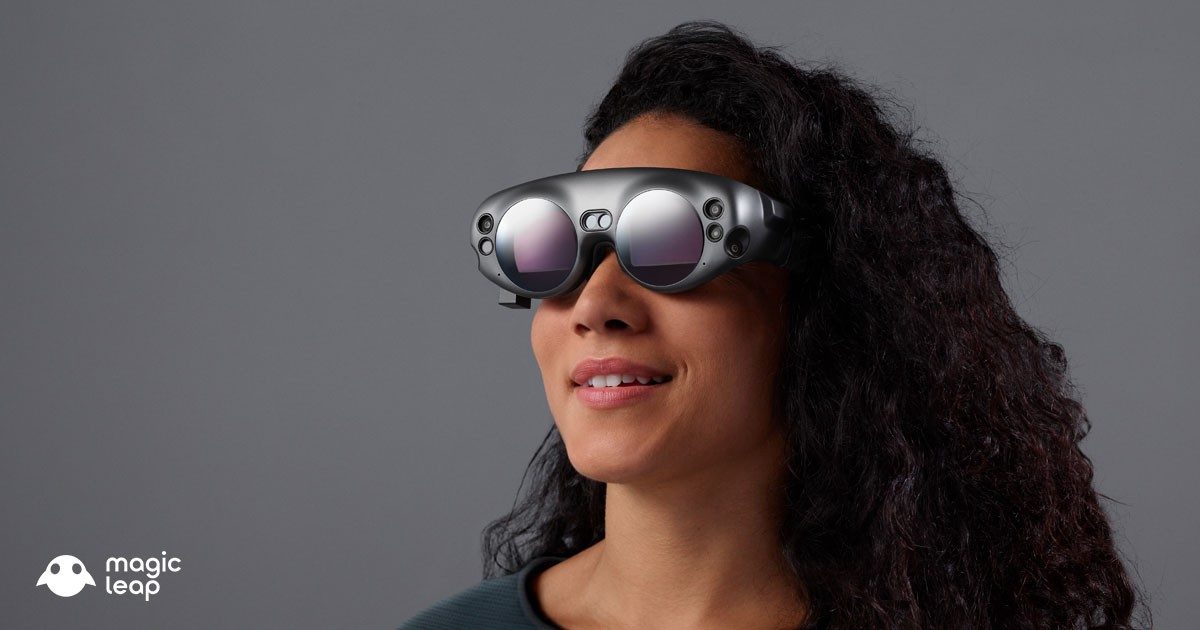
Magic Leap 1 | Image courtesy Magic Leap

What’s more, Magic Leap 1 didn’t even really outperform Microsoft’s staunchly enterprise HoloLens AR headset, or deliver on its promises of “lightfield photonics” to allow for multiple focal planes. Its first ‘Creator Edition’ ML1 headset contained a waveguide-based display with two focal planes. Nothing revolutionary, and at $2,300, too expensive of a platform for most consumer-focused studios to stomach.

But it did provide Magic Leap 2 to enterprise in 2022, which is exactly where it should have focused the entire time. But going that route from the get-go would have been less flashy, and probably less capable of attracting historic levels of funding.
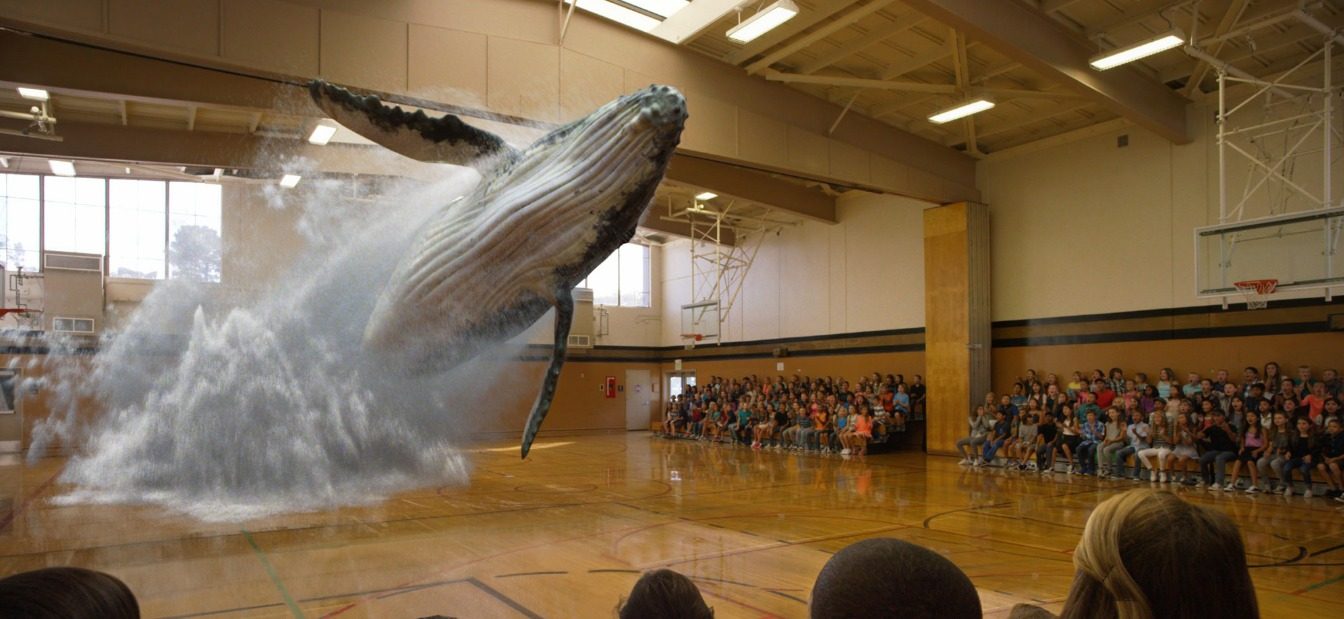
Magic Leap Concept Art (2015) | Image courtesy Magic Leap

Barring all else, Magic Leap’s greatest sin was undoubtedly being a decade too early. Only now it seems that companies are building out the requisite customized chips, waveguides, light engines, everything, and slimming it down into a digestible form factor. And big players like Meta, Google, Samsung and (likely, but unconfirmed) Apple are hoping to use smart glasses first before serving up anything AR remotely targeted at consumers.

In the end, there’s a good reason Magic Leap is still kicking, even this late in the game. The company’s latest funding round was a $590 million debt financing deal struck in January 2024, led by Saudi Arabia’s Public Investment Fund. It seems to have the operational cash on hand, and has been rightfully deflated to make better use of it. That, and there’s still real know-how at Magic Leap to go along with a genuine pile of patents, which I suspect the company is leveraging as it makes its second big transition: from enterprise headset platform creator to glorified AR parts supplier to a company that could really play a big part in the coming AR glasses revolution.

This article may contain affiliate links. If you click an affiliate link and buy a product we may receive a small commission which helps support the publication. See here for more information.

Well before the first modern XR products hit the market, Scott recognized the potential of the technology and set out to understand and document its growth. He has been professionally reporting on the space for nearly a decade as Editor at Road to VR, authoring more than 4,000 articles on the topic. Scott brings that seasoned insight to his reporting from major industry events across the globe.
  • XRC

    Magic leap 1 was actually really impressive, in contrast to all the negative press i had read. Got let loose with the Attenborough dinosaur XR experience amongst other apps, and soon found myself wandering about in a large space with dinosaurs crawling about everywhere.

    found it comfortable, tracking good, impressive display with the dual focal planes, didn't find the compute puck a problem as they gave me a neat shoulder sling to wear. Also had several sessions with Hololens 1 also liked it, like glimpse into future but preferred the ML1.

    Good to see them still moving forward.

    • Magic Leap 1 actually had what I'd consider the best XR experiences I've ever had the pleasure of experiencing, along with the coolest video game I've ever played.

      I'm of course referring to Dr. Grordbort's Invaders.

      It was not only the coolest game I've ever played, but also, without having to worry about bumping into a wall, such is VR, but the device itself had some of the coolest experiences aside from gaming I've ever seen

      Tonandi, Undersea, Create, and Magic Leap's magnum opus at the time, The Last Light.

      I haven't even had the pleasure of experiencing Magic Leap 2, but I can tell you what I've been told about the visual fidelity:

      It's night and day.

  • Nothing to see here

    It is kind of hard to trust in technology from a company that bricked all their headsets when customers paid $2,295 for them without offering any refunds. There is a project to hack them but the company is not offering any help at all. That's really expensive e-waste.

    • Christian Schildwaechter

      Minor addition: they didn't directly brick the Magic Leap One, but they had hardcoded an online authentication that the headset required every six months to operate. For security reasons (?) this function could not be removed with a firmware update.

      Magic Leap shut down their web services 2024-12-31, immediately killing some core Magic Leap One features like running apps, though still leaving the headset operational. But once six months since the last authentication had passed, the now unauthenticated Magic Leaps refused to even boot, effectively bricking them.

      The hardcoding is what makes it difficult to find a hack to re-enable them, you basically would have to alter the motherboard. In a way it is a warning never to trust any offline device that for whatever reason requires at least occasional online access to operate. Or trust companies that time-bomb their producs.

    • Jeggo

      This should be illegal and I hope they got sued for that.

      Probably it would have been easy, to just release a small codebase with their private key for that auth operation that people can host themselves. They can be glad that Louis Rossmann didn‘t buy one of those haha

      • Christian Schildwaechter

        The authentication process requires a secure connection to one specific Magic Leap domain, and the parameters were fixes on the headset so that nobody could spoof that website and upload malicious firmware compromising security that way. A safe method in theory, but in effect meaning that the device would brick the moment said address would no longer respond. You'd need the private key, a DNS server spoofing the address, and a valid SSL certificate for self-hosting, and changing these parameters would require the same effort with hardware changes as removing the whole authentication process would have.

        They probably had some valid reasons to come up with this horrible idea that didn't allow any fixes later, but I'd agree that this should be illegal, and they should be sued for that. I'm afraid that won't happen though, as EULAs now usually state that you don't own the software, only (temporarily) license it, and companies even get away with making movies you bought just disappear from their streaming services.

        For me the question is why they didn't simply let the authentication servers run for another decade, as the cost should be pretty much negligible. They have been on the brink of bankruptcy for years, so maybe anything not essential had to be cut, but the PR damage this caused for their future HMDs is IMHO a lot more expensive than just keeping an already existing server running, even if all other services are terminated.

        • Jeggo

          Totally agree with you. Either letting the auth server run for many more years should cost almost nothing with no new headsets shipping and being mostly dead on arrival anyway.
          One thing I disagree though by guessing is, that I would expect that they could have patched the firmware easily. Of course the auth security claims are broken that way, but at least people can use the hardware they paid for. Even worse when you scratch that culture preservation itch and know that those devices are lost for future generations. Same with Meta though, letting the Oculus Go and Quest 1 rot, because the app does not support their setup anymore. The only circumvention is to get you hands on an old version of the Meta Quest app for Android.

          I hate those companies with such a passion. Greedy bastards without any sense of responsibility for preservation of ownership and digital culture. Sadly the Steam Frame won’t do much damage to Meta, I expect, but I hope Valve will kill Meta in the long term, to the same degree they do damage to ~~MacroHard~~ Microsoft now with Linux. No matter how much VR is pushed forward by Suck’s money that is pumped into the Reality Labs which everyone who loves VR as a technology can be thankful for, I hope that company dies painfully.

          • Christian Schildwaechter

            The issue on Magic Leap is not the firmware itself, the problem happens before that. The HMD has a bootloader that is sort of like a TPM module on PC mainboards, a dedicated crypto processor with a random number generator and a unique private key burned into it during production. On Magic Leap this also seems to be able to do a simple online authentication, with the access data also burned in during production.

            There are different ways to implement TPM, and on PCs you can disable it to boot unsigned operating systems, it is up to each OS to use the key in the TPM to encrypt data, so nobody can access it unless the system was booted with TPM. But on Magic Leap One that crypto module cannot be disabled and basically refuses to boot the firmware in the first place. So even replacing the firmware manually with a USB EEPROM/Flash BIOS programmer like you can do if you borked up a BIOS updated on your PC won't help. You'd basically have to replace the TPM-like module and reimplement the boot loader that then calls the firmware plus all the functions. And to keep using an existing HMD, you'd need to extract the burned in private key to allow decrypting existing OS/data storage.

            TPM exists as dedicated chips or functions as part of CPUs, and the latter can be sort of updated. This doesn't work for the chip solution, which also means that any bugs in the TPM implementation cannot be fixed. And of course, both implementation and design flaws have been found. That is also the best chance to get Magic Leap One to run again, and some time ago someone managed to get the TX2 bootloader of the Nvidia Jetson used on Magic Leap one to execute arbitrary code by exploiting a known vulnerability. So there might be a chance to get the HMD working again without replacing chips on the hardware itself, but it may be still a long way for the above mentioned reasons.

            I mostly hope for legislation to force manufacturers to open their unsupported devices, as we have seen more and more devices requiring cloud access just die once services are stopped, leaving consumers in the dust. It would be nice if the consumer's themselves would avoid these devices, but this often means accepting higher costs and reduced convenience compared to the solutions large companies offer. You can make your home "smart" using only open software, but you have to invest a lot more time. Or you can just use Google Home devices, and then had to replace your Nest thermostats after they dropped support.

            Having Valve as an alternative is great, but they are a tiny company with an estimated value of USD 16B, compared to Meta (> USD 1.5T), Google (> USD 3.5T), Microsoft (> USD 3.5T) or Apple (> USD 4). Meta spent USD 17.7B on MRL just in 2024, based on USD 165B in revenue mostly from Facebook and Instagram ads, resulting in earnings > USD 80B. And the Steam Deck brought the Linux use on Steam a record 3%, but Windows still holds 95%.

            And while Steam generated USD ~16B revenue/USD ~4B earnings in 2025, Microsoft's much younger Game Pass also hit a new height with USD 5B revenue, so even a falling/failing Xbox business won't stop them. Which is why I really hope for government bodies to start raining into the currently very uncontrolled behavior of a few trillion dollar companies positioning themselves in central positions of our daily lives, and trying to keep others out by using proprietary solutions and licenses instead of making things interoperable or user fixable.