A novel use of a single Vive Tracker is to stick it to a rotating platform in order to create a virtual potter’s wheel. Patrick Hackett, co-creator of Tilt Brush, tweeted a short clip of the tracker in action as experimented with by an intern.
Back in 2015, Neuroscientist David Eagleman gave a TED talk about the potential to expand and create new senses. He showed off a haptic vest prototype that could translate audio input into an array of 32 vibrating motors that could be fed directly into your body. The signals would reach the brain and create a neural input that is indistinguishable from what the cochlea would produce, meaning that it’s possible to turn the torso into an ear. The principle of sensory substitution shows that the brain doesn’t care where the data comes from as long as it’s structured in the right format and correlated to feedback within the environment.
Michael Abrash, Chief Scientist at Oculus, as-ever delivered an inspiring presentation at today’s F8 conference, this time on the topic of Augmented Reality. AR has received top billing at this year’s event, with Facebook introducing a camera-based platform to develop today’s technology; Abrash’s talk looked further ahead to glasses-based AR which he says will transform how we work and play.
Regina Dugan, VP of Engineering at Facebook’s Building 8 skunkworks and former head of DARPA, took the stage today at F8, the company’s annual developer conference, to highlight some of the research into brain-computer interfaces going on at the world’s most far-reaching social network. While it’s still early days, Facebook wants to start solving some of the AR input problem today by using tech that will essentially read your mind.
Facebook F8, the company’s annual developer conference, is currently in full swing on its second and final day. Today’s big VR announce from the social platform giant? Facebook is releasing the 360 Capture SDK tool that developers can integrate into VR apps so that you can capture and share your VR experiences through 360 photos and videos. The SDK can be integrated into Unity and Unreal Engines titles, and across NVIDIA and AMD GPUs and is headset agnostic. The 360 Capture SDK is available today on GitHub.
Facebook today announced two new additions to the Surround360 hardware initiative that are poised to make 360 video more immersive. Unveiled at the company’s yearly developer conference, F8, the so-called x24 and x6 cameras are said to capture 360 video with depth information, giving captured video six degrees of freedom (6DoF). This means you can not only move your vantage point up/down, left/right like before, but now forwards/backwards, pitch, yaw and roll are possible while in a 360 video.
At Sundance this year, I had a chance to catch up with a couple of representatives from Google to talk about what’s happening on the YouTube VR platform with 360 videos. I talked with Jamie Byrne, YouTube’s Director of Global Creator & Enterprise Partnerships as well as Julia Hamilton Trost, Google VR’s Business Development & Content Partnerships.
Julia Hamilton Trost
We talked about the YouTube VR application, what they’re doing to do to empower content creators, how they see 360 video as a gateway into higher-end VR, and some of the potential future to add more volumetric and interactive elements to the YouTube platform in the future.
Announced today via the official Vive blog, HTC now has three VR bundles available with 6, 12, and 24-month financing plans in an effort to help customers afford the high upfront cost of the system and the required hardware. Bundles now include the option of a graphics card, laptop, or desktop PC to compliment the Vive system. This adds to the existing financing options for the Vive itself, which can bring the cost down to $40 per month for the $800 hardware.
It appears that Revive is already compatible with the Facebook’s new social VR app, Facebook Spaces. Revive is a popular free hack that allows Oculus content to be played on HTC Vive system.
F8, Facebook’s yearly developer conference, is here again for a two-day info blast from the world’s biggest social platform. Founder and CEO Mark Zuckerberg took the stage today during the keynote address to announce a new initiative that will bring about the beginnings of the company’s augmented reality (AR) platform, an “open platform” called Camera Effects that he says will form the basis of Facebook’s AR future.
Oculus says that Facebook’s newly released social VR app, Facebook Spaces, “takes some of the best features of Facebook and brings them into your VR space,” but it also lets you do new things that you could never do on Facebook before. These three videos show some of Facebook Spaces’ most interesting features.
Sometimes a good idea is a good idea, even if your competitor had it first. Well over two years since the first Gear VR headset was launched (but just a few months after Google’s Daydream VR headset launched) Samsung is launching a motion controller for Gear VR which adds a new layer of interactivity and brings the headset’s input scheme in line with Daydream.
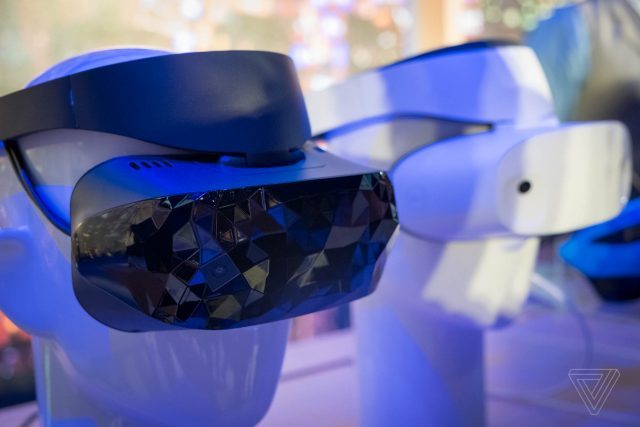
One of the first in a line of Windows Holographic powered immersive devices, Lenovo’s first mixed reality headset will be here in time for US “back to school”, according to Lenovo’s North America VP of Consumer Products Mike Abary.