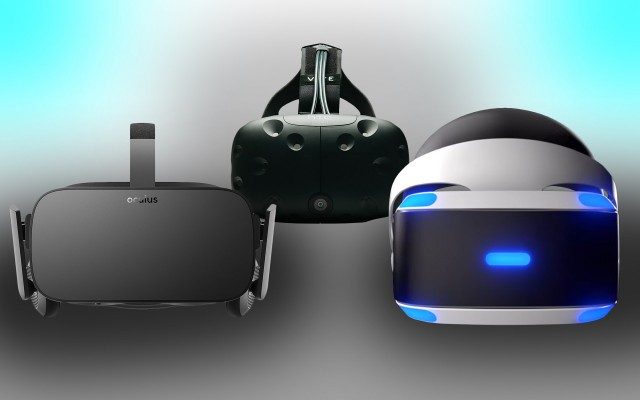
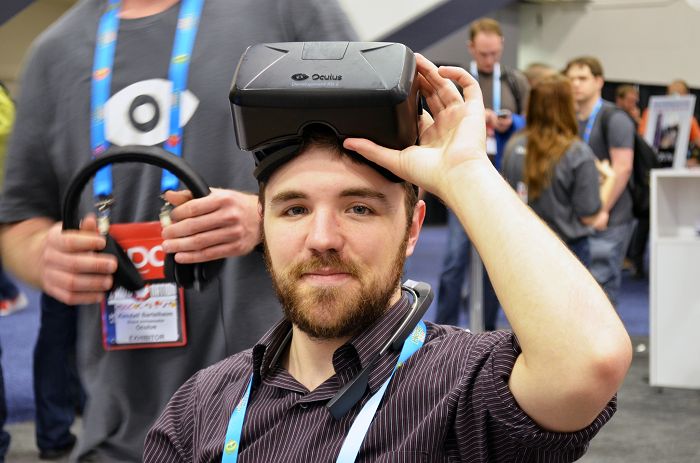
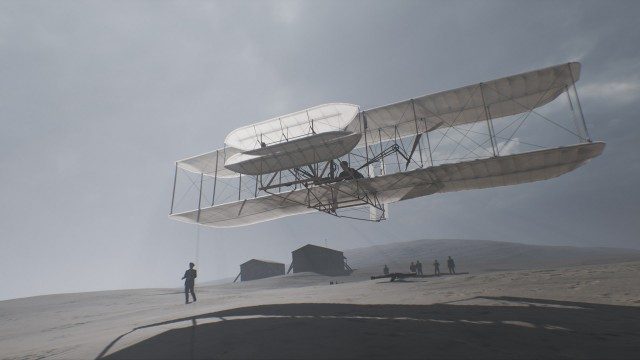
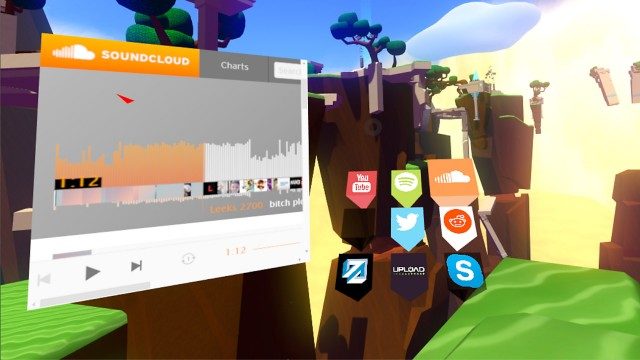
In the real world, most of us have a smartphone in our pocket which means we’re just a few taps away from a wealth of apps and services that enable us to do all manner of things, from communicating with friends, to listening to music, to referencing the vast library of knowledge that exists on the web. Ironically, when we put on a VR headset and become more intimately connected with the digital realm than ever, we actually lose access to many of those functions that we’re used to having simply because we can’t use our smartphones while in VR.
NextVR, the immersive video platform, today announced a partnership with publishing giant Time Inc. to develop live-streaming and on-demand 360 video for the company’s many brands, including Time, People, Entertainment Weekly and Sports Illustrated. Named LIFE VR, 360content will be hosted on the NextVR app.
I didn’t expect that a VR rock-climbing game that used neck thrusts as one of the primary locomotion mechanics would be as immersive or fun as it was, but I was really impressed with the level of immersion and presence that I felt while playing Crytek’s The Climb, which was recently released for the Oculus Rift.
I gave a talk at Silicon Valley Virtual Reality Conference where I attempted to summarize highlights from over 400 Voices of VR podcast interviews. This was a daunting task which forced me to synthesize the emergent patterns that I’ve been seeing, and create an underlying structure that could help tell the story of all of the ways that VR might impact humanity. What resulted from this process was a framework and model for understanding the VR landscape that I’m calling “The Human Experience of Virtual Reality.”
These twelve spheres are spread out across two main axes between self and other on the horizontal plane and your private and public experiences on the vertical plane. You can either watch the video of this talk, or read a brief summary down below while listening to my presentation. I’ve also included a list of specific episodes that I mention during the talk down below.
I cross-referenced this visualization with my Voices of VR podcast interview backlog to discover that I had interviewed about 44% of the companies listed on Tipatat’s snapshot:
This felt like I had made a good start at covering the diversity of the VR landscape, but the thing that was most striking to me was that I wasn’t necessarily aiming to achieve a 100% completion rate. This caused me to look further to see if there might be a simpler approach to understanding the VR landscape that reflected what I’ve been discovering on the podcast, but also could guide me in the future in covering the evolving VR landscape. My next step was to visualized of all of the different guests on the Voices of VR podcast in order to see if there were any patterns that emerged:
I noticed that there were a lot of different topics and realms that I had explored that didn’t quite fit into Tiptat’s mapping of the VR landscape, which was very much motivated by the desire to track the start-up & established companies who are players within the VR space.
I wanted to have a more elegant, simple, and memorable system for helping me keep track of the virtual reality landscape, and so I came up with the following framework, which describes the different domains of “The Human Experience of Virtual Reality”:
The horizontal axis is between self and other. Some experiences are more focused on cultivate a sense of embodied presence where you can exert your agency and express your identity, while other experiences may be more about having you empathize with the story of another person and receive their story. My interview with Eric Darnell made it clear to me that there is a tension between empathy and agency. I personally don’t think that it will be impossible to eventually combine these two polar opposites within the same VR experience, but I do think that it will take some specific context shifts to move between a more passive and interactive mode of storytelling as I discussed with Devon Dolan in the four types of VR storytelling.
The vertical access is between private and public, represented by the personal experiences of connecting to a sense of home and family versus your public life and reputation, which is most often associated with your professional career. You can think of the private experiences as ones that are more of an inner type of meaning and experience specific to you, and on the other extreme are the more outer experiences that are shared with others.
It’s likely that virtual reality experiences will combine a lot of these different spheres, and I’d predict that the social VR and world-building applications that can incorporate as many of these different domains as possible will be some of the early winners in creating a metaverse that’s just as compelling as the full spectrum of the human experience in real reality.
I ask each of my guests to share their thoughts on the ultimate potential of virtual reality, and I often find that their answers can be mapped into one of the 12 different spheres listed above. It’s important to remember that “the map is not the territory,” and that there will be exceptions and imperfections to this model. But I hope that these spheres will be robust enough to encompass the major dimensions of the human experience, and help to orient and contextualize the full breadth of how VR might impact our lives.
The truth of the matter is that no one person can really see the entire spectrum of all of the ways that VR will impact us, and it really does remind me of the ancient Indian parable of the blind men and the elephant.
Every VR developer and pioneer is like a blind men or women with one of their hands on this metaphorical elephant that represents the ultimate potential of VR. No one person can see the overall potential of VR, but if each of us focuses on one specific portion of the future, then perhaps we will be able to add some insight that gives everyone a bigger perspective as to where this is all going. My intention with the Voices of VR podcast is to talk to as many people as I can to get as many different perspectives and data points as I can in order to help us all paint a better picture of the ultimate potential of VR.
I believe that immersive technologies like virtual reality, augmented reality, and mixed reality are going to have as big of an impact on humanity as the Gutenberg Press did in the 15th Century. We’re at the very beginning of a revolutionary time, and I’m looking forward to sharing more of the deep insights and speculation about the future that I capture at SVVR in the form of 25 different interviews and over 13 hours with reflections about the current state of VR, some oral history stories, and a lot of predictions about the future of VR.
Here’s the different podcasts that I either explicitly mentioned or was implicitly thinking about during the talk:
Guinness World Records, an organisation journalling the extraordinary (and often insane) stunts people will pull for notoriety, and now the book has its first virtual reality entry. Watch as Derek Westerman swaps reality for Tilt Brush inside the HTC Vive and stays there for 25 hours straight.
OK, so perhaps not the most revolutionary of updates, but certainly a fun feature addition to the latest SteamVR build is the ability to customise the look of your SteamVR controllers and, should the mood strike you, your base stations too.
Live broadcast VR firm NextVR is today announcing a major collaboration with Live Nation, the premiere event promotion company that’s responsible for more than 25,000 events worldwide, including concerts and performances by some of the world’s leading artists.
A new online study of 12 western countries by Newzoo suggests that 11% of people are looking to buy into virtual reality within the next 6 months, that Spain is the most aware of VR and that Canada is willing to spend the most on it.
The third annual Silicon Virtual Reality Conference (SVVR) happened from April 27 to 29, and I had a chance catch up with Road to VR co-founder and Executive Editor Ben Lang to cover some of the big highlights and takeaways this year. Ben talks about highlights in his keynote, what makes VR unique, social experiences vs. multi-player games, what he’s most looking forward to, as well as some predictions about the future. Will VR ever get good enough that people would want to spend more time in virtual worlds than in the real world? Tune in to hear what we think.
Yes, that's an HTC Vive controller taped to a sandal
Both Oculus and Valve have gone on the record to say that they’d be opening up their respective tracking systems for third-parties to make use of, but after a year, neither company is ready to talk specifics.
Ben Lang caught up with Oculus Studios Designer Ryan Rutherford at Oculus Game Days to find out how the impressive western multi-player shooter Dead & Buried, ended up as as a flagship motion control title for the Rift after starting life on the humble Gear VR.
Developer Digital Cybercherries has today announced plans to develop a new version of their acclaimed virtual arcade. NewRetroArcade: Neon will be built for SteamVR and will include multiplayer, motion-controls, and room-scale capability for the HTC Vive.
Hammerhead VR is soon to launch their début VR film experience ABE VR, a horror experience based on the striking short film ABE (2013) from Writer / Director Rob McLellan. I find out what it’s like to be the object of affection for a murderous robot obsessed with finding love at any cost.



 I didn’t expect that a VR rock-climbing game that used neck thrusts as one of the primary locomotion mechanics would be as immersive or fun as it was, but I was really impressed with the level of immersion and presence that I felt while playing Crytek’s