A new early prototype game for the HTC Vive is aiming to bring your time-shifting, lightsaber wielding dreams to life with Project Ghost, a new game, early in production, which mashes together so many individually cool ideas, some of them have to work!
Modbox, the physics sandbox title where you’re free to create whatever insane contraptions you like, alongside a friend, has expanded its scope. The team are to deliver a big update in June that expands ability for users to mod the title, with the first example a neat looking dungeon construction system.
The imposing Buzludzha Monument in central Bulgaria once invoked infallible power, a power that once rested with the nation’s Communist Party. The brutalist megastructure, opened to the public in 1981 and later abandoned after the lifting of the iron curtain, now lies in ruins, with the grand mosaics of the dear leaders chipped from their walls, and the domed ceiling reduced to little else than a metal framework. But what if the Bulgarian government revived the building? What then?
Didn’t get the memo that the critically acclaimed comedian/beatboxer/musical magician Reggie Watts is coming to VR? There’s still time to sign up for the AltspaceVR event, which is being billed as “the largest attended event in VR ever.”
Netflix engineers working on ways to bring their video streaming service into the immersive realm have released this video of their prototype room-scale virtual reality reality experience modelled on an 80’s VHS video rental store. Yes, it is as odd as it sounds.
Nathan Martz is a product manager for Google’s Daydream SDK, and I had a chance to catch up with him to talk about what developers need to know in order to get started in developing for Daydream, which will be released in the Fall. Road to VR has a great article covering some of what’s needed to build the DIY Dev kit, which Nathan refers to as the “Build Your Own Dev Kit” (BYODK). Or you can follow along the instructions here. I talk to Nathan about the 3DOF Daydream controllers, SDK features, AndroidVR, as well some of the other of the other tips for getting started in developing for Daydream.
See Also: Platform Politics: Inside the Oculus and ‘Revive’ Dilemma
Revive is an application that allows select VR games exclusive to the Oculus Home platform to be played on a rival SteamVR-powered HTC Vive headset. A recent update to Oculus Home crippled Revive, an act that has caused outrage in the VR community. What does Revive actually do under the hood? Who’s behind it? And are Oculus really doing anything wrong anyway? We take a look at the story so far and speak to Revive‘s author LibreVR to dig a little deeper.
In surprise news, it seems that the British company behind the excellent 3DCeption spatial audio pipeline Two Big Ears, has been acquired by Oculus’ parent company Facebook in a move set to see their technology included alongside Oculus’ to deliver what the Two Big Ears call “best in class VR audio”.
Oculus is coming to the UK in a significant way it seems, as they prepare to open a dedicated base in London with a team that’s apparently gearing up to build some “really cool stuff” for virtual reality.
In a revealing statement on Reddit, Alan Yates, a Valve employee who works closely on the company’s Lighthouse tracking system, claims that the Oculus Rift headset is largely derived from Valve’s research.
Google’s mission is “to organize the world’s information and make it universally accessible and useful,” but what happens if there’s a shift from the Information Age to the Experience Age? Google’s Daydream mobile VR platform is part of that answer. It’s Android’s next phase moving beyond the minimum viable Cardboard VR viewers, where it’s starting to really leverage the Android hardware and software ecosystem to help bring virtual reality to the world at scale.
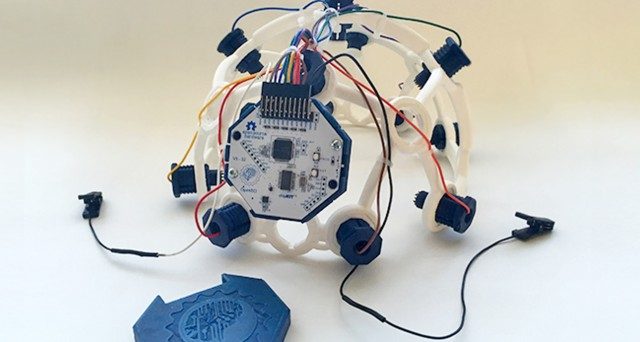
OpenBCI is an open source, brain control interface that gathers EEG data. It was designed for makers and DIY neuroengineers, and has the potential to democratize neuroscience with a $100 price point. At the moment, neither OpenBCI nor other commercial off-the-shelf neural devices are compatible with any of the virtual reality HMDs, but there are VR headsets like MindMaze that are fully integrated their headset with neural inputs. I had the chance to talk with OpenBCI founder Conor Russomanno about the future of VR and neural input on the day before the Experiential Technology and Neurogaming Expo — also known as XTech. Once the neural inputs are integrated in VR headsets, then VR experiences will be able to detect and react whenever something catches your attention, your level of alertness, your degree of cognitive load and frustration, as well differentiating between different emotional states.
LISTEN TO THE VOICES OF VR PODCAST
“Neurogaming” is undergoing a bit of rebranding effort towards “Experiential Technology” to take some of the emphasis off of the real-time interaction of brain waves. Right now the latency of EEG data is too slow and it is not consistent enough to be reliable. One indication of this was that all of the experiential technology applications that I saw at XTech that integrated with neural inputs were either medical and educational applications.
Conor says that there are electromyography (EMG) signals that are more reliable and consistent including micro expressions of the face, jaw grits, moving your tongue, and eye clinches. He expects developers to start to use some of these cues to drive drones or do medical applications for quadriplegics or people who have limited mobility from ALS.
There are a lot of privacy implications once you start to gather some of this EEG data, and Conor is particularly sensitive to this. He says that recent research is indicating that EEG signals are very unique to each person, and represent a unique digital signature that could trace anonymously submitted data back to you. He says that companies of the future will need to take into consider a strict privacy policy, and not use this data to exploit their users.
At the same time, there were a number of software-as-a-service companies at XTech who were taking EEG data and applying their own algorithms to extrapolate emotions and other higher-level insights. A lot of these algorithms are using AI techniques like machine learning in order to capture a baseline signals of someone’s unique fingerprint and start to train the AI to be able to make sense of the data. AI that interprets and extrapolates meaning out of a vast sea of data from dozens of biometric sensors is going to be a big part of the business models for Experiential Technology.
Once this biometric data starts to become available to VR developers, then we’ll be able to go into a VR experience and be able to see visualizations of what contextual inputs were affecting our brain activity and we’ll start to be able to make decisions to optimize our lifestyle.
I could also imagine some pretty amazing social applications of these neural inputs. Imagine being able to see a visualization of someone’s physical state as you interacting with them. This could have huge implications within the medical context where mental health consolers could get additional insight and the physiological context that would be correlated to the content of a counseling session. Or I could see experiments in social interactions with people who trusted each other enough to be that intimate with their inner most unconscious reactions. And I could also see how immersive theater actors could have very intimate interactions or entertainers could be able to read the mood of the crowd as they’re giving a performance.
Finally, there are a lot of deep and important questions to protect users from loosing control of how their data is used and how it’s kept private since it may prove impossible to completely anonymize it. VR enthusiasts will have to wait on better hardware integrations, but the sky is the limit for what’s possible once all of the inputs are integrated and made available for VR developers.
After an excellent partnership of two years, this is the final episode of the Rev VR Podcast that will be published through Road to VR. Ben Lang, Executive Editor of Road to VR joins me for a farewell episode.
We’ve been tracking Manus VR, the start-up dedicated to producing an intuitive VR glove input device, for a while now. The team were present at GDC in March, showing their latest prototype glove along with their in-house developed game Pillow’s Willow.




 Nathan Martz is a product manager for Google’s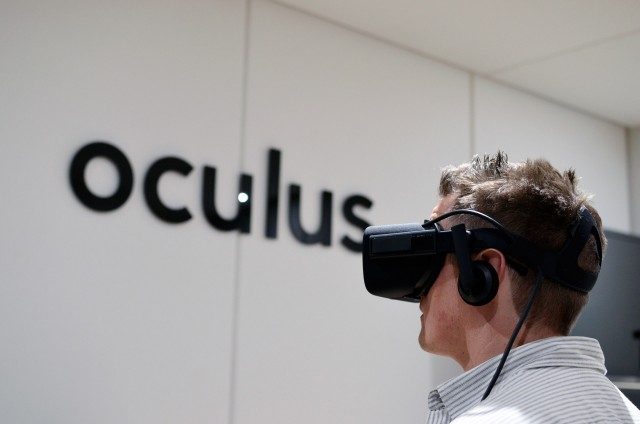




 Google’s