I didn’t expect that a VR rock-climbing game that used neck thrusts as one of the primary locomotion mechanics would be as immersive or fun as it was, but I was really impressed with the level of immersion and presence that I felt while playing Crytek’s The Climb, which was recently released for the Oculus Rift.
I gave a talk at Silicon Valley Virtual Reality Conference where I attempted to summarize highlights from over 400 Voices of VR podcast interviews. This was a daunting task which forced me to synthesize the emergent patterns that I’ve been seeing, and create an underlying structure that could help tell the story of all of the ways that VR might impact humanity. What resulted from this process was a framework and model for understanding the VR landscape that I’m calling “The Human Experience of Virtual Reality.”
These twelve spheres are spread out across two main axes between self and other on the horizontal plane and your private and public experiences on the vertical plane. You can either watch the video of this talk, or read a brief summary down below while listening to my presentation. I’ve also included a list of specific episodes that I mention during the talk down below.
I cross-referenced this visualization with my Voices of VR podcast interview backlog to discover that I had interviewed about 44% of the companies listed on Tipatat’s snapshot:
This felt like I had made a good start at covering the diversity of the VR landscape, but the thing that was most striking to me was that I wasn’t necessarily aiming to achieve a 100% completion rate. This caused me to look further to see if there might be a simpler approach to understanding the VR landscape that reflected what I’ve been discovering on the podcast, but also could guide me in the future in covering the evolving VR landscape. My next step was to visualized of all of the different guests on the Voices of VR podcast in order to see if there were any patterns that emerged:
I noticed that there were a lot of different topics and realms that I had explored that didn’t quite fit into Tiptat’s mapping of the VR landscape, which was very much motivated by the desire to track the start-up & established companies who are players within the VR space.
I wanted to have a more elegant, simple, and memorable system for helping me keep track of the virtual reality landscape, and so I came up with the following framework, which describes the different domains of “The Human Experience of Virtual Reality”:
The horizontal axis is between self and other. Some experiences are more focused on cultivate a sense of embodied presence where you can exert your agency and express your identity, while other experiences may be more about having you empathize with the story of another person and receive their story. My interview with Eric Darnell made it clear to me that there is a tension between empathy and agency. I personally don’t think that it will be impossible to eventually combine these two polar opposites within the same VR experience, but I do think that it will take some specific context shifts to move between a more passive and interactive mode of storytelling as I discussed with Devon Dolan in the four types of VR storytelling.
The vertical access is between private and public, represented by the personal experiences of connecting to a sense of home and family versus your public life and reputation, which is most often associated with your professional career. You can think of the private experiences as ones that are more of an inner type of meaning and experience specific to you, and on the other extreme are the more outer experiences that are shared with others.
It’s likely that virtual reality experiences will combine a lot of these different spheres, and I’d predict that the social VR and world-building applications that can incorporate as many of these different domains as possible will be some of the early winners in creating a metaverse that’s just as compelling as the full spectrum of the human experience in real reality.
I ask each of my guests to share their thoughts on the ultimate potential of virtual reality, and I often find that their answers can be mapped into one of the 12 different spheres listed above. It’s important to remember that “the map is not the territory,” and that there will be exceptions and imperfections to this model. But I hope that these spheres will be robust enough to encompass the major dimensions of the human experience, and help to orient and contextualize the full breadth of how VR might impact our lives.
The truth of the matter is that no one person can really see the entire spectrum of all of the ways that VR will impact us, and it really does remind me of the ancient Indian parable of the blind men and the elephant.
Every VR developer and pioneer is like a blind men or women with one of their hands on this metaphorical elephant that represents the ultimate potential of VR. No one person can see the overall potential of VR, but if each of us focuses on one specific portion of the future, then perhaps we will be able to add some insight that gives everyone a bigger perspective as to where this is all going. My intention with the Voices of VR podcast is to talk to as many people as I can to get as many different perspectives and data points as I can in order to help us all paint a better picture of the ultimate potential of VR.
I believe that immersive technologies like virtual reality, augmented reality, and mixed reality are going to have as big of an impact on humanity as the Gutenberg Press did in the 15th Century. We’re at the very beginning of a revolutionary time, and I’m looking forward to sharing more of the deep insights and speculation about the future that I capture at SVVR in the form of 25 different interviews and over 13 hours with reflections about the current state of VR, some oral history stories, and a lot of predictions about the future of VR.
Here’s the different podcasts that I either explicitly mentioned or was implicitly thinking about during the talk:
Guinness World Records, an organisation journalling the extraordinary (and often insane) stunts people will pull for notoriety, and now the book has its first virtual reality entry. Watch as Derek Westerman swaps reality for Tilt Brush inside the HTC Vive and stays there for 25 hours straight.
OK, so perhaps not the most revolutionary of updates, but certainly a fun feature addition to the latest SteamVR build is the ability to customise the look of your SteamVR controllers and, should the mood strike you, your base stations too.
Live broadcast VR firm NextVR is today announcing a major collaboration with Live Nation, the premiere event promotion company that’s responsible for more than 25,000 events worldwide, including concerts and performances by some of the world’s leading artists.
A new online study of 12 western countries by Newzoo suggests that 11% of people are looking to buy into virtual reality within the next 6 months, that Spain is the most aware of VR and that Canada is willing to spend the most on it.
The third annual Silicon Virtual Reality Conference (SVVR) happened from April 27 to 29, and I had a chance catch up with Road to VR co-founder and Executive Editor Ben Lang to cover some of the big highlights and takeaways this year. Ben talks about highlights in his keynote, what makes VR unique, social experiences vs. multi-player games, what he’s most looking forward to, as well as some predictions about the future. Will VR ever get good enough that people would want to spend more time in virtual worlds than in the real world? Tune in to hear what we think.
Yes, that's an HTC Vive controller taped to a sandal
Both Oculus and Valve have gone on the record to say that they’d be opening up their respective tracking systems for third-parties to make use of, but after a year, neither company is ready to talk specifics.
Ben Lang caught up with Oculus Studios Designer Ryan Rutherford at Oculus Game Days to find out how the impressive western multi-player shooter Dead & Buried, ended up as as a flagship motion control title for the Rift after starting life on the humble Gear VR.
Developer Digital Cybercherries has today announced plans to develop a new version of their acclaimed virtual arcade. NewRetroArcade: Neon will be built for SteamVR and will include multiplayer, motion-controls, and room-scale capability for the HTC Vive.
Hammerhead VR is soon to launch their début VR film experience ABE VR, a horror experience based on the striking short film ABE (2013) from Writer / Director Rob McLellan. I find out what it’s like to be the object of affection for a murderous robot obsessed with finding love at any cost.
Over the last three years, the rise of VR in public discourse has been impossible to ignore. During this time, most mainstream discussions have centered on the same few efforts in the US : Oculus, Valve/HTC, Sony, Samsung, and Google. But there’s something just as important going on roughly 7,000 miles west of San Francisco.
Guest article by Anjney Midha:
Anjney leads KPCB Edge as Founding Partner, and focuses on Virtual Reality and Drones & Aerospace companies. Before founding Edge, Anjney was the youngest partner at Kleiner Perkins Caufield & Byers, and was closely involved with the firm’s investments in RelateIQ (acquired by Salesforce), Ayasdi, Magic Leap, Enjoy, and True Caller, where he is a board observer. Anjney pursued undergraduate and graduate degrees at Stanford, and is on a leave of absence from the Biomedical Informatics department at the Stanford School of Medicine. Anjney enjoys flying microlight planes and modding quadcopters.
Across the Pacific Ocean in Shenzhen, China, in the markets of Huaqiangbei, the factories in Dongguan, and in the high rise offices of Nanshan, is where demand and supply for VR hardware and software are on par, if not outpacing, the US. The Edge team took a few days to go on the ground in Shenzhen in March, and this is a summary of what we saw.
If you, like us, believe that VR has a bright future, then you likely believe in the ability of most people on Earth to access mobile VR. This is because smartphones are the only devices that have anywhere near the scale, computational ability, and price points to bring VR to most of the planet in the near future. This is the story playing out in Shenzhen. Unlike the Rift and Vive, which cost around $1,600 all-in for headset and PC, there are a hundred different flowers of mobile VR blooming (pun intended) in the Chinese electronics market, ranging from low tech VR smartphone cases to standalone Android headsets. Not all of these are strictly VR devices (we’ll get into that in a moment), but when it comes to stereoscopic, head mounted displays (HMDs) for consumers, Shenzhen is a leader.
Broadly, most devices we saw fell into three categories — Mobile VR headsets, PC HMDs, and standalone headsets.
Mobile VR (a.k.a. Budget VR)
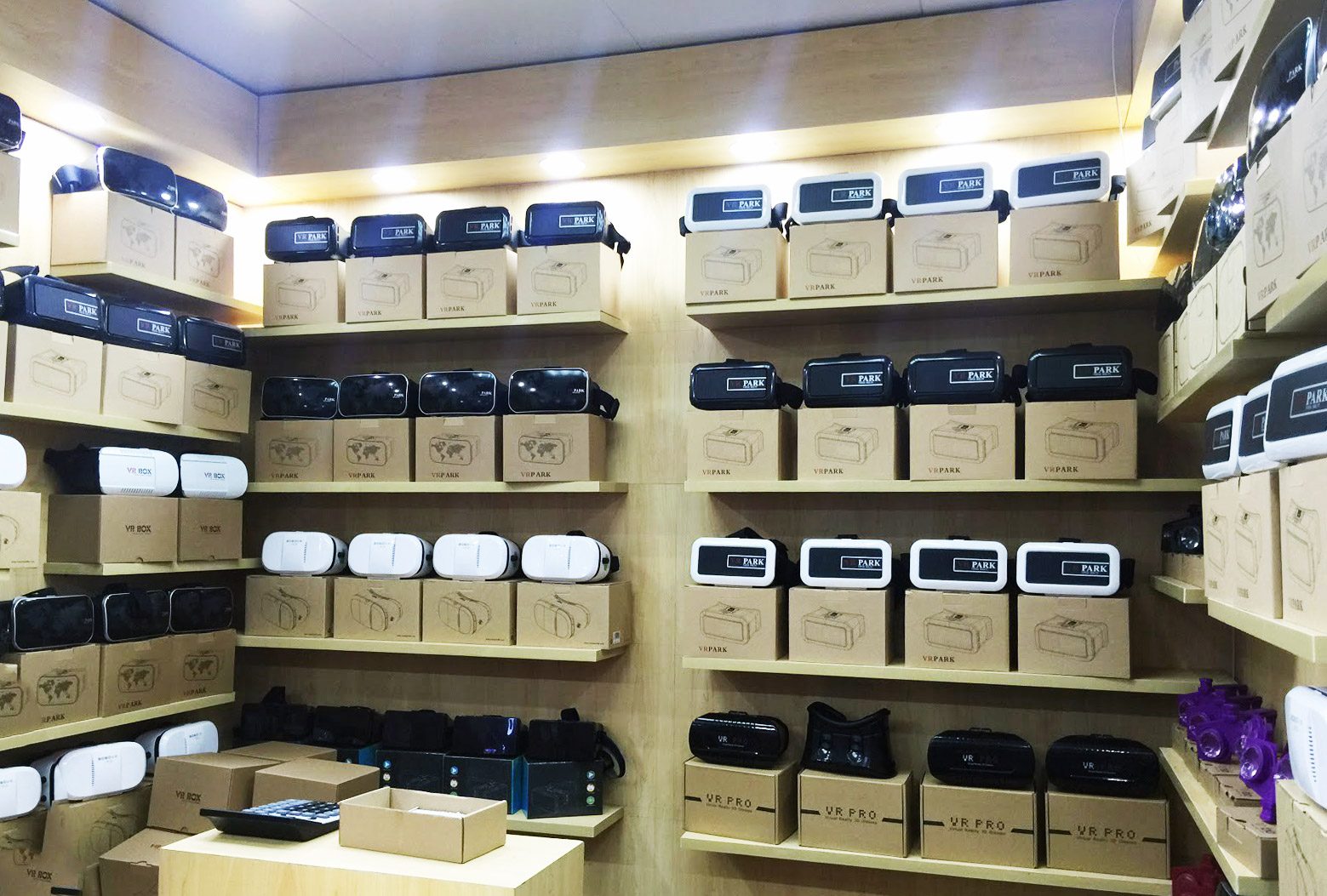
These mobile headsets involve turning your phone into a VR viewer by adding a couple of plastic biconvex lenses to a frame that holds your mobile device, essentially a nicer version of Google Cardboard. The sheer range of these is reminiscent of the explosion in custom smartphone cases since 2010. The bulk of stores we saw dedicated to mobile VR headsets were located in the SEG Communications Market, a multi storey edifice dedicated just to mobile parts and accessories, sold by the sorts of retailers who would otherwise be selling cases, chargers, cables and lens protectors for phones.
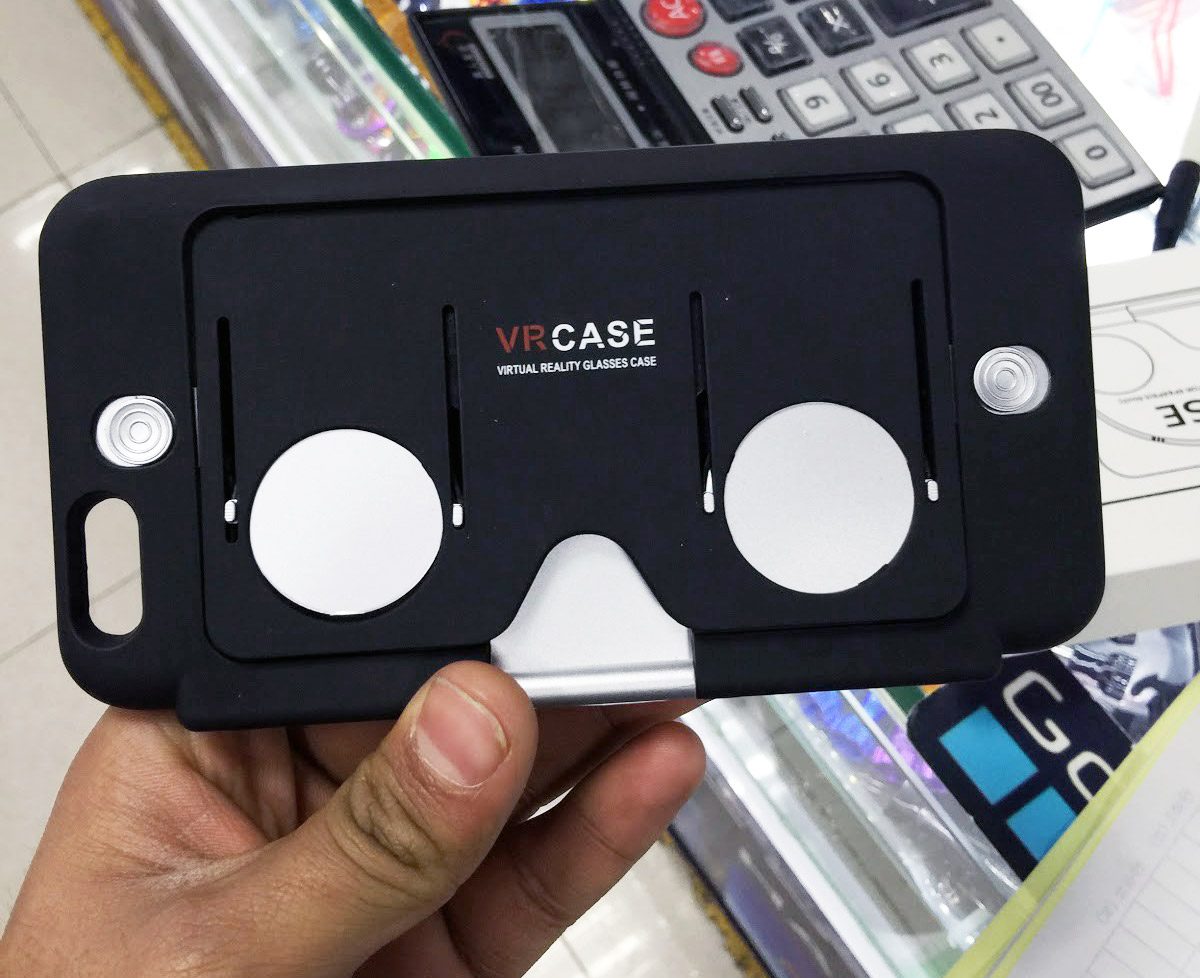
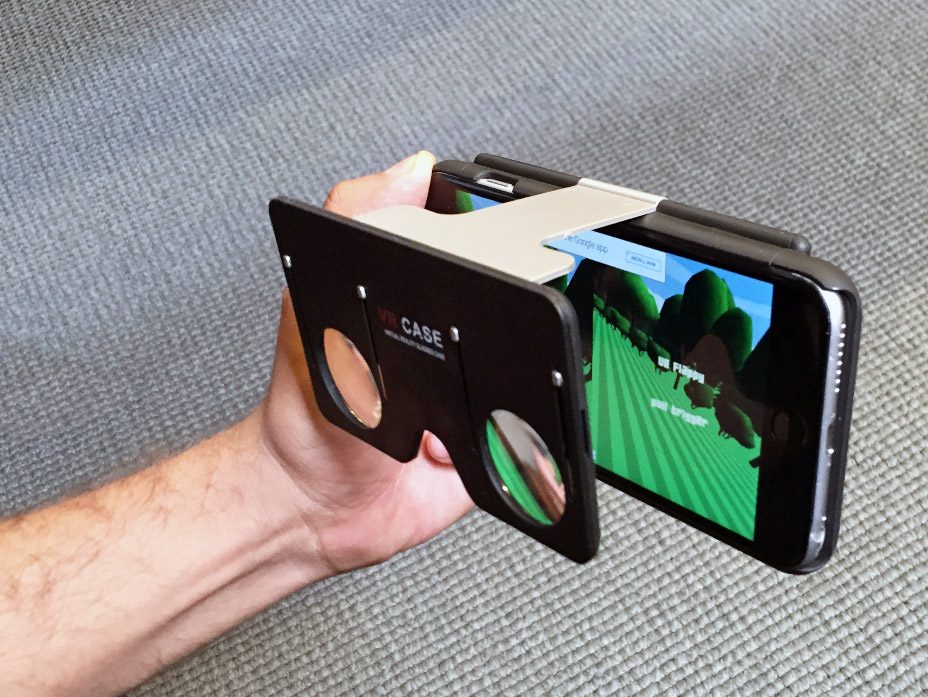
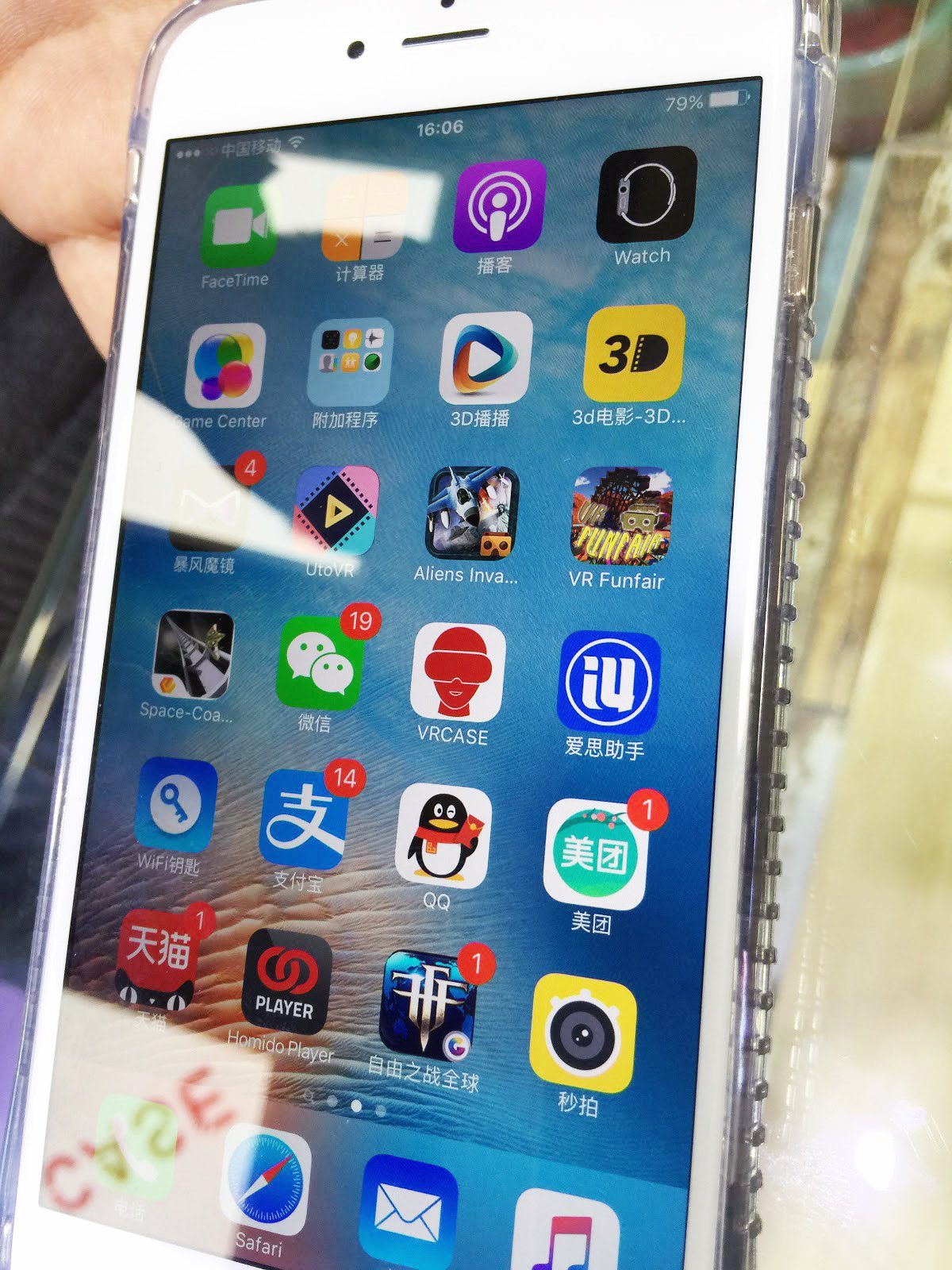
The cheapest of these was the $10 VRCase iPhone case viewer below (prices can drop quickly below this with the number of units you buy) similar to the Figment Kickstarter, with the most expensive one at $45 for a drop-in style viewer.
The $10 iPhone VR Case , seen here with VR Flappy Bird.
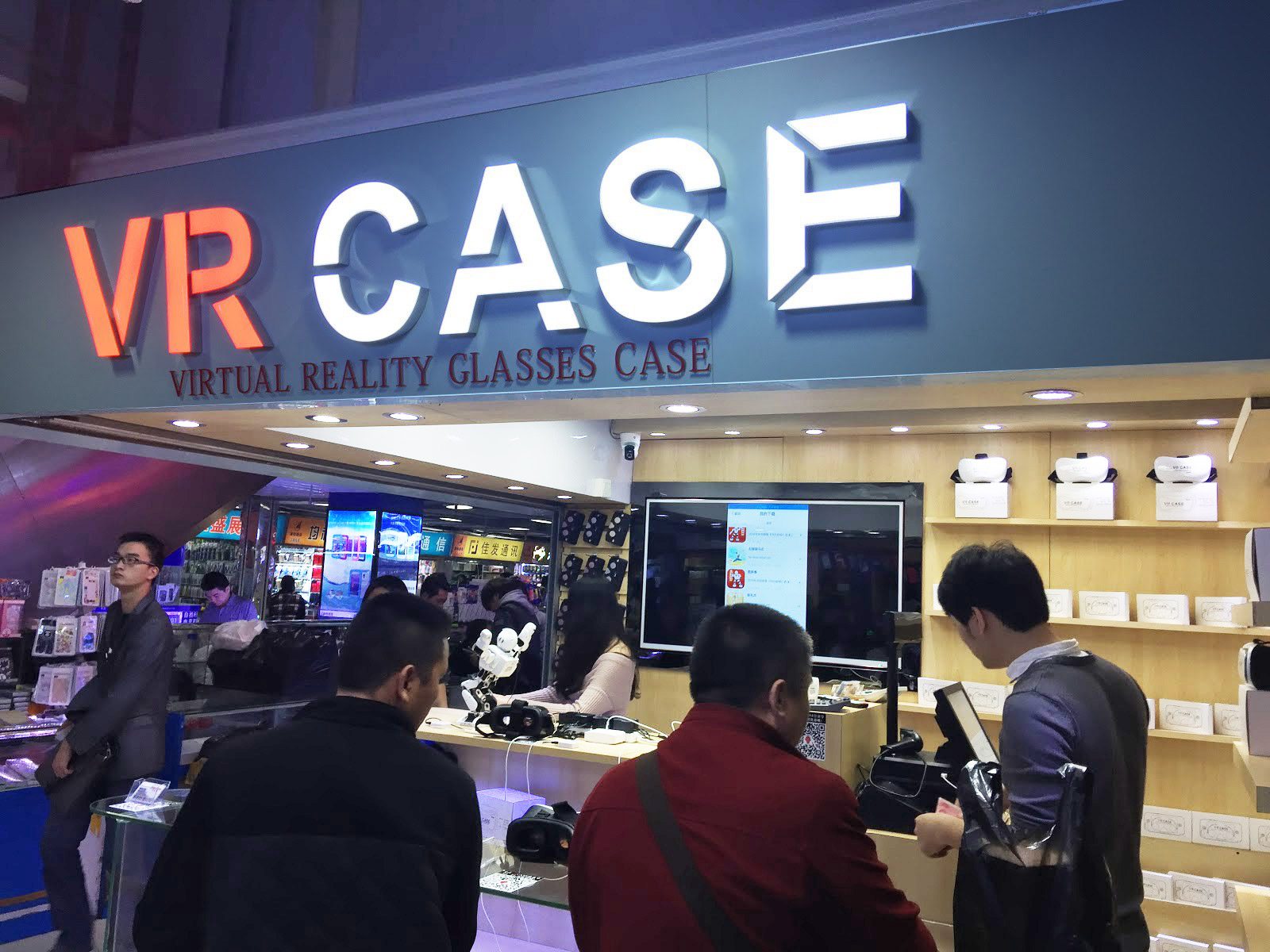
There are entire retail storefronts, like the one pictured below, dedicated just to these mobile VR headsets. While speaking to the folks manning these stores, we were told it’s common to move up to 1,000 headsets a day in retail, and 10k units a day to distributors, with orders mostly from locals or buyers visiting from Korea and Japan.
More VR retail storefront s , this is the one that sells the iPhone case.
Cases selling by the dozens.
When we asked the VR salesmen which apps were most popular with consumers in China, we saw a combination of apps from overseas like Homido and Cmoar’s cinema apps, and homegrown first party apps, like Baofeng Mojing and VRCase’s iOS VR players. Watching 2D movies and videos in 3D spaces is by far the most popular use case for these headsets, with gaming and virtual tours as runner ups.
PC-only Headsets (a.k.a High End VR)
Adjacent to the mobile accessories building is the main SEG tower, a 72 story building with 10 floors dedicated to a dizzying range and number of electronics retailers. Here is where we spotted a few Oculus and Rift alternatives, like the AntVR pictured below which offers similar specs to the DK2 for around $280 and comparable build quality, and the Deepoon E2, another DK2 alternative.
The lack of enthusiasm for these compared to the mobile headsets from the retailers was palpable, and it sometimes felt like these headsets were displayed more for novelty value than anything else. This is understandable, given the low volume of these headsets that are moving in the market and their relatively high prices for the average Chinese consumer market.
All-In Headsets
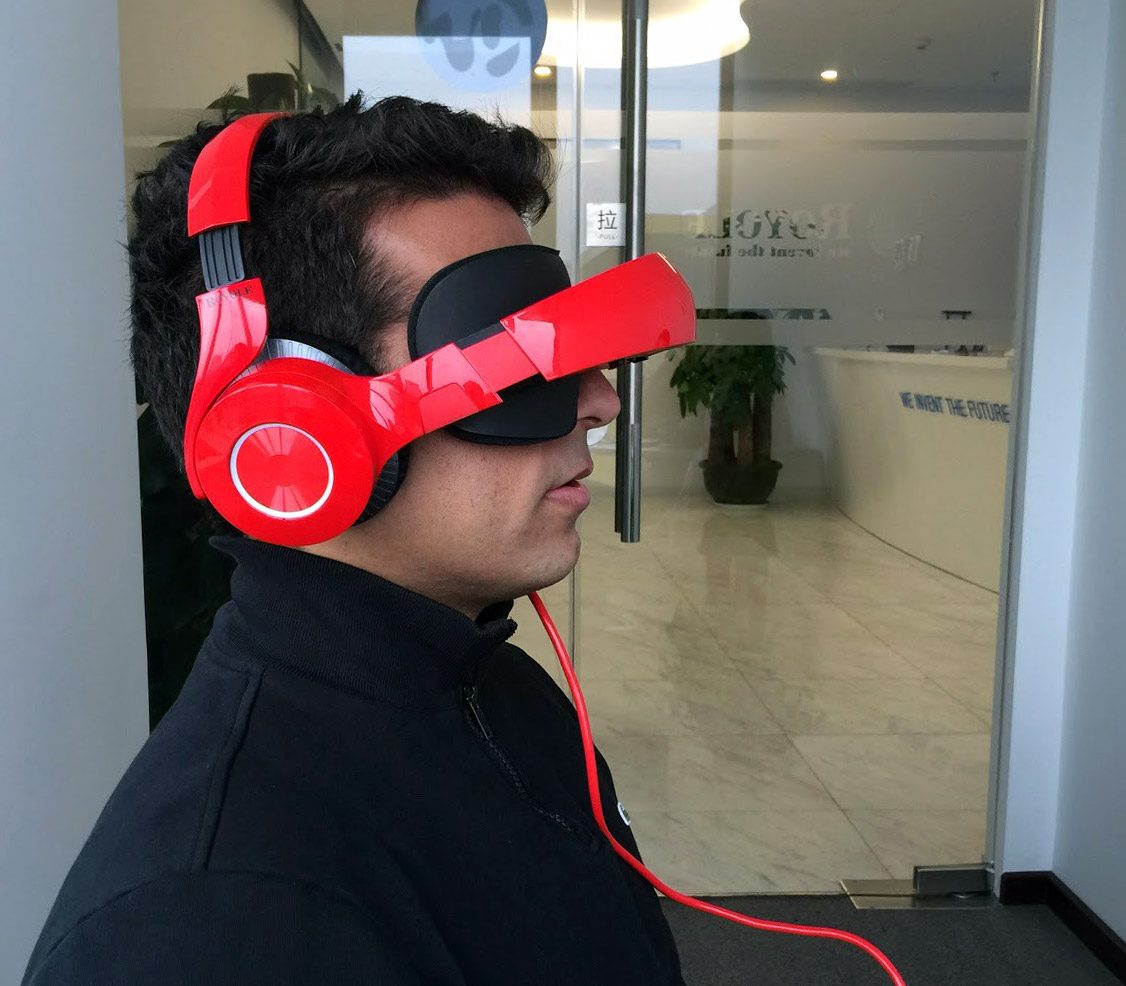
Walking through Huaqiangbei, it became apparent to us that there’s a secondary consequence of the rise of VR taking place — namely, a halo effect on non-VR HMDs. These are essentially stereoscopic media players, which give you the ability to watch your regular 2D content on a display that, when suspended on your face, offers the effect of a much larger screen. While these have been around for years in various form factors and high price points like the $799 Sony HMZ (which launched in 2011) and the $500 Vuzix iWear, we saw a plethora of newer, cheaper alternatives.
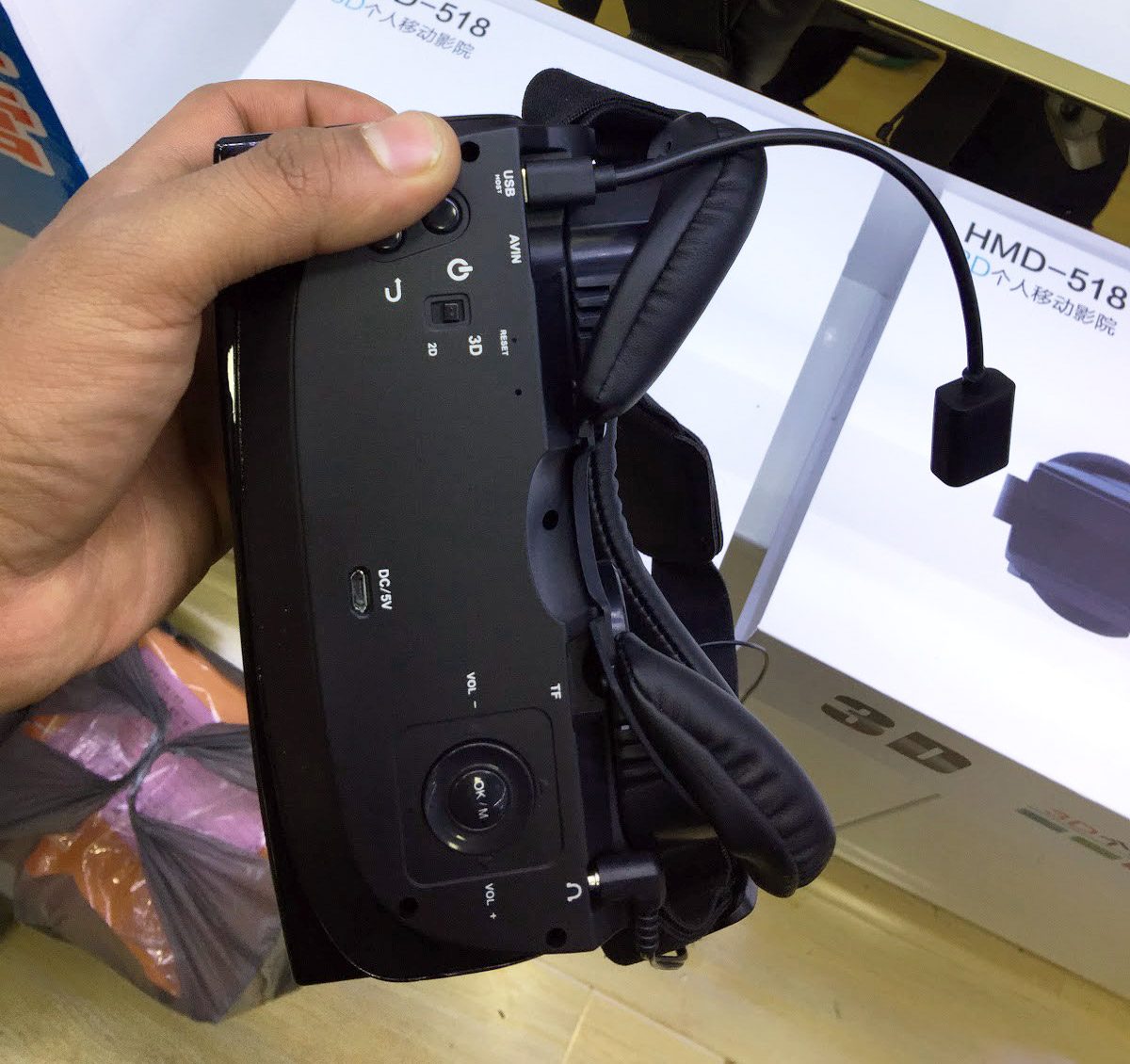
We were told these have become popular as HMDs like the GearVR and Oculus are making it more palatable for consumers to strap displays to their faces. Most of these were running their own flavors of Android on the headset, and had USB ports for users to plug in their own content. These ranged from $120 video players, to the $617 RoyoleX headset that offers a direct alternative to devices like the $700 Avegant Glyph. While none of these are VR headsets in the strict sense that they didn’t have gyroscopes and accelerometers to allow head tracking, it seems to be only a matter of time before that changes with the coming launches of devices like the Baofeng Mowang, LeTV’s Helmet, and Pico Neo.
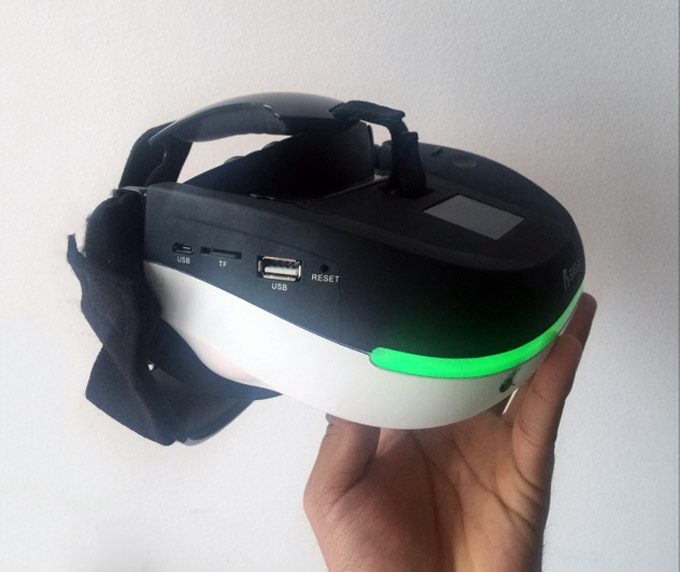
One of the headsets we bought, the Bijela iTheater (pictured), essentially works as a fully functional tablet, allowing you to run all the apps you’d typically want to use with a desktop monitor (Gmail, Chrome, Kindle Reader etc.) but with a mobile device that fits in your backpack, costs you roughly $190 and weighs about 40% less than a GearVR with a phone. It’s easy to see why headsets like these that are somewhere between VR headsets and smartphones both in functionality and price points could become popular with young consumers who have never owned a dedicated PC or laptop.
The Bijela iTheater — one of many non VR HMDs seen in Huaqiangbei.
Another non VR HMD that runs Android on board.
The Bijela iTheater — one of many non VR HMDs seen in Huaqiangbei
Takeaways
Last year, we wrote about a coming age of mobile VR. Shenzhen is where that future is approaching quickly. It’s an exciting time in history, where for the first time we’re seeing the convergence of two unique trends — massive numbers of smartphones in the hands of billions of people, combined with the sheer range of low cost VR headsets described above. Over the next few years, founders working on compelling software experiences in VR will be able to build for an audience of hundreds of millions of users who can access VR for the price of a low cost smartphone accessory. This is the reason we’re excited to work with entrepreneurs working on building the apps, services and metaverses that will bring these headsets to life for consumers across the world.
Samsung’s developer conference, dedicated to all things part of the mobile giant’s hardware and software ecosystem took place last week. Here are some of the VR highlights from the conference.


 I didn’t expect that a VR rock-climbing game that used neck thrusts as one of the primary locomotion mechanics would be as immersive or fun as it was, but I was really impressed with the level of immersion and presence that I felt while playing Crytek’s The Climb, which was recently released for the Oculus Rift.