The Wild West of Early VR
 Oculus Share was launched a little over a year ago as a way to gather together the torrents of content being produced by developers around the world. After the Oculus Rift DK1 shipped, well after its hugely successful Kickstarter campaign even Oculus must have been surprised at the sheer amount of early games and applications that were produced by developers even before they’d received their DK1 units. As an early adopter it was difficult to find and discover content and Oculus recognised the need to focus all this talent and content in one place.
Oculus Share launched August 2013 and offered a curated portal for developers to showcase their work and for enthusiasts to find it. Oculus introduced play-testing and a certification of sorts which ensured content in the store met a minimum threshold for quality. It also meant that they could vet any apps for virtual reality user comfort – something all the more important before the inclusion of motion sickness limiting positional tracking in the DK2.
Oculus ‘Share’ Becomes Oculus ‘Platform’
 Oculus has had a roller coaster couple of years and I suspect there is no one involved with the company form the start who would have imagined the company and its products would have evolved quite as quickly as it has. Oculus’s content horizons have now spread. Along with catering for early adopters in hardcore gaming, the company is heavily invested in the future of mobile VR, something their CTO John Carmack has been spearheading passionately with Gear VR. Oculus have evolved from a pure hardware start-up to an end to end solution and content provider.
See Also: Samsung Announes Gear VR
Oculus is keenly aware that, once VR becomes established as a technology, it’s the software that matters from thereon out. With that in mind, Oculus is broadening its content production and delivery plans to better position itself for having to deliver great games and apps to (if you’re to believe Oculus CEO Brendan Iribe) 2 Billion VR Users.
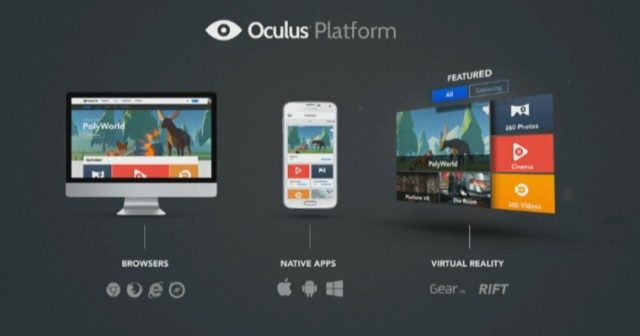
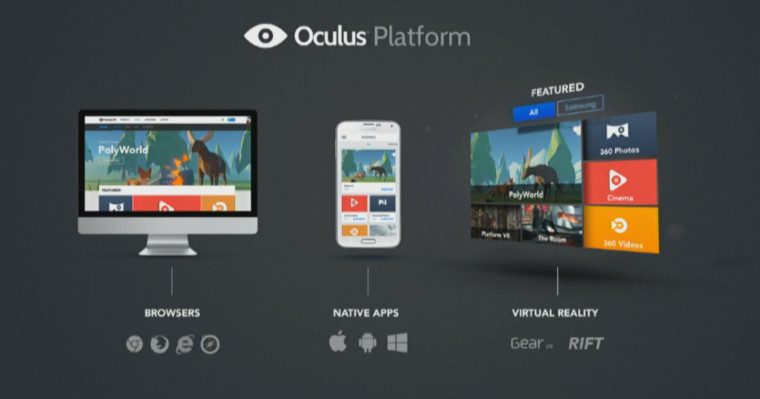
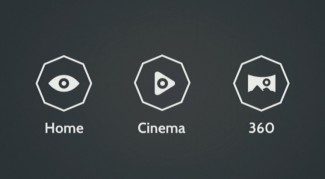
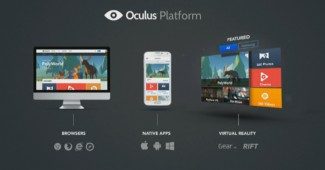 As part of the opening keynote addresses, yesterday VP of Product Nate Mitchell announced their vision for the future of VR content delivery. Oculus Platform is a moniker given to what will eventually become a suite of apps and portals on multiple platforms. A glimpse of one of Platform’s forms was seen during the recent launch of the Oculus / Samsung produced Gear VR Headset (see right). Oculus Platform will enable developers to publish content and, eventually, make money from it from purchases made in the same way as IOS or Android developers and users do now. The Gear VR variant is still in development but offers a way to purchase content whilst still ‘in’ VR, that is, no need to take your headset off to buy a new game.
It’s reasonable to assume that Oculus will want to offer a similar look and feel for all Oculus Platform based stores and what we’ve seen on Gear VR may be a glimpse of what PC users will see when they don their Consumer Oculus Rift looking for cool new VR experiences. Nate Mitchell outlined that Oculus Platform would also be available in more traditional web and app (IOS or Android) based forms, ensuring that wherever you are you can purchase content for your VR device of choice.
It’s fascinating to see Oculus, an incredibly cool but nevertheless scrappy startup just 2 years ago, positioning itself calmly as the go-to curators and purveyors of virtual reality content. It’s easy to see that, in just another 2 short years, comparisons to the IOS App Store and Android Play store might not be entirely far from the mark – beyond those 2 years, frankly the mind boggles.