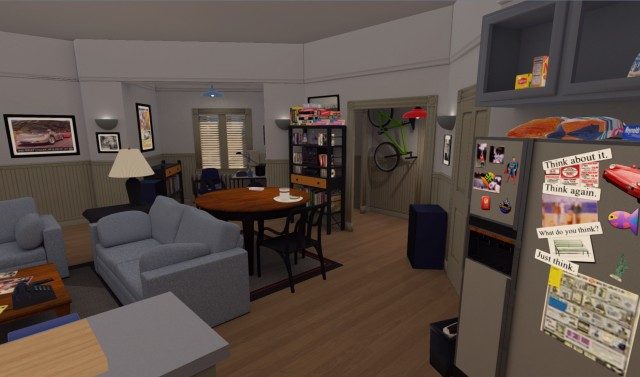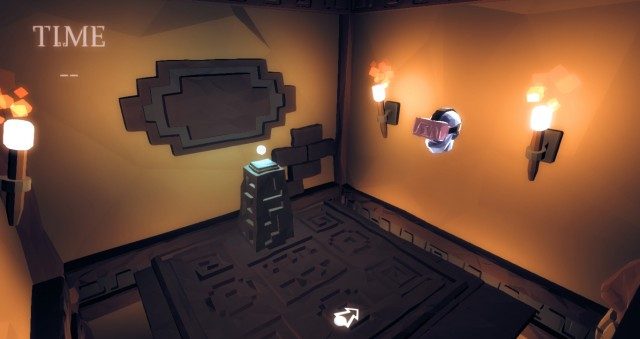
I had a chance to try out VREAL’s VR streaming technology a few weeks ago, and I think they’ve made some key technological breakthoughs that makes it possible to livestream an entire virtual reality experience. Rather than render out a 2D, first-person video or a third person mixed reality video, VREAL is sending a smaller set of serialized data so that you can render all of the VR objects, cameras, and internal state of a VR experience at 90 fps by utilizing your own PC hardware. I had a chance to catch up with CEO and founder Todd Hooper to talk about VREAL’s streaming plans, key features, and functionality including video exports, website ecosystem, and future plans. Just as streaming has become a big deal in video games, VR streaming is going to be an even bigger deal since they’re combining the magic of social VR interactions with watching their favorite personalities be immersed within VR experiences.
Kittypocalypse is a first-person tower defense game for Oculus Rift that wants to liven up some pretty well-trodden territory. With its army of infectiously cute alien kitties waddling ever closer to your base, your only hope is to find the correct combination of weapons to fend off the horde and reduce them to a green goo. Attention all cat people: don’t be deceived by their adorable faces. The only good cat alien is a dead cat alien.
Darshan Shankar started BigScreen VR with a deceptively simple premise of wanting to have Virtual LAN parties with other gamers in VR, but using your computer screen as a center point of conversation has catalyzed a wide range of different use cases. In the first 3-4 weeks since their launch, the initial intended audience of gamers are indeed holding virtual LAN parties with 2D and 3D games, but there are also some surprising emergent behaviors. These range from business meetings, co-working rooms, ad-hoc training and technical support, user testing of applications and websites, cultivation of business partnerships, cultivation of niche communities, and enabling the expression of identity through your collection of digital artifacts. The computer screen is a “social lubricant” that kicks starts a conversation, and allows people to connect with other people through playing, sharing, and exploring.
LISTEN TO THE VOICES OF VR PODCAST
There are also enough constraints in locomotion and a limit of four people per room that encourages intimate conversations, but there are also some surprising behaviors. People are hanging out in Big Screen playing their own games and in some cases don’t directly connect with anyone else, just as one might go to coffee shops to be able to focus on work. Sometimes playing a 2D game on Big Screen will have a lower resolution, but the ambient presence of other gamers with similar interests and values is enough to have users come back again and again.
I had a chance to do a demo with BigScreen co-founder Hayden Lee, and then catch up with him after talking to some random users within BigScreen VR. We talked about the wide range of social behaviors, being able to rapidly iterate on a product where the developers can literally watch their users every move via their shared screens, and some of their future plans moving forward. There’s a clear list of features from their users, and because of the wide range of use cases and applications, then I expect to see BigScreen VR become a big player in the future of social VR.
Sega Live Creation, the amusement arm of parent company Sega-Sammy, is bringing the Zero Latency VR experience to the Joypolis amusement center in Tokyo, the chain’s flagship branch.
See Also: The HTC Vive Costs $799 and Ships April 1st
HTC has announced that it’s first VR headset, the SteamVR powered Vive, is to appear at 100 retail locations from this month and for those ordering online, they’re promising to ship to you within 72 hours wherever you are in the world.
With things already heating up for this year’s E3, Sony has today announced a new addition to the PlayStation VR lineup—Tethered, an impossibly cute strategy game from UK-based studio Secret Sorcery.
Philip Rosedale has been working with virtual worlds for a long time, having founded Second Life back nearly 13 years ago in 2003. He co-founded High Fidelity in 2013, and he previously told me that he wanted to fix a lot of the things that were holding Second Life back. One big limitation was having all of the virtual worlds hosted by Linden Lab’s servers, and so Philip wanted to flip that model on it’s head by going with an open source model. Users will be able to host their own virtual spaces in a more scalable fashion like the Internet, but High Fidelity also has plans to leverage the idle GPU power of millions of machines to help render a high-resolution metaverse.
I’ve spoken to Philip at SVVR 2014 & 2015, and I had a chance to catch up with him again at SVVR 2016, where High Fidelity announced beta access to their Sandbox client. We talk about physics in VR, body tracking, 3D audio & social presence, experiments with SMI eye tracking, scaling the metaverse, avatar continuity for group collaboration, and the future of using VR as a neutral meeting ground to interface with AI robots.
Oculus' 'Rift' VR Headset, one of many to launch in 2016
Tired of jumbo pixels muddling in-game detail on your Rift games? Wish there was a way to boost detail even on VR titles with no options? Then the Oculus Debug tool may just be your saviour, as long as you have a PC that can handle it.
Sony have confirmed 10 PlayStation VR titles to be playable on the show floor at E3 this year including the return of some old favourite franchises, Psychonauts and Rez.
Valve’s The Lab, the ridiculously fun Portal-themed tech demo for HTC Vive, recently released a new update that will have you sharpening your skills against the best in the world.
Edge of Nowhere is a third-person VR survival horror game recently released for the Oculus Rift that places you in 1932 in the boots of Victor, a biologist and adventurer attempting to track down his lost fiance Eva.
Epic Games’ popular Unreal Engine has just received a major update with version 4.12 now sporting Google VR ‘Daydream’ and OSVR native support. It also ships with a preview of the company’s impressive VR Editor, which allows developers to natively build their 3D applications entirely from virtual reality.
Razer Chief Executive and co-founder Min-Liang Tan has stated his company’s intent to dominate China’s rapidly growing virtual reality market, with new products built around the OSVR platform, tailored to the region launching next month.
The Virtual Reality Foundation announced the 2016 Proto Awards submissions will be open from July 10th through July 24th. All virtual reality developers and creators are welcome to participate in the submission process for consideration in categories honoring sound design, mobile experience, live action experience, innovation and more!
At the IEEE VR conference this year, there was a pre-conference workshop about Immersive Analytics, which talked about how to use VR & multi-sensory interfaces to support analytical reasoning, decision making, and real-world analytics tasks by immersing users in their data. Data visualization expert Chris North gave the keynote for the Immersive Analytics workshop, and I had a chance to catch up with him to talk about the four different ways that intelligence analysts use space for Big Visualization, Big Cognition, Big Interaction, and Big Algorithms. Chris also explains why the principles of embodied cognition are causing intelligence analysts to look at how to use the body, physical movement, and the surrounding environment in order to support and amplify distributed cognition.